Showing posts with label NP. Show all posts

Thursday, May 9, 2019

Train Day 2019 Success

Thank you to all who supported us by attending the 2019 Train Day festivities at the Billings Depot! After about 50 combined hours of set up, we had 8 operational loops for our guests!


Here is a overhead plan of the layout:


The set up and operation crew consisted of my folks and my uncle, who traveled from Chicago, IL for the event. During the event, we were all dressed as the crew of the Northern Pacific’s Vista Dome North Coast Limited passenger train, circa mid-1950’s. We had a conductor, brakeman, stewardess, and engineer (me). The gents all kept time with antique railroad-era pocket watches.

We also developed a free EBook, available here: https://payhip.com/b/kiXu, and a new website: https://www.modelrrfun.com/ prior to the event. We orchestrated a giveaway contest, where winners would receive either a Thomas the Tank Engine DVD, or one of two O-scale delivery trucks. A few hundred people attended our layout presentation. It was a lot of hard work, and stressful at times, but overall very rewarding to share the fun of model railroading with the community!

A friend loaned us a few boxes of Lionel Fastrack, which proved very helpful on the layout surface we had available. We ended up with 3 Fastrack loops, 3 tubular O27 loops, a Gargraves O54 loop, and a tubular O-style O42 loop. We were provided with 14 identical plastic tables as the foundation for the layout. We arranged them into a 5x3 grid, with an opening in the middle for the control station. This resulted in a 24’x12.5’ surface. We covered each table with a disposable green tablecloth, and ran track power lines between the table edges. There was very little wire visible on the table top, but LOTS of it under the tables, which we managed with cable ties. Once we had the track loops powered and tested, we added buildings, structures, and a bit of scenery to the layout.

Track 1 used O36 Fastrack and proved to be pretty reliable. It was actually used to display a trainset we were selling for a friend (one of the attendees actually purchased it later.) It ran a Postwar Lionel #1467W freight set, consisting of black Erie Alco locomotives (from 1952-3) and O27 freight cars (Lionel Lines stock car, Leigh Valley hopper car, Sunoco tank car, and Lionel Lines SP-style caboose.) Our backup motive power was the yellow Union Pacific Alco locomotives from the same set in earlier years. The Erie locomotives ran well for several hours, and then we gave them a break and pulled in the UP locos for the remainder of the event. Track 1 was powered by a Lionel RW transformer via a single lock-on. The only issues we had with the loop was the Fastrack versus the unevenness of the plastic table tops (as was an issue with every loop for the most part.) The tables were “high” on the edges, and went down half an inch or more into the “bowl” of the middle part of the table top. This was enough of a height difference to cause trouble at the track joints. We occasionally had to tighten the Fastrack connections, and eventually moved the loop slightly so that it only covered two tables instead of three. In the middle of this loop was our farm structures, along with a laptop that looped a video of my previous layout back in Illinois, along with footage of the real North Coast Limited passenger trains.

Track 2 also used O36 Fastrack, and was the most reliable, and maintenance-free-est loop on the layout. It was a Postwar Lionel passenger train, consisting of three Lionel Lines silver passenger cars (Elizabeth, Clifton, and Summit). It started the day being pulled by my father’s silver Union Pacific Alcos, and at midday we changed motive power to my son’s #2046 Lionel Lines hudson steam locomotive. The loop was powered by a Lionel LW transformer, which was fun to use (the whistle button worked great with the hudson’s whistle!) This loop just had one power connection, which was plenty. In the middle of this loop were several neighborhood-ish buildings: houses and a fast food restaurant.

Track 3 was a roughly 8’x3’ O27 layout, that encircled the control station at the very center of the layout. It hosted rapid transit trains (a Bowser streetcar in the morning and an MTH single CTA L car in the afternoon.) This loop was powered by one of the dual-track MRC O27 transformers, and had two lock-ons. This track was prone to separate in various places throughout the day, but was very easy to maintain since I was standing inside the loop all day. One of the 10” straight sections was so dirty that I had to spend some time cleaning it with an Emory cloth, which proved successful. I had intended to run a 4-car L train in the afternoon, but the cars had trouble navigating the O27 curves when coupled together, so I just ran the powered unit. It was still fun, since it provides a fun whistle and station announcement sounds.

Track 4 was an O36 Fastrack dog-boned-shaped track on the north side of the layout. It was powered by Lionel diesel locomotives, and pulled a variety of modernly-produced freight rolling stock. This track did not have ANY problems whatsoever – we just developed some locomotive issues. The rolling stock on this line shifted throughout the day, based on which locomotive was pulling the train. It hosted a die-cast K-line Northern Pacific hopper, a K-line wood-sided IGA reefer, a Lionel Great Northern wood-sided box car, a Lionel Dairy Men’s League reefer, an MTH Northern Pacific steel reefer, a Lionel Copper Range ore car, a K-Line Texaco tank car, a Lionel Montana Rail Link double-door box car, and for cabeese, either a Lionel Montana Rail Link extended vision or a K-Line Chicago Burlington and Quincy offset cupola. We started the day with a Lionel Montana Rail Link SD9 and finished with a Lionel Postwar Celebration Series Chicago Burlington and Quincy GP7. The line was powered by one of the MRC O27 transformers, through a single lock-on. This was probably part of the problem. I had another lock-on prepped, but ran out of time to actually run the power line and connect it to the transformer. The effect was that after the train ran through the loop a dozen times or so, it would become sluggish at certain points, even though the power supply remained at a consistent level. On the other hand, I’ve observed this behavior with trains powered by the MRC O27’s, even when there are MANY lock-ons on a line. The main takeaway from the event was a problem with the MRL SD9. When I picked it up to trade it with the CBQ GP7, I discovered that the front powered truck was no longer attached to the frame! Over time the mounting screw had come undone. What was remarkable was that the locomotive continued running as expected, even though it was literally “sitting” on the truck! Track 4 encircled the “yard” which is where all the backup motive power and rolling stock was stored for easy access. There were also several yard structures nearby.

Ah, Track 5, my bane for much of the day… So, Track 5 and Track 6 (also a problem child) used O27 track, and were mirrors of each other: one on the north side and the other on the south side of the layout. Overall, they were horseshoe-shaped, and met each other at a few spots along the center line of the layout. On paper, this provided a neat effect, and a lot of track for the train to enjoy. The combination of O27 track, the non-flat surface of the table tops, and two S-curves resulted in troublesome operation. Track 5 was the logging train. I set aside my two MTH steam switcher locomotives, a Northern Pacific 0-6-0 and a Chicago Northwestern 0-8-0, with matching cabeese, to pull seven log cars. The cars were all Lionel-produced, with four hauling a set of three stacked-logs each, and the other three hauling one “chunk” of a gigantic tree each. These last three cars were very short overall, only 9” long each. Through many trials, we found that the four “traditional” log cars, at 11.5” each, were too long to handle the track situations mentioned above. Also, after about a dozen derailments, we took the Lionel Northern Pacific caboose out of the roster and placed the MTH Chicago Northwestern caboose there instead. The CNW steamer was unable to handle the O27 S curves at all, as it’s 4 drivers ended up being to long to traverse the S curve properly. So, the NP 0-6-0 got to run all day. It had dozens of derailments in that time, including a spectacular wreak that sent it off the track onto its side. At one point the tender was smoking due to electrical issues. Just a bad day overall for the #1163! In the afternoon, we added some cork padding underneath the curves on the west side of this loop, which appeared to fix the majority of issues. This train, with the final roster being the NP 0-6-0, the three skeleton log cars, and the CNW caboose, ran without any problems for the last 2 hours of the event. It just took a while to figure out the right formula. The line was powered by a Lionel Z transformer via 3 lock-ons. Inside of Track 5 was Track 4, several yard structures on the west side, and a forest and logging buildings on the east side. We created the forest with two pieces of Styrofoam, covered with disposable table cloth, and then poked trees through the cloth into the Styrofoam. The end result was very good!

And onto Track 6, the southern twin of Track 5. This loop started with moderate goals but we had to chip away at them throughout the day. This line was supposed to feature some of the larger Postwar Lionel freight cars, and be pulled by either the (modern) Lionel Chicago Northwestern 4-6-2 pacific steamer, or the Postwar Lionel #2037 2-6-4 adriatic steamer. The rolling stock would have consisted of four 6464-series box cars, a gondola, a flat car carrying trucks, a searchlight car, and a bay window caboose. After much consternation, the roster for the event ended up being the CNW loco, two Great Northern 6464 box cars, and the Lionel Lines bay window caboose. The S curves, track separations, and frequent derailments proved very annoying. At point, a derailment and electrical short went unnoticed for an unknown period of time, resulting in a section of track becoming ALMOST white-hot. The line was powered by a Lionel ZW transformer. Here’s the main problem I have with Postwar transformers, in this situation: if an electrical short occurs, these transformers just keep sending power to feed it. Yes, that is the nature of things, but the MRC O27 transformers actually stop sending power when an electrical problem occurs, saving equipment and preventing several dangers. This happened frequently prior to and during the event. Locomotive 2037 did not perform well, even after lubricating it, so the CNW pacific had to run the line for all 6 hours of the event. We added cork padding to this loop as well, but it was not as effective as the cork on track 5. By the end of the day, I wasn’t dealing with the curves any more – I just manually ran the train backwards and forwards along the 16-foot straight section near the front of our display. Inside of the Track 6 loop was Track 1 and Track 2, along with the “downtown” section of the layout, which included the large MTH station as the focal point.

Track 7 carried the heavyweight passenger steam train on O54 Gargraves track. Everything mentioned thus far was “inside” of the Track 7 loop. Morning power was supplied by a Lionel Frisco 2-8-2 mikado, and afternoon power was supplied by an MTH Chicago Northwestern 4-6-4 covered Hudson. This train, with its large steam locomotives, and its overall 60’ track-length, proved to be a crowd favorite. After various troubleshooting efforts, to ensure that this train wouldn’t impact the train on Track 8, it pulled all six of my Lionel 19” heavyweight Pullman cars and a K-Line Santa Fe heavyweight car at the end. Initially there was a Weaver Railway Express Agency headend car behind the locomotive, but it developed some coupler problems later in the day. All-in-all it was an impressive looking train with either locomotive. It was powered by one of the O27 MRC transformers, through five lock-ons. This track provided the biggest mystery of the day. During the testing phase, the locomotive would lose power within a length of track section, very close to a lock-on. We worked on it for a long time to ascertain what was going on. We replaced the offending piece of track with several smaller pieces, and that resolved the issue. The mystery continues: how do you lose power in the middle of a 3-foot piece of track, with wooden ties, and a lock-on on the adjoining track to the west and a couple tracks to the east? Despite our track alignment efforts, this train did bump into the VDNCL on Track 8 along the eastern side of the layout, so I began running them separately from each other.

Track 8 featured our flagship passenger train: the 11-car Northern Pacific Vista Dome North Coast Limited. The cars were produced by MTH, and were pulled in the morning by a Lionel Northern Pacific F3 ABA set, and in the afternoon by a K-Line Chicago Burlington and Quincy E8 AA set. With just a couple inches difference in the two motive power sets, the train was nearly 21 feet long. And due to the size of Track 8, the entire train could be on straight sections without any curves along the northern and southern edges of the layout. That alone was fantastic! I’ve run this train on my home layout on Track 4, and it chases its tail and is nearly all curves. It was so neat to see this train really stretch out! The track used brand-new O-gauge track from Menards with O42 curves (which is the minimum allowed radius for this set.) The track was prone to disconnecting at a few spots, so we wired them together. Track 8 encompassed Track 7, and thus the entire layout was ringed by Track 8. This train was admired by all our guests. An impressive feat discovered during testing: I ran the entire train with a single lock-on connected to a MRC O27 transformer! I added several more after the initial test, but wow that Lionel F3 has power! As mentioned earlier, this train did bump into the heavyweight train at a few spots, so I had to either make sure they only passed on straight sections, or alternated between the two trains. After attempting to drive 8 trains simultaneously for many hours, I found that alternating Track 7 and 8 was easier and much less stressful. Especially while continuing to deal with the antics of Track 5 and 6.

The train crew greeted visitors and encouraged them to sign up for our giveaway contest. They answered questions and explained the train layout and the real trains that the layout represented. The crew also had to help with any layout problems, as I couldn’t physically reach most issues without shutting the layout down, crawling under the table and addressing them myself. We opened a window, which allowed those outside to see the layout as well, and provided some refreshing spring air to the room.
It was a great event, and I believe it was a success. This was most likely the largest temporary O-gauge layout constructed in this state this century. The engineer would like to thank the following people for making this display and presentation possible:
Bill Monteleone, our Conductor
Merrill Poynter, our Brakeman
Joyce Poynter, our Stewardess
Julie Poynter, our Right-Of-Way Liaison
Charlie Pratt, provider of historic artifacts
Gary Aasheim, provider of track
Toni Calton, provider of historic artifacts
The Billings Depot staff: Marci, Caleb, Michelle and company

My beautiful bride and kids for helping me and putting up with me all the time, even more so this past week!

The Depot did another great job for their second annual Train Day event. The Rimrock modelers had wonderful HO and N scale layouts, in addition to a slew of railroad artifacts and railroad footage playing in their section. We had our O gauge layout and a section of Northern Pacific artifacts and information. The Depot hosted two different gift shops and several activities for kids - a miniature train ride, giant coloring pages, a carnival game, face painting, food, and the return of the "Race the Train" exhibit. It was a beautiful day, and we were so happy to welcome so many folks to the event!

Thursday, May 4, 2017

CNW Days

A merry welcome to May ~

In the past month, I've put away the Through-lines roster and set up the CNW roster. I also partially resolved an issue with locomotive sound problems on Track 4. A minor brake wheel repair was also performed on the CNW piggyback flatcar.

So, here's the new CNW roster!

On Track 1, we see the reliable CNW 0-8-0 switcher pulling a couple ATSF cars. The orders were to transport a boxcar full of dynamite to the Midnight Gold Mine at Juniper Peak. However, the engineer didn't want to make the trip with just his tender between him and a few tons of explosives, so he got permission to cut in the hopper car as a spacer! The locomotive was made by MTH and the rolling stock are K-Line productions. Occasionally, the tender coupler was opening when entering the 45 degree crossover track from the northeast, which sometimes resulted in a crash and derailment. This issue has been temporarily resolved with some electrical tape to keep the coupler closed, and no damage has been reported.

On Track 2, the CNW Doodlebugs are making another appearance. For the next month or so, the 'bugs will be running folks and supplies between Red Stone and Juniper Peak. The little unit train runs very smoothly, and I think the directional lighting is nifty.

On Track 3, the mighty and massive CNW Fairbanks Morse Train Master locomotive is hauling a mostly-coal train. Coal prices are up, and so is production at the Peacock Coal Mine deep in the Roosevelt Mountains. They needed a strong motive unit to pull this load through the foothills and into Silver Falls for distribution. From a prototypical viewpoint, the Train Master is the most powerful single-unit diesel locomotive in the current fleet, being slightly stronger than a single E8 unit. (As of this entry, I believe the prototypically strongest locomotive I have is the GG1.) With two motors, the actual model is pretty powerful too. Built in 1980 by Lionel, this loco has a nice growling sound when running, making a sound system unnecessary! This locomotive does have one prototypical flaw, in that the real CNW never operated a Train Master, but the paint scheme is sharp and it’s a fun loco to operate! Behind the engine are three hoppers filled with coal: an MTH GN, and MTH CNW, and a K-Line NP. After that is a Williams CNW covered hopper and another MTH CNW hopper, both empty for this trip. Then there's the 4-truck Yule Marble Co #6 flatcar, carrying a big chunk of marble to be used in a monument in Silver Falls. And, the train is completed by an MTH CNW woodside caboose. This might be the first time the caboose is being run separately from its original freight set. It's been slightly troublesome, in that its coupler kept opening on the northeast corner of the loop, but some electrical tape fixed that right up. No damage reported.

On Track 4, the Minneapolis and Black Hills Express (M&BHX) is being pulled by the CNW class E-4 Hudson. The M&BHX has been led by various locomotives in the past, but this is its first pairing with #4008. There are many happy vacationers on board, heading from the Twin Cities to visit Mount Rushmore, Custer, and the surrounding attractions. The steam engine was made by MTH and the 5 passenger cars (REA baggage, "Chicago" coach, "Minneapolis" coach, "Milwaukee" coach, and "Kansas City" observation) were made by Frank's Roundhouse.

As with the PRR GG1 in the Through-lines roster, the Hudson had sound system issues when running on Track 4. After more troubleshooting, I figured out that the problem was with the wired remote control assigned to the track coming from the MRC transformer. I swapped the remote with the Track 2 remote, and the sound issues went away. The Doodlebugs on Track 2 are not experiencing any sound issues, but their sound system is much less complicated compared to the Hudson.

Now on to the pics and video! Keep those rails shiny ~


CNW switcher #65 hauls some coal and dynamite on Track 1

The CNW Doodlebugs squeeze between the freight trains

The Train Master and the Kansas City

Colorful hoppers

The CNW covered Hudson waits while passengers board the M&BHX

The M&BHX

Thursday, September 22, 2016

An Intense Day of Ferroequinology!


Happy First Day Of Autumn to all ~ this past Sunday I crammed a lot of train fun into a few hours. 

I headed out at 5:30AM traveling west. I met with friend and fellow modeler Darren in Butte, MT, and had a great conversation regarding the world of trains. After some breakfast, I headed northwest and viewed a static outdoor railroad equipment display in Deer Lodge, MT. The equipment has been cosmetically restored, and consists of all Milwaukee Road equipment: a bay window caboose, an E-9 diesel locomotive, and a Little Joe electric locomotive. The electrified Milwaukee Road line used to travel through Deer Lodge, beginning further east in Harlowton.  

Leaving Deer Lodge, I continued northwest. I attended a train show in Missoula, MT. I sold the 5 pieces of equipment that I brought, and purchased a Lionel PW 6464-125 NYC boxcar from Jim Caras, and a K-Line K742-8025 Kingan's ham/bacon reefer from Bob Peterson. About 60 tables were set up, 5 of which included O gauge trains. There were lots of kids, HO trains, and railroad artifacts. There were also two or three small, functional layouts. 

After the train show I visited the restored Northern Pacific depot in Missoula and photographed NP 4-6-0 steam locomotive #1356 on static display. Then I viewed the "City of Spokane" passenger train parked in the Missoula MRL yard. The train was made up of 18 or so historic, road-worthy passenger cars from throughout the country, generally traveling from Denver to Spokane. I've seen several of these cars parked in Billings at various times, but it was neat to see them all together. 

On my return trip I photographed the ruins of a Milwaukee Road electrical substation along I-90 east of Missoula. Then I explored the abandoned BNSF tracks in Homestake, MT right along the Continental Divide east of Butte, MT. I found a loose piece of a switch mechanism to add to my railroadania collection. 

All in all a great day of trains and 10 hours of driving in Montana! Keep those rails shiny ~


Deer Lodge MT: Little Joe E70, my Yukon, and E9 36A

Sunlight through the E9's cab

Missoula train show

NP Ten-wheeler 1356 in Missoula

The City of Spokane parked in Missoula

Abandoned Milwaukee Road substation along I-90

Forgotten rails atop the Continental Divide

Unused rails at Homestake at the end of summer

Switch equipment with a loose part

Thursday, June 23, 2016

Four F-Units

This week I finished inventorying the new roster. Here are the trains that are now set to run:

Track 1 – C&NW F7 AA and short freight
Track 2 - SR F3 AB and long freight
Track 3 - CP F3 AA and the Northern Range
Track 4 - NP F3 ABA and 5-car Vista Dome North Coast Limited

Notes:
-The Lionel Northern Range (actually Commodore Vanderbilt) heavyweight cars are made for O-54 track, but Track 3 is only O-42. This train needs to run slowly, and will bump passenger cars on Track 4, so I run it independently.
-First all-F-unit-powered roster.
-SR Postwar #2356 is performing well after making repairs last week.
-First time running for K-Line ATSF “Midnight Chief” boxcar 97199, Lionel GN boxcar 24872, and Weaver GN boxcar 2512.
-First time running (on this train set) for Weaver CNS&M boxcar 500814
-NP #2390A seems to need a new battery, as the sounds are acting strangely.

The all-F-unit lineup

Williams C&NW F7 and a short freight

60-year old SR F3 pulls a scale boxcar freight

Brand new boxcars on Track 2

North Shore boxcar and a brand new GN boxcar

CP locos pull a 4-car Northern Range

Lionel NP engines pull a 5-car MTH NP passenger set

Thursday, June 16, 2016

More engines back in service

Over the past week, I was able to make some nice progress in train-land.

Northern Pacific Quirk
I tried running the NP 0-6-0 on a track by itself. Upon startup, the whistle began sounding non-stop automatically. Pushing the whistle or bell buttons on the transformer would not resolve this. I looked up solutions on the Internet, and after a few trials, I found a fix. MTH locomotives running Proto-Sounds 2.0 or 3.0 should not be the only thing on a track drawing power. Add a lighted car to the track (or wire an accessory that uses a lightbulb to the track), and the extra power usage somehow resolves the issue. So, all is well with the 0-6-0.

Southern Railroad Surprise
I opened up the SR F3 A unit to repair it, but found that it was working properly. Previously, it seemed like the rear motor was frozen up, putting a lot of pressure on the front motor. I checked the connections and confirmed that both motors were spinning merrily along, so I closed up the engine and deemed it ready for service. This #2356 locomotive is at least 60 years old.

Rock Island Return
I opened up the RI 4-8-4, and confirmed that the motor drive is not staying in contact with the main gear (slipping). I experimented with different motor angles and came up with a good one using some scrap pieces of cork. The cork worked well temporarily, but needed to be replaced with something safer and more permanent. The next day, I picked up some rubber erasers and cut them to fit the locomotive. The locomotive tested well with the new rubber spacers, so I re-affixed the shell.


I also got out more trains for the new roster and inventoried them.

Fancy new blue rubber spacers under the Rock Island 4-8-4 motor

This Northern is back in action. It is currently the 2nd-largest locomotive in the fleet.

RI 4-8-4 ready for service

Thursday, June 9, 2016

Back from the Engine House

Three steam locomotives are back on the active roster list! C&NW 0-8-0, NP 0-6-0, and GN 2-8-2 have received computer repairs and have now been tested successfully here in Billings. The C&NW had a board literally burn out this past Christmas. The NP was not outputting any sounds at all. The sounds on the GN seemed to be out of sync with the wheel movement, and that movement was rather jerky. The engines were repaired by Xavier at Caboose Hobbies in Denver last month. The GN runs smoothly now, although the sounds are still a bit out of sync. Using a human emotion to describe the sounds, I'd say it sounds "insane". However, this doesn't prevent it from running, so if the sounds really bother me, I can just turn the volume down. Overall, I'm very happy to have these steamers running again!

NP 0-6-0 Switcher #1163 tested and ready to go

C&NW 0-8-0 Switcher #65 running on Track 3

GN 2-8-2 Mikado barrels along with a freight train in tow

Thursday, November 12, 2015

MPC Diesels and Front Range Curves

Welcome back to rail-land ~
This was a fruitful week in the Train Room. I also did some more planning for future expansion. And, I’ve detailed some more of my train adventures from our trip to Denver last month.

In the Train Room, I used the voltmeter to measure the ohm resistance in the speaker on the NP 0-6-0. The measurement showed approximately 16 ohms, which is exactly what a healthy speaker should show. According to MTH’s ProtoSounds 2.0 troubleshooting guide, either the chip needs to be reprogrammed, or the board needs to be replaced! Bleh! I emailed the MTH Customer Service team to see if they could provide any other insight.

To begin prepping for the Christmas season, I’ve put away the current projects, and will take them out again next year. So, the NP 0-6-0 and Electroliner were reassembled and stored safely in their boxes, and the rest of the roster was stored as well (The Bozeman Zephyr, CSS Interurbans, the NP freight train, and the UP Postwar train). While storing the Postwar searchlight car, the light housing fell and cracked. Thankfully, this was already a replacement housing, and more replacements are readily available. I’ve added this to the Engine House spreadsheet. As I put these trains away, I also inventoried them in the spreadsheet.

On Sunday, I got out all of the trains for the Nov/Dec roster. I also did some general straightening of the room, and changed all of the calendars to November. On Monday, I set up Track 1 with the MKT NW2 leading 4 CNW ore (grain) cars and an MKT caboose. The MKT engine is the first diesel locomotive we had on our train set when I was a kid. My father bought it at the Brass Whistle train store in Rockford, IL. For many years, this was the "ol' reliable" engine for moving freight. I also moved the portable fireplace, and in its place stacked 3 tubs of trains. On Tuesday I did some rearranging under the train table, to place frequently accessed tubs on top of infrequently accessed ones. I also set up Track 2 with the CNW Trainmaster pulling 5 reefers (MRR, GN, CNW, Dairy Men’s, NP) and a CNW caboose. I also lubricated the MKT NW2 and CNW Trainmaster. Both of these diesels were manufactured by “Lionel” during the 1970-1986 “MPC” era. MPC (Model Products Corporation) was a subsidiary of General Mills, and owned the Lionel rights during this time. These engines are 35-40 years old, and after some lubricating, they are running very well! As I set up these trains, I also inventoried them in the spreadsheet.

I also had fun planning out some options for the train building of the future. After dealing with a lot of boxing and unboxing trains recently, I’d like to one day have all of the trains on display or running on the layout. This means that I have to plan for sufficient wall/shelving space in the new building, so I did some preliminary calculating and wall-layout planning.

So, back to my Denver train-doings… On the Thursday of our trip, after dropping my bride off at training for the day, I drove north of Golden on Highway 93, and turned left towards the mountains on Highway 72. After two miles, I turned into a residential area on Blue Mountain Drive. This road took me to the top of a foothill, and I had views facing east towards Denver. I parked along the side of the road, and walked over to the edge of the hill. I was able to tracks below me, which traveled through a variety of curves. I arrived just in time to photograph and film a BNSF EB mixed freight coming down the mountains and entering the curves. Like the BNSF trains that travel through Billings, this one had engines on the front end and a few more at the back. It took it about 10 minutes to navigate the wandering track path, and I was able to view it the whole time. A few moments after the BNSF cleared, a waiting UP WB mixed freight powered up and began climbing the hill. The UP was headed by 5 locomotives, and had 1 helper locomotive located in the middle of the train. I watched the train wrap around itself as it continued up the hill. While watching the trains, a local resident came by as she was walking her dogs. She didn’t seem too surprised to see a railfan here, and she provided some interesting information about the curve the trains were traveling through below. Along the eastern side of the curve, on the west side of the track, a string of hopper cars were buried in the ground and filled with dirt. Trees were planted behind them. The trees and buried cars create a type of snow/wind fence, as this curve is in the direct path of any inclement weather coming off the mountains. The buried cars are somewhat visible from Highway 72. After the UP train went out of sight, I drove down the mountain road and met the train at the crossing. It continued through another curve around Coal Creek Peak while I headed back east. After another hour or two of climbing and curving, the train would arrive at the Moffat Tunnel and traverse the Continental Divide.

Meanwhile, I went back to Golden and drove through the Coors Brewery/Manufacturing plant. I drove through the entire facility and saw many interesting rail operations and equipment used at the beer-producing plant. Coors has their own fleet of locomotives, and a lot of freight cars get shuffled about all day long. There are also semi-frequent BNSF trains making deliveries to the plant. After returning to Lakewood, I visited Jenny’s Junk Emporium, which is a consignment shop that specializes in railroad and model railroad items. They had a lot of railroad artifacts and media, and trains of all scales, including quite a few G-Scale items. The prices were rather restrictive, so I just enjoyed looking. So, this was another fun morning of train-related activities! Next week I’ll conclude with a review of my visit to the Colorado Model Railroad Museum.

My Train goals for the coming week are: setup/inventory/lubricate trains on Tracks 3 & 4, finish reorganizing the tubs under the table, repack the “Train Boxes”, and make sure ALL of the tubs are labeled.

Until then, enjoy some more photos, and keep those rails shiny ~

BNSF train headed down the hill through the S curve

UP train headed up the hill towards the curves

UP train approaching the buried hopper cars

The mid-train helper engine

The UP WB train continues past Coal Creek Peak

Coors locomotive C997 awaiting orders

Another Coors engine parked in a siding

An intricate layout of tracks supporting the Coors plant

Testing the NP 0-6-0 speaker with a voltmeter

The MKT NW2 and the CNW Trainmaster pull their consists around Tracks 1 and 2

The first diesel train I ever operated (back in the 1980's)

Thursday, November 5, 2015

Light Rail, Caboose Hobbies, and More...

Welcome to November y'all. Here you'll find details about my over-the-rails trip to a hobby shop in Denver, and you'll see what railroad-related adventures I've been having in Billings over the last week.

Continuing on from last week's post...
While staying in Lakewood, CO last month, my wife attended some training classes for work, which freed me up to pursue my own interests (trains) during the day. On the Wednesday of our trip, I dropped my wife off at her class, and proceeded back to our hotel on Union Blvd in Lakewood. I prepped a small backpack for the journey, and walked a few blocks east to the Regional Transportation District (RTD) Federal Center Station. This station allows for transfers between buses and light rail trains. Denver uses overhead catenary wires to power its commuter trains. It was another beautiful day, and I've shared several pictures of the journey at the end of this post. I started by riding the W line east to the Auraria West station. The W line is relatively new, and they are continuing to expand the line west into Golden. The track, bridges, crossings, and stations are all clean and safe and beautifully decorated. Each station along the W line seems to have a different "theme", and local artists were hired for each station to beautify them. The styles varied widely, but one commonality across the whole line was that each signal box had a mural painted on it. For those that aren't familiar with "signal boxes", these are typically located at road crossings or, as the name implies, near signals. They are usually silver in color, and vary in size, but for the most part they have a human-sized door on them, and look like a small, metal hut. On the W line, you won't find silver signal boxes - rather, you'll see very colorful murals, each with a different theme.

After a 30 minute ride, I arrived at the Auraria West station close to downtown Denver. This is a transfer station with access to all of the other lines. This station was clean, but was much more active than the stations on the W line, and it didn't have any art. But, it did have a nice view of Denver landmarks, like the football stadium, the university, the amusement park, and the skyline. For my next destination, either a C or E line train would work, so I took the first available, which was an E line train. After a 10 minute ride, I departed at the Alameda Station. This station is located behind a shopping center. I walked a few blocks east to the Caboose Hobbies store on Broadway street.

Caboose Hobbies is one of the largest train stores in the country, and is most likely the closest large store to Billings. They sell trains of all scales, and also have expansive sections of railroad media, model railroad scenery, and railroad miscellany for sale. I enjoyed seeing new and used trains up close, although they were all priced outside of my budget. Based on our conversation with Alan the previous day, I looked for specific items among the G-scale train section. I had planned to purchase some scale-sized people for my train set, and that is exactly what I did. They have a plethora of people for sale in all scales, and I took my time choosing 6 that would fit in with my 1950's era layout. I think the section of the store that impressed me the most was the scenery area. They have a few scenic'd model railroads on display, and a good selection of Thomas & Friends toys. They also have a large staff of folks to assist, and to top it off, they were having a special sale that I was able to take advantage of. It is a lot of fun to visit a big train store! Impressively, I was in and out in under an hour, and was back on my way to the Alameda Station before lunch.

The Alameda Station is located at the southern end of a large Union Pacific rail yard. South of the station is a very wide curve to the west, and since the end of the yard was devoid of parked trains, I had a great view of approaching and departing trains traversing the curve. I hopped on a C line train headed north, and snapped some photos of the downtown area and UP yard en route to Auraria West. While waiting at the next station, I saw several other trains pass through, dropping off and picking up passengers. Most of the people at this station were university students, headed to various parts of the city. I only saw two people taking advantage of the city's currently lax drug stance. An interesting train that came through was a short, two-car train labeled "Training Train" and was listed as out of service. An experienced conductor was riding with a trainee on their route. After a bit, a west bound W line train came along, and I began my trip back west. I viewed the opposite side of the tracks this time, and photographed some of the interesting art pieces along the way. I de-trained at Federal Center Station and grabbed some lunch on the way back to the hotel. It was a very fun experience and was more than appropriate for a trip to a train store! Check back next week for more tales of railfanning adventures along the Front Range of the Rockies ~

Now for some more local train news! Last Saturday (Halloween), I affixed my DIY cross buck to our backyard shed. It looks pretty neat, along with the existing Whistle sign post. On Sunday, I spied an EB CSX train in the Laurel yard, far from home. It was hauling several coal hoppers, and a variety of mixed freight. It had two engines at the head (the second had been painted recently), and no helper units. Occasionally I'll see CSX locomotives mixed with local liveries (BNSF or MRL), but I haven't seen a solely-CSX train around here, so it was worth noting. During the week, I made some more improvements to my train spreadsheet: based on Alan's advice, I sketched a revised garden railroad track plan, I improved the Abbreviations list, and I created topographic and signal maps for the O Scale layout of the future. Yesterday I (finally) finished repairs to the CBQ E8 A. A few weeks back I thought I had resolved the problem of a wire rubbing against the rear vertical motor while running. However, when I went to pick up the locomotive a few days ago, I discovered that I had neglected to re-fasten the shell to the frame and ended up relapsing the original problem! Yesterday, I caused further problems by accidentally breaking a soldered joint in the shell. So, I transported the engine to my work bench (the washing machine with an old t-shirt draped over it), and re-soldered the broken link. I then used electrical tape to affix the misbehaving wires to the shell. After a few tests on the track, I deemed the problem was finally solved, and I screwed the shell back to the frame. Last night I hung up a framed picture of the New York Central's 20th Century Limited passenger train in our stairwell. Amber had purchased this picture for me at an auction last spring, and now it has a nice spot on the wall. Finally, I finished up the night studying how to use a voltmeter to properly test the speaker on the NP 0-6-0. MTH provides a list of troubleshooting steps for Protosounds 2.0 locomotive issues. In this case, the steamer runs properly, and the lighting and smoke systems function. There are no sounds whatsoever. The first steps are basic - make sure the power is on; make sure the tender is connected to the loco; make sure the volume is turned up... The next step was to "reset" the locomotive to factory defaults. All modern locomotives with sound systems have a method for programming different features. This method differs based on the transformer you are using to operate the locomotive. To reset a Protosounds 2.0 locomotive with a Postwar ZW transformer and separate whistle and bell buttons, the method is this: 1) place the locomotive on the track and supply about 10V of power to it, 2) press the whistle button once, and then press the bell button five times, holding each button for about 1 second. This process is supposed to reset the engine. I have performed this a few times with the 0-6-0, and it hasn't resolved the problem. The next step is to measure the ohms resistance on the internal speaker inside the tender. MTH provides the exact measurements that it should be outputting, but I have never measured an ohm before, so I used wikihow to find out how. I hope to give this a shot over the next week and see what I can find!

Enough talk - how about some pics! Take care, and keep your rails shiny ~

The Federal Center Station. There is currently an EB W Line train in the station. In the foreground is some art, and you can see some of the signal boxes painted with murals as well. In the background you can see the Denver skyline and smog.

The Auraria West Station, with a good view of the catenary wires and their supporting structures. Notice how clean the station is!

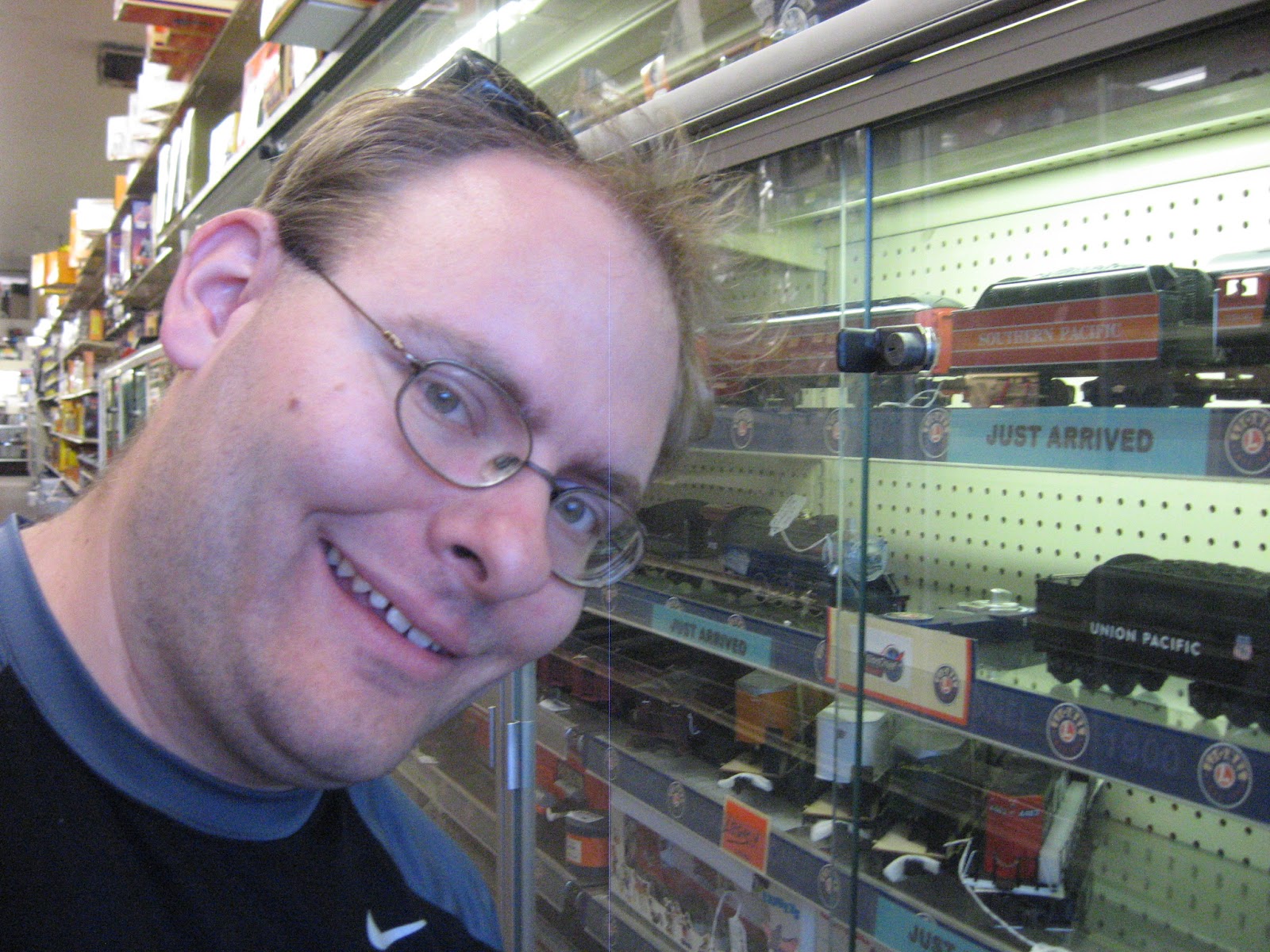
Here I am in one of the O Gauge aisles at Caboose Hobbies

The 6 new citizens I purchased for the train layout

Two RTD trains meet along the curve south of the Alameda Station

A few of about 100 UP locomotives parked in the yard

A string of 6 UP engines await clearance to enter the yard, with the Mile High Stadium and the Rocky Mountains in the background

Here's the nifty Training Train at the Auraria West Station

Boats taking a hike at the Oak Station in Lakewood

The DIY cross buck on the shed, with the Whistle sign in the foreground

The 20th Century Limited can now be viewed in our stairwell