Showing posts with label Purchase. Show all posts

Thursday, November 3, 2016

Banana cheese logs

Happy November ~

Please enjoy some views and video of the all-electric roster below. Visitors since the last blog posting included my uncle and aunt from the Chicago-area. Also, some new rolling stock just came in: a K-Line reefer full of bananas, a MTH reefer carrying Phenix cheese, and three heavy-duty log cars carrying some massive sections of tree trunks. The banana car really has bananas inside. The cheese car is a scale version of a 36' reefer, and thus it is shorter than the other reefers in the fleet, but is still prototypical. The log cars are referred to as "skeleton cars" since they are "bare-bones" only - just a rolling platform for transporting big logs.

Until next time, keep your rails shiny ~


Trolley, L Train, Interurbans and Electroliner

South Shore and North Shore

3rd rail and overhead electrics

Loops of electric trains


The banana car has lots of accessories

New rolling stock

Three new log cars

New cheese reefer

Banana car with bananas inside

Bananas, cheese and logs


Thursday, September 22, 2016

An Intense Day of Ferroequinology!


Happy First Day Of Autumn to all ~ this past Sunday I crammed a lot of train fun into a few hours. 

I headed out at 5:30AM traveling west. I met with friend and fellow modeler Darren in Butte, MT, and had a great conversation regarding the world of trains. After some breakfast, I headed northwest and viewed a static outdoor railroad equipment display in Deer Lodge, MT. The equipment has been cosmetically restored, and consists of all Milwaukee Road equipment: a bay window caboose, an E-9 diesel locomotive, and a Little Joe electric locomotive. The electrified Milwaukee Road line used to travel through Deer Lodge, beginning further east in Harlowton.  

Leaving Deer Lodge, I continued northwest. I attended a train show in Missoula, MT. I sold the 5 pieces of equipment that I brought, and purchased a Lionel PW 6464-125 NYC boxcar from Jim Caras, and a K-Line K742-8025 Kingan's ham/bacon reefer from Bob Peterson. About 60 tables were set up, 5 of which included O gauge trains. There were lots of kids, HO trains, and railroad artifacts. There were also two or three small, functional layouts. 

After the train show I visited the restored Northern Pacific depot in Missoula and photographed NP 4-6-0 steam locomotive #1356 on static display. Then I viewed the "City of Spokane" passenger train parked in the Missoula MRL yard. The train was made up of 18 or so historic, road-worthy passenger cars from throughout the country, generally traveling from Denver to Spokane. I've seen several of these cars parked in Billings at various times, but it was neat to see them all together. 

On my return trip I photographed the ruins of a Milwaukee Road electrical substation along I-90 east of Missoula. Then I explored the abandoned BNSF tracks in Homestake, MT right along the Continental Divide east of Butte, MT. I found a loose piece of a switch mechanism to add to my railroadania collection. 

All in all a great day of trains and 10 hours of driving in Montana! Keep those rails shiny ~


Deer Lodge MT: Little Joe E70, my Yukon, and E9 36A

Sunlight through the E9's cab

Missoula train show

NP Ten-wheeler 1356 in Missoula

The City of Spokane parked in Missoula

Abandoned Milwaukee Road substation along I-90

Forgotten rails atop the Continental Divide

Unused rails at Homestake at the end of summer

Switch equipment with a loose part

Thursday, August 25, 2016

Little trains and the Night of the Rolling Frankencoach

There was some nice activity in the train room this week!

I started by reattaching a brake wheel on the new MTH Great Northern caboose. I think it separated during shipping, and some super glue fixed it right up. Over the weekend, I took down the F-unit roster and set up the new semi-scale roster. In the process, I inventoried 36 items. It's the first time running in Montana for most of these semi-scale cars. By "semi-scale", I mean that the engines/rolling stock are smaller than O-scale. Semi-scale cars are typically shortened models designed to decrease cost and allow them to run on smaller radius track (O-27). I began modeling with all O-27 equipment, so this was a fun nostalgic experiment, getting to play with these smaller cars again.

Now, just because a model train car is short does not mean that it isn't O-scale. O-scale, by my definition, simply means that the model is really really close to 1:48 proportions (1 inch on the model equals 48 inches on the real-life prototype). So, there are a lot of O-27 train cars and engines that fit my definition of O-scale. Good examples from my collection include GP7 and F3 diesels and 0-6-0 and 0-8-0 steam switchers. Also, all of my ore cars are O-scale, but by their nature are rather short. Semi-scale equipment is not O-scale, but they are a lot of fun to operate. I typically would not intermix semi-scale pieces with their larger O-scale counterparts, because in my opinion it would look silly. However, I see many real-life examples of long and short freight cars next to each other on the same train.

I have sold off the majority of my "modern" (meaning "not Post-War") O-27 rolling stock. I have kept a number of engines and passenger cars though, and continue to collect Post-War pieces, which are typically semi-scale. Most of these pieces are part of the current roster. On Track 1, I'm running a short Post-War freight, headed by K-Line C&NW S2 diesel #2320. This diesel has dual motors, and is a mighty little brick. It has always been very reliable. That is, until now. I attached it to 4 short Post-War cars, and quickly noticed that it was consistently derailing on two sections of curved track. I deduced that there was a weight issue. The Post-War cars, short as they are, are almost entirely made of metal, and thus much heavier than the plastic cars this engine usually pulls. Furthermore, I had included the #3472 operating milk car in the bunch, which has a lot of machinery inside it, making it almost as heavy as the locomotive. I removed the milk car from the train, effectively reducing the draw bar strain, and this resolved the derailing problems. The weight of the heavy cars was pulling down on the rear powered truck of the S2, and the unfettered front powered truck had enough oomph to push the flanged wheels off the track. This probably wouldn't be a problem on larger-radius track, but Track 1 is all O-31, and it is almost entirely curves.

Track 2 is hosting IC Pacific #2099, 5 ore cars, and an unmarked Post-War work caboose. The IC steamer is another really reliable locomotive. It has no bells or whistles, except for the fake bell and whistle, and the real air whistle. It runs very smoothly, and has no problem pulling the relatively light train. In reality, loaded ore cars are among the heaviest cars on a train. This ore train has the added drama of an AEC car loaded with radioactive materials, which has been placed as far away from the engineer as possible! The unmarked caboose is a Lionel #6120. This variation has a hole in the roof for a smoke stack.

On Track 3 we have the IC City of New Orleans passenger train. I remember when my father bought this set in the early 90's and we displayed it on the floor of the family room as soon as we got home from the Wheaton, IL train show. Originally a 6-car set, Lionel released a dining car and a full vista dome car a few years later. The two Alco FA engines were manufactured by K-Line, as an alternative to the matching Lionel 2-6-2 steam locomotive. Like the K-Line S2 diesel, the lead FA unit has dual motors. The second FA unit was fitted with trucks that were power-ready, so a few years later we purchased a motor, gears, and an E-unit in order to energize the dummy. So, the set now has 3 motors instead of 2. Since this was a DIY project, and the second engine typically runs in reverse, it makes syncing the E-units a bit of a challenge. Thankfully, the lead FA unit can be locked into forward, so it just takes a few tries to get both engines running in the same direction. A quirk is that sometimes the former dummy unit switches into neutral randomly as it travels along Track 3, so the operator (me) has to pay pretty close attention to the movement and sounds of this train. The passenger cars are all fully lit and perform with excellence - it's really a sharp-looking train.

And the C&NW Pacific-powered Rockfordian is running on Track 4. This was the first full train set I purchased myself in the mid 90's. It's a pleasure to run this train in my own house for the first time. The steamer is noisy and has only moderate pulling power, but the feel of its metal and the smell of its running motor and drivers produces a feeling of magic that can't be beat. This was the first steam locomotive model I purchased, and I still remember getting it in the second hall of the Wheaton train show (now called the "Great Midwest Train Show"). I had to pay for it and the passenger cars over two separate visits. On the subject of the passenger cars, these are sometimes called "baby madison cars" due to their small size. I call them "semi-scale heavyweight cars", and they've had an interesting history in my employ. Originally, our layout in Illinois had about a 6" rise, so the train had to go up and down all the time. The locomotive's Magne-traction feature helped a lot, but the cars required some modifications to run smoothly. I think I added some weights to keep them from wobbling or derailing as the track elevation changed. After a while, I abandoned the graduated inclines and changed the configuration of the train layout, and then this train had an easier time running on flat surfaces. The cars run well on Track 4; they just need some electrical work to get the lights to remain on consistently. I recall issues with bulbs and pickup wires that will need to be revisited. These cars have a funky way of sliding off the shell by depressing some hidden tabs. I believe there's a video online that shows the process to help take most of pain out of the endeavor. The Rockfordian name is a moniker of my own design; there never was a real passenger train called this.

All in all, setting up and running these trains is a delightful trip down memory lane, and I plan to keep all of these semi-scale goodies on the active-service list!

Last night I unpacked some new stock. This should be the last new stuff for a while, which is fine - I'll have plenty of things to keep me busy soon! Anyway, this shipment involved the completion of the Northern Range heavyweight set. Last month I ran a 4-car abbreviated version of this train, and I recently found some good deals on the final components of this train. Up to now, the Northern Range consisted of 6 scale heavyweight cars, 5 of which are Pullman coaches or sleepers, and 1 is a similarly-painted Santa Fe coach (Granite Canyon). I also added a head-end REA car to complete the look and carry some baggage. However, one REA car isn't enough to contain all of the baggage for 6 car-worths of passengers, so this week I added the Pullman Van Twiller combine, to provide more luggage space and some more seating. That brings the heavyweight count up to 7, which is where I'd like it to stay. So, naturally I purchased another heavyweight car - the Santa Fe Cafe Observation. Why? Well, the Granite Canyon had a lot of problems with trucks and electronics (see a previous blog post or two). I found the Cafe Observation for just $11 and decided it was worth it for the parts. Last night, I proceeded with the macabre task of swapping the chassis of the Granite Canyon for the chassis of the Cafe Observation. There were a few complications, but the operation was a success, and the Frankencoach Granite Canyon is... alive... Alive... ALIVE! I did take the time to reassemble the Cafe Observation, because that's just the kind of microferroequinologist that I am. It's still a striking-looking scale observation car, and might look great as somebody's decoration. I'll bring it with me to the NMRA show in Missoula next month and see if I can find a new home for it. Northern Range now consists of up to three head-end cars (two are waiting for new 3-rail trucks from Atlas), Pullman combine Van Twiller, Santa Fe coach Granite Canyon, Pullman coaches Willow Range, Willow Valley, and two Willow Rivers, and sleeper Highland Falls. That equates to a real-life train that's over 700 feet long. It will look exquisite on the train layout of the future!

The other item I received was a vehicle. It's an intricately detailed M35 Army cargo truck manufactured by Corgi, and it appears brand-new. It will show up in the town of Red Stone, the settlement closest to the military base, picking up some shipments at the freight depot. Until then, it will be stored safely in its box.


I'm expecting some train room visitors in the next week, so I'll provide a report next Thursday! Keep your rails shiny ~

The semi-scale roster

The IC-powered ore train

The Rockfordian


Van Twiller combine

Granite Canyon fully powered

And, my bride got to ride on a short train today!

Thursday, August 18, 2016

I saw the (PostWar) Light

This week involved some Postwar searchlight car endeavors. Many years ago I received a PW Lionel #3620 Searchlight car, but it was missing the searchlight assembly. I found a reproduction unit at the monthly train show at the DuPage County Fairgrounds in Illinois, and used it for many years. Earlier this year, the reproduction searchlight assembly got damaged (cracked). I recently found an original PW searchlight assembly online and had it shipped to Billings. The #3620 now has all original, functional parts for the first time in decades.

Last month I obtained a #6520 PW Lionel searchlight car at an estate sale. While the car has many good features, it also requires some work. One of the couplers is broken, it is missing the searchlight lens, and the wire running to the bulb is disconnected. This week I was able to replace the lens, and I attempted to re-solder the wire running to the bulb. After several attempts, I found this to not be worth the trouble. Next month I’ll be headed to western MT for a train show, and I’ll see if I can sell/trade the car there.

Also this week I received 5 new pieces of rolling stock. I purchased these scale cars online: K-Line ATSF Dynamite boxcar, K-Line Kraft Cheese reefer, K-Line Union 76 tank car, Lionel US Army tank car, and a Lionel Philadelphia Quartz tank car.

Next week there should be a few more new arrivals, which will be the last new modern stock for a while.


Until then, keep those rails shiny ~

An original searchlight housing (L) and the reproduction housing


Handle with care

For the cheese lovers

Orange and blue oil

Contents are classified

Off to make some sodium silicate!

Thursday, July 21, 2016

Searchlight 6520

Hello, this week I purchased a Postwar Lionel searchlight car at a local estate auction. My folks were actually the purchasing agents, so thank you to them! I purchased this in order to use the searchlight housing to replace the broken one on my existing car, but now I've found out this won't work... My searchlight car is #3520, but the new one is #6520, which is a bit fancier. So now I've ended up with two different Postwar searchlight cars, both of which need some repair, but I'm happy to own them. The 6520 also includes the original box. Here's a photo, and keep those rails shiny:

Searchlight #6520

Thursday, November 19, 2015

Total Re-org and CMRM Part 1

Howdy readers – today’s long post details a lot of work done in the Train Room over the past few days, and Part 1 of my visit to the CMRM.

I devoted nearly 12 hours to the Train Room this week, and while most of the changes will be invisible to guests, it was an extremely fruitful week! I’ll start with the layout…

I set up the CTA 4-car “L” set on Track 3. From reading the manual, I decided to try out a fun feature that allows me to program the train to stop automatically at a set of stations that I decide. To program the train, I use the “whistle/horn” and “bell” buttons on the transformer. However, the Lionel ZW transformer I’ve been using to power the set since March 2014 is about 70 years old and doesn’t have these buttons. A ZW transformer has a whistle lever, but this doesn’t work that well for programming purposes. To get around this, Lionel manufactured separate buttons that can be wired between the transformer and the track to provide whistle/horn and bell functionality to any transformer. I had been using these separate buttons, but there are a few drawbacks. One, a ZW controls four trains, meaning I would need 8 buttons (4 trains x 2 buttons each) to get full sound capabilities on each track. Two, these buttons are about $20 each, and I have 3, so it would be kind of expensive to get an entire set for a ZW transformer. Three, I use some rather beefy 10 or 12 gauge wire to power the layout, but these buttons use tiny 18 gauge wire, so when the buttons are used, the power flow is decreased significantly. Four, since bringing the remainder of the collection back from Illinois, I now have my full complement of transformers available to me, some of which have built-in whistle/horn and bell functionality.

So, I decided to make a big change in the layout power supply configuration. I swapped out the 250W Lionel ZW transformer with two 270W MRC transformers. This improves things significantly, and solves the whole whistle/horn and bell button issue. It also means that 2 tracks get to share 270W instead of 4 tracks sharing 250W, so train performance will improve overall. The MRC transformers are controlled by wired remotes. These remotes provide some handy added functionality as well – they have a “brake” button that smoothly slows down the train, and a “stop” button to be used in case of a problem that immediately kills power to both tracks. While I prefer operating a ZW to a wired remote, I am so far pleased with the results.

Anyway, back to the “L” cars… After hooking up the MRC transformers, I began programming the CTA set to stop at specific spots on the track and announce specific stations in an order of my choosing. I followed the manual, and after several attempts I got the train programmed. Even with buttons for the horn and bell functions, it is difficult to get the timing just right. When the train is running, I can send it a command to enter “auto mode”, and it will run and stop indefinitely without any prompting from me. It’s a neat feature for an “L” train!

I set up The Canadian on Track 4, which consists of 3 F3 locomotives and 6 streamlined passenger cars. For more details on this train, please see my December 5, 2013 blog post. This is the first time I’ve run this set in Montana, and it looks really sharp. And now I can operate the horn and bell a lot more effectively with the MRC transformer.

I ran all four trains and found that the extra-long CNW Trainmaster will bump trains on Track 3 when it is rolling on Track 2. So, I’ll just run 3 trains at a time, which is fine and slightly less noisy. Also, I discovered that CP Coach 111 has a low magnet on one of its couplers that occasionally strikes a track joint on the west side of Track 4, which needs some fixing. Later in the week, I opened up CP Coach 111 to check for problems with the truck. While I didn’t see any problems, I was pleasantly surprised by the car’s construction. I’ve never had need to open one of MTH’s passenger cars, but they are well built, especially compared to earlier car designs from other manufacturers. I ran the car with the low magnet at the rear and didn’t have any problems after 10 loops.

In preparation for the Christmas season, I set up the O-scale nativity set that my wife gave me. It looks pretty good with some rocks in the background. It is a neat feature that helps us remember what Christmas is all about!

Also in “above layout” news, I’ve hung up two more artifacts: a PRR can and an MRL crossing post license. I’ve also had some correspondence with the MTH Service Dept regarding the NP 0-6-0 sound problem. I also gave the room a good dusting. Last night I vacuumed the floor and some surfaces.

Now for “under layout” news… I spent a lot of Saturday sorting and organizing all of the non-train tubs. Meaning, the scenery, figures, vehicles, track, transformers, accessories, buildings, electronics, non-O-gauge trains, and a plethora of other items were removed and then replaced into new homes for storage. I found a few things I had been missing, and threw out some un-needed boxes and miscellany. Another big project was the completion of my “every train needs a box” initiative, which started and ended on Saturday. I have four specially designed padded corrugated boxes made for storing/transporting O gauge trains. These boxes now contain all of my trains that don’t have their original box anymore, and each box has a category: Post War Engines, Post War Freight, Modern Engines, and Modern Rolling Stock. After sorting everything, I reorganized the under-table area and the locomotive closet. The under-table area is now in a “U”-shaped storage formation, with the tubs/boxes that I access most often in front and on top. The tubs at the bottom of the locomotive closet contain items that I most likely will not need to access until the layout of the future is being built.

To help keep track of which “train box” contains which train, I’ve added a Location column to my inventory spreadsheet, so I can quickly see where a train is located in the train room. For example, if the field shows “TB1”, then I know that it is located in “Train Box 1”.


And now, back to Colorado...

On the second Saturday of our trip, my wife attended a shopping event in Loveland, CO, and I headed to Greeley. The Colorado Model Railroad Museum is located there in a 15,000 sqft steel building. I had a delightful visit! The museum contains a very large HO layout, a Thomas-themed O gauge layout, a wooden trainset for little kids, a real caboose, a Lionel collection, a large collection of railroadania, and a gift shop. I was there for about 3 hours, but easily could have spent the entire day. There were folks of all ages there to visit, and there were over a dozen staff members or volunteers onsite as well. I took a lot of pictures and video, and got some good ideas for layout details, as well as building construction ideas. I also purchased a Lionel Yule Marble flat car to commemorate the trip, and serve as a birthday present to myself in a few months J

The full-size caboose is a restored Colorado & Southern (CB&Q) rear-cupola wooden model. It sits on rails and ties inside the building. The interior is open for inspection, and is fully outfitted with authentic, period details (including the linens on the bed).

The O gauge layout, although rather small, is very impressive. It is basically a maze of interconnected track loops, and is covered with modern and historic operating accessories. There are 6 trains on the track, which consist of a Thomas-style locomotive and a caboose. There are buttons all around the perimeter of the layout which activate the multitude of accessories, and control the whistle sounds on the locomotives as well. The most impressive part of the layout is the control system, which is housed in a large set of processors on the wall. The system insures that the trains do not run into each other using a rather complicated set of blocking. The trains also run very fast, so they look sort of like a swarm of bees zipping in every direction when in motion.

The Lionel collection consists of about 200 Post War pieces in a glass display case. They also have some Post War transformers, accessories, and advertising on display.

The railroadania collection is spread throughout the entire facility, and consists of nearly 1,000 artifacts ranging from full-size semaphores to vintage time schedules. If time allowed, I would have spent more time studying these items. Highlights include a collection of 40 Pullman seat cloths from various railroads, over 100 time schedules from various railroads in a custom-built wooden rack, which visitors can read, railroad signage and uniforms, one of the most complete railroad lantern collections I’ve ever seen, 100’s of railroad switch keys in a glass case, and a pair of seats from a MRR Olympian Hiawatha passenger car. Wow!

The gift shop had mostly touristy items. However, there were a few custom model railroad cars for sale (including the Yule Marble car I purchased), and several DVD’s produced in house about layout construction and scenery. These looked pretty interesting!


But, the unopposed star of the museum is the massive HO layout, which I will talk about next week in the Thanksgiving post! Until then, have a jolly time, and keep all of your rails shiny ~

The November-December Roster: MKT NW2 Grain Train, CNW Trainmaster Fast Reefer Freight, CTA 6200-series “L” cars, CP F3 ABA The Canadian

The Canadian

CNW reefer freight

The CTA 6200-series set

PRR can

Under-layout view

Train box for PW Freight cars

The model railroad nativity set

Lionel display at the CMRM

Passenger car towel display at the CMRM

Railroad time tables display at the CMRM

Part of the railroad lantern collection at the CMRM


O gauge layout at the CMRM, notice the control system on the wall

C&S caboose inside the CMRM

Thursday, November 5, 2015

Light Rail, Caboose Hobbies, and More...

Welcome to November y'all. Here you'll find details about my over-the-rails trip to a hobby shop in Denver, and you'll see what railroad-related adventures I've been having in Billings over the last week.

Continuing on from last week's post...
While staying in Lakewood, CO last month, my wife attended some training classes for work, which freed me up to pursue my own interests (trains) during the day. On the Wednesday of our trip, I dropped my wife off at her class, and proceeded back to our hotel on Union Blvd in Lakewood. I prepped a small backpack for the journey, and walked a few blocks east to the Regional Transportation District (RTD) Federal Center Station. This station allows for transfers between buses and light rail trains. Denver uses overhead catenary wires to power its commuter trains. It was another beautiful day, and I've shared several pictures of the journey at the end of this post. I started by riding the W line east to the Auraria West station. The W line is relatively new, and they are continuing to expand the line west into Golden. The track, bridges, crossings, and stations are all clean and safe and beautifully decorated. Each station along the W line seems to have a different "theme", and local artists were hired for each station to beautify them. The styles varied widely, but one commonality across the whole line was that each signal box had a mural painted on it. For those that aren't familiar with "signal boxes", these are typically located at road crossings or, as the name implies, near signals. They are usually silver in color, and vary in size, but for the most part they have a human-sized door on them, and look like a small, metal hut. On the W line, you won't find silver signal boxes - rather, you'll see very colorful murals, each with a different theme.

After a 30 minute ride, I arrived at the Auraria West station close to downtown Denver. This is a transfer station with access to all of the other lines. This station was clean, but was much more active than the stations on the W line, and it didn't have any art. But, it did have a nice view of Denver landmarks, like the football stadium, the university, the amusement park, and the skyline. For my next destination, either a C or E line train would work, so I took the first available, which was an E line train. After a 10 minute ride, I departed at the Alameda Station. This station is located behind a shopping center. I walked a few blocks east to the Caboose Hobbies store on Broadway street.

Caboose Hobbies is one of the largest train stores in the country, and is most likely the closest large store to Billings. They sell trains of all scales, and also have expansive sections of railroad media, model railroad scenery, and railroad miscellany for sale. I enjoyed seeing new and used trains up close, although they were all priced outside of my budget. Based on our conversation with Alan the previous day, I looked for specific items among the G-scale train section. I had planned to purchase some scale-sized people for my train set, and that is exactly what I did. They have a plethora of people for sale in all scales, and I took my time choosing 6 that would fit in with my 1950's era layout. I think the section of the store that impressed me the most was the scenery area. They have a few scenic'd model railroads on display, and a good selection of Thomas & Friends toys. They also have a large staff of folks to assist, and to top it off, they were having a special sale that I was able to take advantage of. It is a lot of fun to visit a big train store! Impressively, I was in and out in under an hour, and was back on my way to the Alameda Station before lunch.

The Alameda Station is located at the southern end of a large Union Pacific rail yard. South of the station is a very wide curve to the west, and since the end of the yard was devoid of parked trains, I had a great view of approaching and departing trains traversing the curve. I hopped on a C line train headed north, and snapped some photos of the downtown area and UP yard en route to Auraria West. While waiting at the next station, I saw several other trains pass through, dropping off and picking up passengers. Most of the people at this station were university students, headed to various parts of the city. I only saw two people taking advantage of the city's currently lax drug stance. An interesting train that came through was a short, two-car train labeled "Training Train" and was listed as out of service. An experienced conductor was riding with a trainee on their route. After a bit, a west bound W line train came along, and I began my trip back west. I viewed the opposite side of the tracks this time, and photographed some of the interesting art pieces along the way. I de-trained at Federal Center Station and grabbed some lunch on the way back to the hotel. It was a very fun experience and was more than appropriate for a trip to a train store! Check back next week for more tales of railfanning adventures along the Front Range of the Rockies ~

Now for some more local train news! Last Saturday (Halloween), I affixed my DIY cross buck to our backyard shed. It looks pretty neat, along with the existing Whistle sign post. On Sunday, I spied an EB CSX train in the Laurel yard, far from home. It was hauling several coal hoppers, and a variety of mixed freight. It had two engines at the head (the second had been painted recently), and no helper units. Occasionally I'll see CSX locomotives mixed with local liveries (BNSF or MRL), but I haven't seen a solely-CSX train around here, so it was worth noting. During the week, I made some more improvements to my train spreadsheet: based on Alan's advice, I sketched a revised garden railroad track plan, I improved the Abbreviations list, and I created topographic and signal maps for the O Scale layout of the future. Yesterday I (finally) finished repairs to the CBQ E8 A. A few weeks back I thought I had resolved the problem of a wire rubbing against the rear vertical motor while running. However, when I went to pick up the locomotive a few days ago, I discovered that I had neglected to re-fasten the shell to the frame and ended up relapsing the original problem! Yesterday, I caused further problems by accidentally breaking a soldered joint in the shell. So, I transported the engine to my work bench (the washing machine with an old t-shirt draped over it), and re-soldered the broken link. I then used electrical tape to affix the misbehaving wires to the shell. After a few tests on the track, I deemed the problem was finally solved, and I screwed the shell back to the frame. Last night I hung up a framed picture of the New York Central's 20th Century Limited passenger train in our stairwell. Amber had purchased this picture for me at an auction last spring, and now it has a nice spot on the wall. Finally, I finished up the night studying how to use a voltmeter to properly test the speaker on the NP 0-6-0. MTH provides a list of troubleshooting steps for Protosounds 2.0 locomotive issues. In this case, the steamer runs properly, and the lighting and smoke systems function. There are no sounds whatsoever. The first steps are basic - make sure the power is on; make sure the tender is connected to the loco; make sure the volume is turned up... The next step was to "reset" the locomotive to factory defaults. All modern locomotives with sound systems have a method for programming different features. This method differs based on the transformer you are using to operate the locomotive. To reset a Protosounds 2.0 locomotive with a Postwar ZW transformer and separate whistle and bell buttons, the method is this: 1) place the locomotive on the track and supply about 10V of power to it, 2) press the whistle button once, and then press the bell button five times, holding each button for about 1 second. This process is supposed to reset the engine. I have performed this a few times with the 0-6-0, and it hasn't resolved the problem. The next step is to measure the ohms resistance on the internal speaker inside the tender. MTH provides the exact measurements that it should be outputting, but I have never measured an ohm before, so I used wikihow to find out how. I hope to give this a shot over the next week and see what I can find!

Enough talk - how about some pics! Take care, and keep your rails shiny ~

The Federal Center Station. There is currently an EB W Line train in the station. In the foreground is some art, and you can see some of the signal boxes painted with murals as well. In the background you can see the Denver skyline and smog.

The Auraria West Station, with a good view of the catenary wires and their supporting structures. Notice how clean the station is!

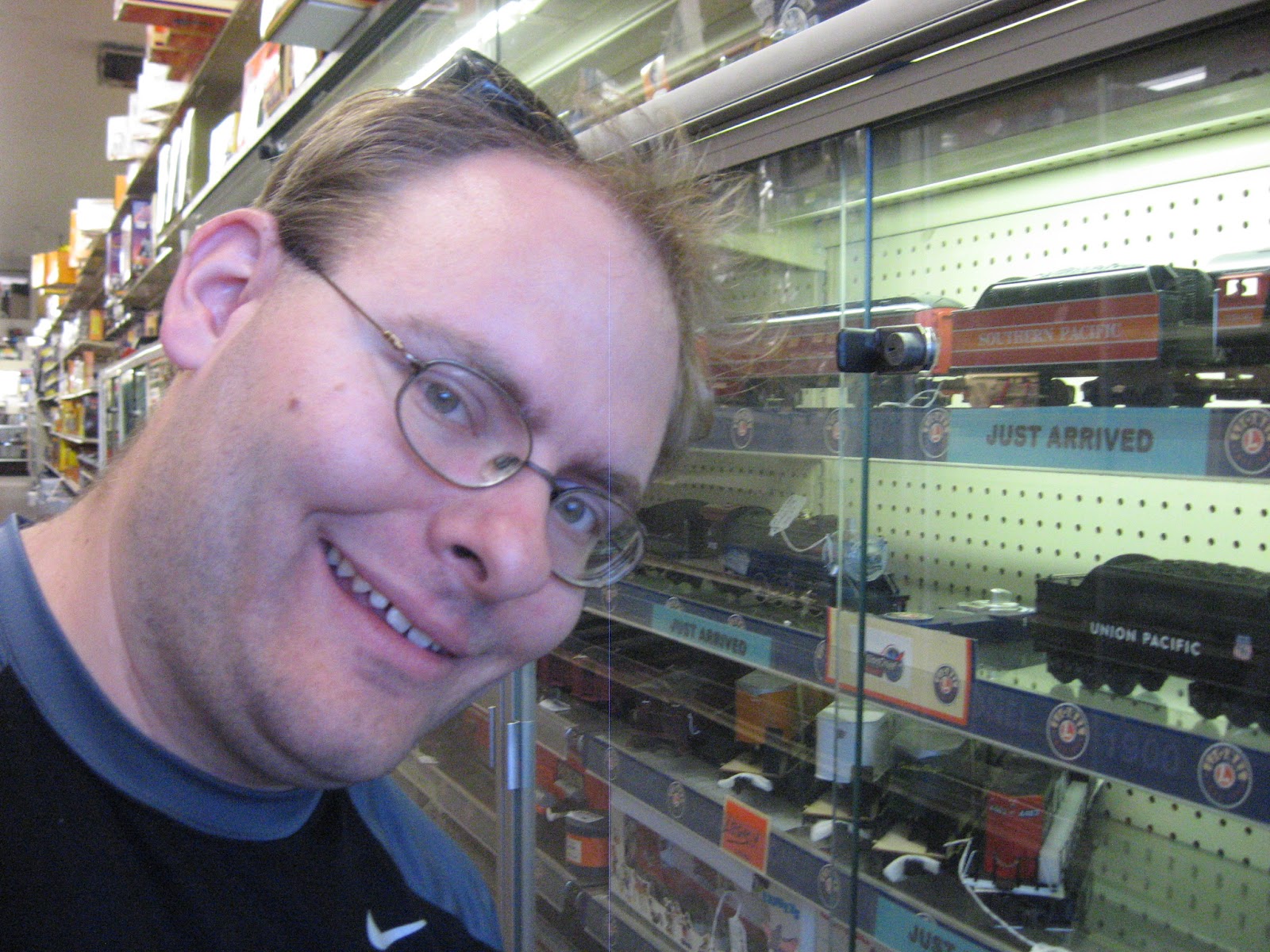
Here I am in one of the O Gauge aisles at Caboose Hobbies

The 6 new citizens I purchased for the train layout

Two RTD trains meet along the curve south of the Alameda Station

A few of about 100 UP locomotives parked in the yard

A string of 6 UP engines await clearance to enter the yard, with the Mile High Stadium and the Rocky Mountains in the background

Here's the nifty Training Train at the Auraria West Station

Boats taking a hike at the Oak Station in Lakewood

The DIY cross buck on the shed, with the Whistle sign in the foreground

The 20th Century Limited can now be viewed in our stairwell