Showing posts with label SLSF. Show all posts

Thursday, May 9, 2019

Train Day 2019 Success

Thank you to all who supported us by attending the 2019 Train Day festivities at the Billings Depot! After about 50 combined hours of set up, we had 8 operational loops for our guests!


Here is a overhead plan of the layout:


The set up and operation crew consisted of my folks and my uncle, who traveled from Chicago, IL for the event. During the event, we were all dressed as the crew of the Northern Pacific’s Vista Dome North Coast Limited passenger train, circa mid-1950’s. We had a conductor, brakeman, stewardess, and engineer (me). The gents all kept time with antique railroad-era pocket watches.

We also developed a free EBook, available here: https://payhip.com/b/kiXu, and a new website: https://www.modelrrfun.com/ prior to the event. We orchestrated a giveaway contest, where winners would receive either a Thomas the Tank Engine DVD, or one of two O-scale delivery trucks. A few hundred people attended our layout presentation. It was a lot of hard work, and stressful at times, but overall very rewarding to share the fun of model railroading with the community!

A friend loaned us a few boxes of Lionel Fastrack, which proved very helpful on the layout surface we had available. We ended up with 3 Fastrack loops, 3 tubular O27 loops, a Gargraves O54 loop, and a tubular O-style O42 loop. We were provided with 14 identical plastic tables as the foundation for the layout. We arranged them into a 5x3 grid, with an opening in the middle for the control station. This resulted in a 24’x12.5’ surface. We covered each table with a disposable green tablecloth, and ran track power lines between the table edges. There was very little wire visible on the table top, but LOTS of it under the tables, which we managed with cable ties. Once we had the track loops powered and tested, we added buildings, structures, and a bit of scenery to the layout.

Track 1 used O36 Fastrack and proved to be pretty reliable. It was actually used to display a trainset we were selling for a friend (one of the attendees actually purchased it later.) It ran a Postwar Lionel #1467W freight set, consisting of black Erie Alco locomotives (from 1952-3) and O27 freight cars (Lionel Lines stock car, Leigh Valley hopper car, Sunoco tank car, and Lionel Lines SP-style caboose.) Our backup motive power was the yellow Union Pacific Alco locomotives from the same set in earlier years. The Erie locomotives ran well for several hours, and then we gave them a break and pulled in the UP locos for the remainder of the event. Track 1 was powered by a Lionel RW transformer via a single lock-on. The only issues we had with the loop was the Fastrack versus the unevenness of the plastic table tops (as was an issue with every loop for the most part.) The tables were “high” on the edges, and went down half an inch or more into the “bowl” of the middle part of the table top. This was enough of a height difference to cause trouble at the track joints. We occasionally had to tighten the Fastrack connections, and eventually moved the loop slightly so that it only covered two tables instead of three. In the middle of this loop was our farm structures, along with a laptop that looped a video of my previous layout back in Illinois, along with footage of the real North Coast Limited passenger trains.

Track 2 also used O36 Fastrack, and was the most reliable, and maintenance-free-est loop on the layout. It was a Postwar Lionel passenger train, consisting of three Lionel Lines silver passenger cars (Elizabeth, Clifton, and Summit). It started the day being pulled by my father’s silver Union Pacific Alcos, and at midday we changed motive power to my son’s #2046 Lionel Lines hudson steam locomotive. The loop was powered by a Lionel LW transformer, which was fun to use (the whistle button worked great with the hudson’s whistle!) This loop just had one power connection, which was plenty. In the middle of this loop were several neighborhood-ish buildings: houses and a fast food restaurant.

Track 3 was a roughly 8’x3’ O27 layout, that encircled the control station at the very center of the layout. It hosted rapid transit trains (a Bowser streetcar in the morning and an MTH single CTA L car in the afternoon.) This loop was powered by one of the dual-track MRC O27 transformers, and had two lock-ons. This track was prone to separate in various places throughout the day, but was very easy to maintain since I was standing inside the loop all day. One of the 10” straight sections was so dirty that I had to spend some time cleaning it with an Emory cloth, which proved successful. I had intended to run a 4-car L train in the afternoon, but the cars had trouble navigating the O27 curves when coupled together, so I just ran the powered unit. It was still fun, since it provides a fun whistle and station announcement sounds.

Track 4 was an O36 Fastrack dog-boned-shaped track on the north side of the layout. It was powered by Lionel diesel locomotives, and pulled a variety of modernly-produced freight rolling stock. This track did not have ANY problems whatsoever – we just developed some locomotive issues. The rolling stock on this line shifted throughout the day, based on which locomotive was pulling the train. It hosted a die-cast K-line Northern Pacific hopper, a K-line wood-sided IGA reefer, a Lionel Great Northern wood-sided box car, a Lionel Dairy Men’s League reefer, an MTH Northern Pacific steel reefer, a Lionel Copper Range ore car, a K-Line Texaco tank car, a Lionel Montana Rail Link double-door box car, and for cabeese, either a Lionel Montana Rail Link extended vision or a K-Line Chicago Burlington and Quincy offset cupola. We started the day with a Lionel Montana Rail Link SD9 and finished with a Lionel Postwar Celebration Series Chicago Burlington and Quincy GP7. The line was powered by one of the MRC O27 transformers, through a single lock-on. This was probably part of the problem. I had another lock-on prepped, but ran out of time to actually run the power line and connect it to the transformer. The effect was that after the train ran through the loop a dozen times or so, it would become sluggish at certain points, even though the power supply remained at a consistent level. On the other hand, I’ve observed this behavior with trains powered by the MRC O27’s, even when there are MANY lock-ons on a line. The main takeaway from the event was a problem with the MRL SD9. When I picked it up to trade it with the CBQ GP7, I discovered that the front powered truck was no longer attached to the frame! Over time the mounting screw had come undone. What was remarkable was that the locomotive continued running as expected, even though it was literally “sitting” on the truck! Track 4 encircled the “yard” which is where all the backup motive power and rolling stock was stored for easy access. There were also several yard structures nearby.

Ah, Track 5, my bane for much of the day… So, Track 5 and Track 6 (also a problem child) used O27 track, and were mirrors of each other: one on the north side and the other on the south side of the layout. Overall, they were horseshoe-shaped, and met each other at a few spots along the center line of the layout. On paper, this provided a neat effect, and a lot of track for the train to enjoy. The combination of O27 track, the non-flat surface of the table tops, and two S-curves resulted in troublesome operation. Track 5 was the logging train. I set aside my two MTH steam switcher locomotives, a Northern Pacific 0-6-0 and a Chicago Northwestern 0-8-0, with matching cabeese, to pull seven log cars. The cars were all Lionel-produced, with four hauling a set of three stacked-logs each, and the other three hauling one “chunk” of a gigantic tree each. These last three cars were very short overall, only 9” long each. Through many trials, we found that the four “traditional” log cars, at 11.5” each, were too long to handle the track situations mentioned above. Also, after about a dozen derailments, we took the Lionel Northern Pacific caboose out of the roster and placed the MTH Chicago Northwestern caboose there instead. The CNW steamer was unable to handle the O27 S curves at all, as it’s 4 drivers ended up being to long to traverse the S curve properly. So, the NP 0-6-0 got to run all day. It had dozens of derailments in that time, including a spectacular wreak that sent it off the track onto its side. At one point the tender was smoking due to electrical issues. Just a bad day overall for the #1163! In the afternoon, we added some cork padding underneath the curves on the west side of this loop, which appeared to fix the majority of issues. This train, with the final roster being the NP 0-6-0, the three skeleton log cars, and the CNW caboose, ran without any problems for the last 2 hours of the event. It just took a while to figure out the right formula. The line was powered by a Lionel Z transformer via 3 lock-ons. Inside of Track 5 was Track 4, several yard structures on the west side, and a forest and logging buildings on the east side. We created the forest with two pieces of Styrofoam, covered with disposable table cloth, and then poked trees through the cloth into the Styrofoam. The end result was very good!

And onto Track 6, the southern twin of Track 5. This loop started with moderate goals but we had to chip away at them throughout the day. This line was supposed to feature some of the larger Postwar Lionel freight cars, and be pulled by either the (modern) Lionel Chicago Northwestern 4-6-2 pacific steamer, or the Postwar Lionel #2037 2-6-4 adriatic steamer. The rolling stock would have consisted of four 6464-series box cars, a gondola, a flat car carrying trucks, a searchlight car, and a bay window caboose. After much consternation, the roster for the event ended up being the CNW loco, two Great Northern 6464 box cars, and the Lionel Lines bay window caboose. The S curves, track separations, and frequent derailments proved very annoying. At point, a derailment and electrical short went unnoticed for an unknown period of time, resulting in a section of track becoming ALMOST white-hot. The line was powered by a Lionel ZW transformer. Here’s the main problem I have with Postwar transformers, in this situation: if an electrical short occurs, these transformers just keep sending power to feed it. Yes, that is the nature of things, but the MRC O27 transformers actually stop sending power when an electrical problem occurs, saving equipment and preventing several dangers. This happened frequently prior to and during the event. Locomotive 2037 did not perform well, even after lubricating it, so the CNW pacific had to run the line for all 6 hours of the event. We added cork padding to this loop as well, but it was not as effective as the cork on track 5. By the end of the day, I wasn’t dealing with the curves any more – I just manually ran the train backwards and forwards along the 16-foot straight section near the front of our display. Inside of the Track 6 loop was Track 1 and Track 2, along with the “downtown” section of the layout, which included the large MTH station as the focal point.

Track 7 carried the heavyweight passenger steam train on O54 Gargraves track. Everything mentioned thus far was “inside” of the Track 7 loop. Morning power was supplied by a Lionel Frisco 2-8-2 mikado, and afternoon power was supplied by an MTH Chicago Northwestern 4-6-4 covered Hudson. This train, with its large steam locomotives, and its overall 60’ track-length, proved to be a crowd favorite. After various troubleshooting efforts, to ensure that this train wouldn’t impact the train on Track 8, it pulled all six of my Lionel 19” heavyweight Pullman cars and a K-Line Santa Fe heavyweight car at the end. Initially there was a Weaver Railway Express Agency headend car behind the locomotive, but it developed some coupler problems later in the day. All-in-all it was an impressive looking train with either locomotive. It was powered by one of the O27 MRC transformers, through five lock-ons. This track provided the biggest mystery of the day. During the testing phase, the locomotive would lose power within a length of track section, very close to a lock-on. We worked on it for a long time to ascertain what was going on. We replaced the offending piece of track with several smaller pieces, and that resolved the issue. The mystery continues: how do you lose power in the middle of a 3-foot piece of track, with wooden ties, and a lock-on on the adjoining track to the west and a couple tracks to the east? Despite our track alignment efforts, this train did bump into the VDNCL on Track 8 along the eastern side of the layout, so I began running them separately from each other.

Track 8 featured our flagship passenger train: the 11-car Northern Pacific Vista Dome North Coast Limited. The cars were produced by MTH, and were pulled in the morning by a Lionel Northern Pacific F3 ABA set, and in the afternoon by a K-Line Chicago Burlington and Quincy E8 AA set. With just a couple inches difference in the two motive power sets, the train was nearly 21 feet long. And due to the size of Track 8, the entire train could be on straight sections without any curves along the northern and southern edges of the layout. That alone was fantastic! I’ve run this train on my home layout on Track 4, and it chases its tail and is nearly all curves. It was so neat to see this train really stretch out! The track used brand-new O-gauge track from Menards with O42 curves (which is the minimum allowed radius for this set.) The track was prone to disconnecting at a few spots, so we wired them together. Track 8 encompassed Track 7, and thus the entire layout was ringed by Track 8. This train was admired by all our guests. An impressive feat discovered during testing: I ran the entire train with a single lock-on connected to a MRC O27 transformer! I added several more after the initial test, but wow that Lionel F3 has power! As mentioned earlier, this train did bump into the heavyweight train at a few spots, so I had to either make sure they only passed on straight sections, or alternated between the two trains. After attempting to drive 8 trains simultaneously for many hours, I found that alternating Track 7 and 8 was easier and much less stressful. Especially while continuing to deal with the antics of Track 5 and 6.

The train crew greeted visitors and encouraged them to sign up for our giveaway contest. They answered questions and explained the train layout and the real trains that the layout represented. The crew also had to help with any layout problems, as I couldn’t physically reach most issues without shutting the layout down, crawling under the table and addressing them myself. We opened a window, which allowed those outside to see the layout as well, and provided some refreshing spring air to the room.
It was a great event, and I believe it was a success. This was most likely the largest temporary O-gauge layout constructed in this state this century. The engineer would like to thank the following people for making this display and presentation possible:
Bill Monteleone, our Conductor
Merrill Poynter, our Brakeman
Joyce Poynter, our Stewardess
Julie Poynter, our Right-Of-Way Liaison
Charlie Pratt, provider of historic artifacts
Gary Aasheim, provider of track
Toni Calton, provider of historic artifacts
The Billings Depot staff: Marci, Caleb, Michelle and company

My beautiful bride and kids for helping me and putting up with me all the time, even more so this past week!

The Depot did another great job for their second annual Train Day event. The Rimrock modelers had wonderful HO and N scale layouts, in addition to a slew of railroad artifacts and railroad footage playing in their section. We had our O gauge layout and a section of Northern Pacific artifacts and information. The Depot hosted two different gift shops and several activities for kids - a miniature train ride, giant coloring pages, a carnival game, face painting, food, and the return of the "Race the Train" exhibit. It was a beautiful day, and we were so happy to welcome so many folks to the event!

Thursday, October 4, 2018

While I was out... and Cody too!

Hello again. The summer flew by, as always. So here’s a summary posting of the ferroequinological goodness I’ve been up to these past three months…
In June, we traveled to Illinois to visit family and trains. We visited the Illinois Railway Museum during their celebration of the Railroad Post Office (RPO). My son Wesley got to experience a real, running steam locomotive for the first time, as we were happy to see that SLSF decapod #1630 was operational that day. We also got to visit the J Neils Lumber Company shay #5 in steam shop, which was “close” to running as a refit continued (the shay should be fully operational for the 2019 season). Plus, we got to see dozens of other locomotives, rolling stock, and “railroad accessories” at the country’s largest train museum! Wesley also got his first ride on a streetcar (CTA “Red Rocket” #3142), and we got to enjoy the day with my Uncle Bill (another long-time ferroequinologist). When I was young, I was blessed to be able to go to IRM frequently, but it’s a bit harder when one lives 1200 miles away…
Speaking of Uncle Bill, we were able to stay with him and Aunt Dee in the Chicago area. And Wesley got the opportunity to see his great O Gauge layout. While visiting my wife’s relatives north of Chicago, we took a trip to the Chicago Botanical Gardens and viewed their substantial outdoor G Scale layout. I had never been there before and was delighted by the dozen trains they were running simultaneously through a landscape of American landmarks. We all had a great time experiencing the mesh of gardening and model railroading!
Back home, and after cleaning up the “wreck of the wreckers”, I switched the layout to an all-Lionel-Post-War-steam roster. The planned roster never actually ran, but here it is anyway:
Track 1: #2034 2-4-2 steam with LL searchlight, NYC gondola, LV hopper and a LL SP-style caboose
Track 2: #2037 2-6-4 steam with 6 6464-series boxcars and a LL bay window caboose
Track 3: #2035 2-6-4 steam with a set of silver O27 streamlined passenger cars
Track 4 #671 6-8-6 steam with remaining O27 Post-War freight cars and a work caboose
Right off the bat, there were a few setbacks. #2037, while a reliable runner, doesn’t have the strength to pull itself and 7 freight cars. Also, #2035 wouldn’t advance more than a couple wheel revolutions. It would reverse for a few inches, but after a bit of cleaning and troubleshooting I couldn’t get it running, so I took it out of service. Then, some tests of the turbine (#671) proved that it was in a rather cantankerous mood. First, the whistle mechanism got stuck in the “on” position. Then, it started giving me intermittent electrical problems, causing trains on other tracks to malfunction, due to their connection through the transformer. And finally, the thing looks and sounds like a fireworks display when operating, with its thunderous grinding sounds and constant under-chassis sparking. So 671 was put out of service too.
The eventual roster that actually went into service, keeping to the “spirit” of all-steam Post-War running, was:
Track 1: #2034 2-4-2 steam with LL searchlight, NYC gondola, LV hopper and a LL SP-style caboose
Track 2: #2037 2-6-4 steam with 3 6464-series boxcars and a LL bay window caboose
Track 3: modern Lionel Illinois Central 2-6-4 steam with a variety of O27 Post-War rolling stock and a work caboose
Track 4 Union Pacific #2023 FA diesel and the other 3 6464-series boxcars and a LL SP-style caboose
This roster ran well for a few months, and then I encountered more steam trouble. Both #2034 and the IC steamer went offline. Diesel 2023 moved to Track 1 and the MTH NP 0-6-0 steamer took over Track 4 (note that the NP still does not output any sounds).
Back in the real world, I got a picture of a freight train at sunset in Big Timber, MT, with the Crazy Mountains in the background.
And, since it’s been so long since the last update, I’ve changed the roster a second time! The current roster, through the end of October 2018, is “Passenger trains”:
Track 1: Trolley
Track 2: CSS Interurbans
Track 3: RI E7A and partial Rocky Mountain Rocket
Track 4 CBQ E8AA and the Bozeman Zephyr
This setup is far less problematic than the previous one. The major issue is that running 18” cars (and really long locomotives) on Track 3 is always a poor idea, as they end up bumping into trains on both Track 2 and Track 4. So, the short Rocky Mountain Rocket only got to run when Track 2 and Track 4 trains were parked in safe places.
Oh yes, we had another baby too. He decided to come a little early. At home. With just my wife and I in attendance. So guess who got to deliver Cody? The ferroequinologist, that’s who. Everybody is healthy and the 4 of us are adjusting to each other, and Cody enjoys watching the trains run J Special addition!
We've kept our tradition of giving our boys middle names that are also steam locomotive classes. Wesley Hudson, and now Cody Selkirk. Selkirk is a Canadian 2-10-4. Why Canadian? Well, my bride and I were married in Canada, and Cody happened to arrive on our anniversary! Plus, "Cody" means "helper", and thus his name can be translated "helper locomotive".

Take care and keep those rails shiny til next time!


Wesley and the 1630

Happy day at IRM

Wesley and Uncle Bill detrain the Red Rocket

Two Hudsons: CBQ 3007 and Wesley

Wesley and Shay #5, both asleep

Wesley and I marvel at Uncle Bill's train layout

At the botanical gardens, a Santa Fe loco meanders between Old Faithful and Old Faithful Inn

The botanical garden layout is impressive; I could easily spend a few hours there!

Back in MT, we have the Post-War consists


Big Timber sunset on Sept 7th, 2018

Night time passenger trains


Myself and my boy, Cody Selkirk

Wesley, Cody and I watching trains downstairs

Cody and his boxcar

So blessed to have these two unique cars in my collection


Thursday, March 2, 2017

Through-lines coming Through

Here's an update from the train room for March 2017. I'm very happy to report that my son, now 3 months old, really enjoys model trains. When he's upset, I run the trains for him, and he calms down every time. The combination of the train's motion and sounds have a lulling affect, and he's even fallen asleep a couple of times as the trains circle about in front of him.

Since my last post, I celebrated another birthday, and my parents and my parents-in-law all gifted me some nice railroad-related items. I received two nice posters of steam locomotive paintings, for the Northern Pacific and Great Northern railroads. I was also given several model railroad scenery supplies, including a bag of real coal. I also received an authentic chain for my railroad pocket watch. And, my wife gave me an evening with just the two of us, which meant a lot more to me than a thousand trains. Thank you to everybody for your generosity!

I've been running NP 0-6-0 for my son (well, for me too) and haven't had any problems until recently. I warmed it up one day, and there were no audible sounds from the speaker. This is the same issue I encountered last year, and took it to Caboose Hobbies in Denver to have it repaired. I've contacted The Caboose (new owner and location) to see if they have detailed records of what was specifically repaired last year, in hopes that I can duplicate it.

Over the past week, with help from my father and son, the train layout roster has been changed. We also performed a bit of inventory on the previous and new roster items. As of now, there are 97 items remaining to inventory. The theme of the roster is "through-lines", meaning that these trains are not run by local/regional railroads - they are "passing through". The locomotives in use are the only ones in the collection from their respective railroads. So, here's the new March-April 2017 roster for your review and entertainment:

On Track 1, the Blue Train makes its first-ever run this month. With the majority of its members hailing from the mostly-blue livery of Montana Rail Link, I developed this train simply because my bride likes the color. With last year's acquisition of the Union 76 tank car, this mixed freight now includes three scale-and-time-displaced cars with a locomotive and caboose. As more primarily-blue rolling stock is collected, they will be added to this special freight. This version of the Blue Train consists of the MRL SD9 (Lionel), a Needham Packing reefer (MTH), a Union 76 oil tank (K-Line), an MRL double-door boxcar (Lionel) and an MRL extended vision caboose (Lionel).

Track 2 hosts an all-dairy-related train. The Dairy Express is led by the MPC-era MKT NW2 (Lionel), a GN stock car (Petersen) a Borden milk tank car (Lionel), a Carnation reefer (K-Line), a Dairy Men reefer (Lionel) and an MKT extended vision caboose (Lionel). The NW2 is a single-motor unit and runs very well - it growls like a Postwar locomotive and was the first diesel model I had as a youngster.

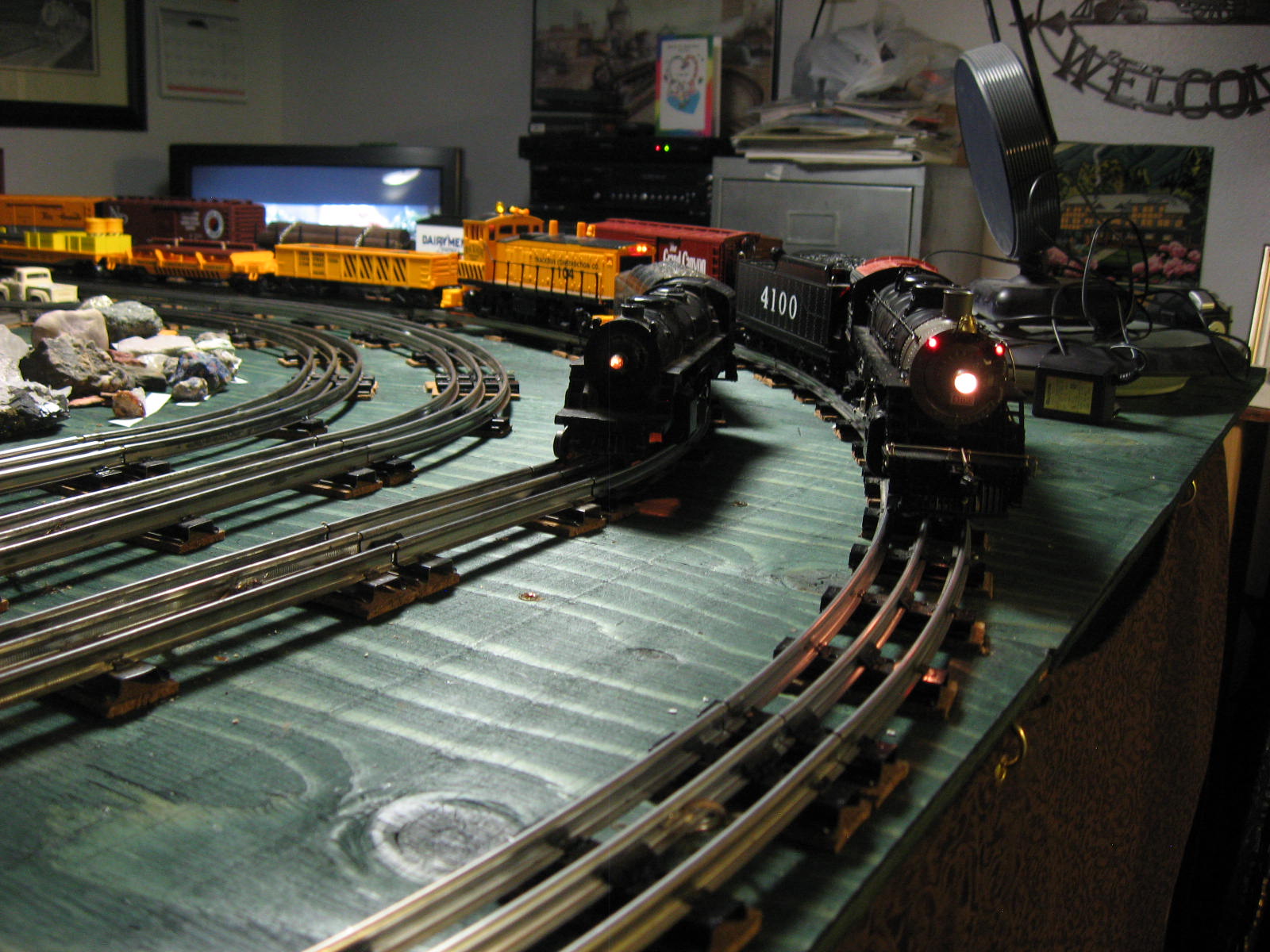
On Track 3, reliable and mighty Mikado #4100 pulls mixed freight #408. A variety of goods and materials are in tow behind the Frisco 2-8-2 steam locomotive, built by Lionel in 1993. First, a CP log car (Lionel), followed by two recently acquired Lionel tankers with Philadelphia Quartz and Army liveries, a Midnight-Chief-inspired boxcar (#97191, K-Line), a Peacock reefer (K-Line), an Old Dutch reefer (K-Line), a GN hopper laden with coal (MTH), a CNW flatcar with semi trailer (called a "piggyback") (MTH), a late-80's MRR tank car (Lionel), an IC hopper (Williams) and a Frisco wood-sided caboose.

The ATSF boxcar has a brake-side coupler issue. It's opening at certain spots on the loop, but I haven't determined the cause yet. I thought the magnet was activating, but I've proved that isn't the issue. It only opens when it is coupled to another car, so weight and force, combined with certain sections of track are somehow causing it to malfunction. I'll keep troubleshooting, but for now I've placed the boxcar at the end of the train to prevent uncoupling problems.

Also, as I learned while holding my son, one should not shift the Frisco Mikado into forward from neutral at 25% power. I had gotten used to running the NP Switcher, which has a very gentle shift and can run smoothly at low speeds, but the 2-8-2 experienced extreme acceleration. The log car uncoupled from the tank car and both derailed. Of course, this happened at the inaccessible corner of the layout, so it took some ingenuity, while holding a baby, to pull the cars closer and re-rail them. No harm done, and everything is running again, but it was a small adventure to fix it.

And on Track 4, I've assembled the longest-yet version of the Northern Range heavyweight coach train. This time, its being pulled over Pennsylvania Railroad ROW, so the train is called the "Philly Phoenix" and is pulled by a big GG1 electric locomotive (Williams). The real-life prototype for this locomotive is nicknamed "Blackjack", and can be viewed at the Pennsylvania Railroad Museum. Behind my O-scale version of Blackjack is a troop car converted into an REA head-end car (Weaver), the Van Twiller combine (Lionel, first time on rails ever), the Willow River coach (Lionel), the Willow Valley coach (Lionel), the Willow Range coach (Lionel), the second Willow River coach (Lionel), the Highland Falls sleeper (Lionel), and the Granite Canyon coach (K-Line) takes up the rear.

The GG1 horn sputters frequently while pulling the Philly Phoenix. This can be prevented by holding down the Bell button on the controller. I think this is just a symptom of something fishy going on electronically with Track 4, as I’ve had problems with Whistle/Horn-Bell functionality in the past.

With my son around, the trains are all getting a lot more run time, which means more fun for everybody!

Have a blessed day, and keep those rails shiny!


Bday steam locomotive artwork

The Blue Train

Dairy Express

Frisco 2-8-2

"Chicaqo" piggyback

Santa Fe Blackbonnet paint scheme

Mike and Blackjack

Part of the Philly Phoenix


Thursday, August 20, 2015

Catch Up

Howdy - this post will give some brief details about my railroading exploits over the past year, when this blog was on hiatus. And of course, there are spiffy pics at the bottom!

July 2014
-Took some photos of individual trains while changing out the roster.
-Trains on track included the CNW Doodlebugs, Lionel Lines Columbia-class 2-4-2 Postwar steamer "trying" to pull the Rock Island Denver Rocket, Rock Island Northern 4-8-4 with a reefer freight, and Illinois Central GP9 with a caboose train.
-Repair work on the CNS&M Electroliner. One motor was failing to run, putting a lot of pressure on the second motor. I deemed that either the motor was bad, or that I did not have the tools/skills to repair. I send the Electroliner to Illinois to await repair in Michigan.
-On a hot day I photographed track repair equipment at work near the Billings Depot.
-I won my first game of Ticket to Ride.
-Set up the new roster: Track 1 - CBQ GP7 and small freight, Track 2 - CNW F7 and freight, Track 3 - Trackside Construction set headed by MP-15, Track 4 - Frisco Mikado 2-8-2 and freight

August 2014
-Saw a wacky-looking ballast recycling machine near the Depot.
-Also at the Depot, a special MRL train pulling a mix of modern and heavyweight passenger cars was parked for a day.
-Repaired Postwar #2034 to working order

September 2014
-My bride gave me a beautiful piece of artwork - a hand painted historic map of the Montana Railroad
-A string of nine BNSF locomotives came through Billings
-My folks were in town and visited the train layout
-While traveling, saw two enormous new MRL EMD SD70ACe locomotives followed by two little SW switcher locomotives in an EB train

October 2014
-Set up a model logging train at work as part of a "north woods" Halloween theme

November 2014
-Set up the new roster: Track 1 - LL 2-4-2 and small freight, Track 2 NP 0-6-0 and logging train, Track 3 - CNW GP7 #1518 and reefer freight, Track 4 - complete Vista Dome North Coast Limited passenger train (chasing its own tail)
-Decided to sell the K-Line Milwaukee Road GP7, as it is not a scale locomotive

December 2014
-Set up Christmas tree on the layout, with train ornaments
-Set up permanent Christmas lights under the layout for storage illumination
-Hosted family on Christmas day in the train room
-Set up CNW 0-8-0 freight around Christmas tree in the library room
-Prepared train tickets for visitors to the train room, and stamped them upon admission

No activity for a few months

April 2015
-Set up the new roster: Track 1 - green Brill trolley, Track 2 - CNW 0-8-0 and ore car train, Track 3 - GN 2-8-2 and mixed freight, Track 4 - CNW F7's and bi-level passenger train with the UP American View.
-Took various photos of the roster

May 2015
-Got to see a Lionel Smithsonian-edition NYC 20th Century Limited set at an auction in Lewistown. Only 500 of these were produced.
-At the auction, bought: ZW transformer, mint BA&P freight tag, numerous railroad paperwork items (majority from 1893), several railroad maps, framed painting of an NYC steam train, a heavy box of railroad spikes, and a large 1961 Burlington wall map of its western US tracks

June 2015
-Set up the new roster: Track 1 - CNW Doodlebugs, Track 2 - IC GP9 and caboose train, Track 3 - RI GP9 and CNW GP7 #1518 with the CNW Minnesota and Black Hills Express heavyweight passenger train, Track 4 - CNW 4-6-2 with a hopper car train
-Put all of the trains away in preparation for the remainder of railroad items to arrive from IL
-At the end of June, we set out for Illinois, and the rest you know! Now we're caught up, and keeping those rails shiny ~

CNW Doodlebugs take a ride on Track 4

A fast reefer freight heads around Track 4, pulled by the RI Northern

Electroliner under repair

Removing old, and installing new ties on MRL tracks by the Depot

First time playing, first time winning - Ticket to Ride

CBQ GP7, CNW F7, Trackside MP15, and Frisco Mikado all pulling freights

Special MRL passenger train at the Depot

Wacky looking ballast machine in Billings

Postwar 2034 undergoing repairs

Example of O27 vs O steam locomotives in action

Hand painted map of the Montana Railroad

9 locos at once

2 big locos and 2 small ones

Halloween at work

NP 0-6-0 pulls a log train

The Vista Dome North Coast Limited chases its own tail, while the 2034 zips around Track 1

Christmas time in the Train Room

Under-table illumination

Special Christmas tickets for the Train Room

My nephew enjoys the CNW 0-8-0 circling a Christmas tree

A trolley, the CNW 0-8-0, the GN 2-8-2, and the CNW F7's are all featured in Spring 2015

The switcher and the road engine at night

The illuminated 21" CNW Bilevels

The trolley takes a night trip

Busy day on the layout

A steel caboose follows the ore train

One of 500 Lionel Smithsonian NYC 20th Century Limited sets

Hat is a wee bit small for me

CNW Pacific #2903 pulls a long row of hopper cars

RI and CNW geeps team up to pull a heavyweight passenger train

Doodlebugs and cabeese