Thursday, November 5, 2015

Light Rail, Caboose Hobbies, and More...

Welcome to November y'all. Here you'll find details about my over-the-rails trip to a hobby shop in Denver, and you'll see what railroad-related adventures I've been having in Billings over the last week.

Continuing on from last week's post...
While staying in Lakewood, CO last month, my wife attended some training classes for work, which freed me up to pursue my own interests (trains) during the day. On the Wednesday of our trip, I dropped my wife off at her class, and proceeded back to our hotel on Union Blvd in Lakewood. I prepped a small backpack for the journey, and walked a few blocks east to the Regional Transportation District (RTD) Federal Center Station. This station allows for transfers between buses and light rail trains. Denver uses overhead catenary wires to power its commuter trains. It was another beautiful day, and I've shared several pictures of the journey at the end of this post. I started by riding the W line east to the Auraria West station. The W line is relatively new, and they are continuing to expand the line west into Golden. The track, bridges, crossings, and stations are all clean and safe and beautifully decorated. Each station along the W line seems to have a different "theme", and local artists were hired for each station to beautify them. The styles varied widely, but one commonality across the whole line was that each signal box had a mural painted on it. For those that aren't familiar with "signal boxes", these are typically located at road crossings or, as the name implies, near signals. They are usually silver in color, and vary in size, but for the most part they have a human-sized door on them, and look like a small, metal hut. On the W line, you won't find silver signal boxes - rather, you'll see very colorful murals, each with a different theme.

After a 30 minute ride, I arrived at the Auraria West station close to downtown Denver. This is a transfer station with access to all of the other lines. This station was clean, but was much more active than the stations on the W line, and it didn't have any art. But, it did have a nice view of Denver landmarks, like the football stadium, the university, the amusement park, and the skyline. For my next destination, either a C or E line train would work, so I took the first available, which was an E line train. After a 10 minute ride, I departed at the Alameda Station. This station is located behind a shopping center. I walked a few blocks east to the Caboose Hobbies store on Broadway street.

Caboose Hobbies is one of the largest train stores in the country, and is most likely the closest large store to Billings. They sell trains of all scales, and also have expansive sections of railroad media, model railroad scenery, and railroad miscellany for sale. I enjoyed seeing new and used trains up close, although they were all priced outside of my budget. Based on our conversation with Alan the previous day, I looked for specific items among the G-scale train section. I had planned to purchase some scale-sized people for my train set, and that is exactly what I did. They have a plethora of people for sale in all scales, and I took my time choosing 6 that would fit in with my 1950's era layout. I think the section of the store that impressed me the most was the scenery area. They have a few scenic'd model railroads on display, and a good selection of Thomas & Friends toys. They also have a large staff of folks to assist, and to top it off, they were having a special sale that I was able to take advantage of. It is a lot of fun to visit a big train store! Impressively, I was in and out in under an hour, and was back on my way to the Alameda Station before lunch.

The Alameda Station is located at the southern end of a large Union Pacific rail yard. South of the station is a very wide curve to the west, and since the end of the yard was devoid of parked trains, I had a great view of approaching and departing trains traversing the curve. I hopped on a C line train headed north, and snapped some photos of the downtown area and UP yard en route to Auraria West. While waiting at the next station, I saw several other trains pass through, dropping off and picking up passengers. Most of the people at this station were university students, headed to various parts of the city. I only saw two people taking advantage of the city's currently lax drug stance. An interesting train that came through was a short, two-car train labeled "Training Train" and was listed as out of service. An experienced conductor was riding with a trainee on their route. After a bit, a west bound W line train came along, and I began my trip back west. I viewed the opposite side of the tracks this time, and photographed some of the interesting art pieces along the way. I de-trained at Federal Center Station and grabbed some lunch on the way back to the hotel. It was a very fun experience and was more than appropriate for a trip to a train store! Check back next week for more tales of railfanning adventures along the Front Range of the Rockies ~

Now for some more local train news! Last Saturday (Halloween), I affixed my DIY cross buck to our backyard shed. It looks pretty neat, along with the existing Whistle sign post. On Sunday, I spied an EB CSX train in the Laurel yard, far from home. It was hauling several coal hoppers, and a variety of mixed freight. It had two engines at the head (the second had been painted recently), and no helper units. Occasionally I'll see CSX locomotives mixed with local liveries (BNSF or MRL), but I haven't seen a solely-CSX train around here, so it was worth noting. During the week, I made some more improvements to my train spreadsheet: based on Alan's advice, I sketched a revised garden railroad track plan, I improved the Abbreviations list, and I created topographic and signal maps for the O Scale layout of the future. Yesterday I (finally) finished repairs to the CBQ E8 A. A few weeks back I thought I had resolved the problem of a wire rubbing against the rear vertical motor while running. However, when I went to pick up the locomotive a few days ago, I discovered that I had neglected to re-fasten the shell to the frame and ended up relapsing the original problem! Yesterday, I caused further problems by accidentally breaking a soldered joint in the shell. So, I transported the engine to my work bench (the washing machine with an old t-shirt draped over it), and re-soldered the broken link. I then used electrical tape to affix the misbehaving wires to the shell. After a few tests on the track, I deemed the problem was finally solved, and I screwed the shell back to the frame. Last night I hung up a framed picture of the New York Central's 20th Century Limited passenger train in our stairwell. Amber had purchased this picture for me at an auction last spring, and now it has a nice spot on the wall. Finally, I finished up the night studying how to use a voltmeter to properly test the speaker on the NP 0-6-0. MTH provides a list of troubleshooting steps for Protosounds 2.0 locomotive issues. In this case, the steamer runs properly, and the lighting and smoke systems function. There are no sounds whatsoever. The first steps are basic - make sure the power is on; make sure the tender is connected to the loco; make sure the volume is turned up... The next step was to "reset" the locomotive to factory defaults. All modern locomotives with sound systems have a method for programming different features. This method differs based on the transformer you are using to operate the locomotive. To reset a Protosounds 2.0 locomotive with a Postwar ZW transformer and separate whistle and bell buttons, the method is this: 1) place the locomotive on the track and supply about 10V of power to it, 2) press the whistle button once, and then press the bell button five times, holding each button for about 1 second. This process is supposed to reset the engine. I have performed this a few times with the 0-6-0, and it hasn't resolved the problem. The next step is to measure the ohms resistance on the internal speaker inside the tender. MTH provides the exact measurements that it should be outputting, but I have never measured an ohm before, so I used wikihow to find out how. I hope to give this a shot over the next week and see what I can find!

Enough talk - how about some pics! Take care, and keep your rails shiny ~

The Federal Center Station. There is currently an EB W Line train in the station. In the foreground is some art, and you can see some of the signal boxes painted with murals as well. In the background you can see the Denver skyline and smog.

The Auraria West Station, with a good view of the catenary wires and their supporting structures. Notice how clean the station is!

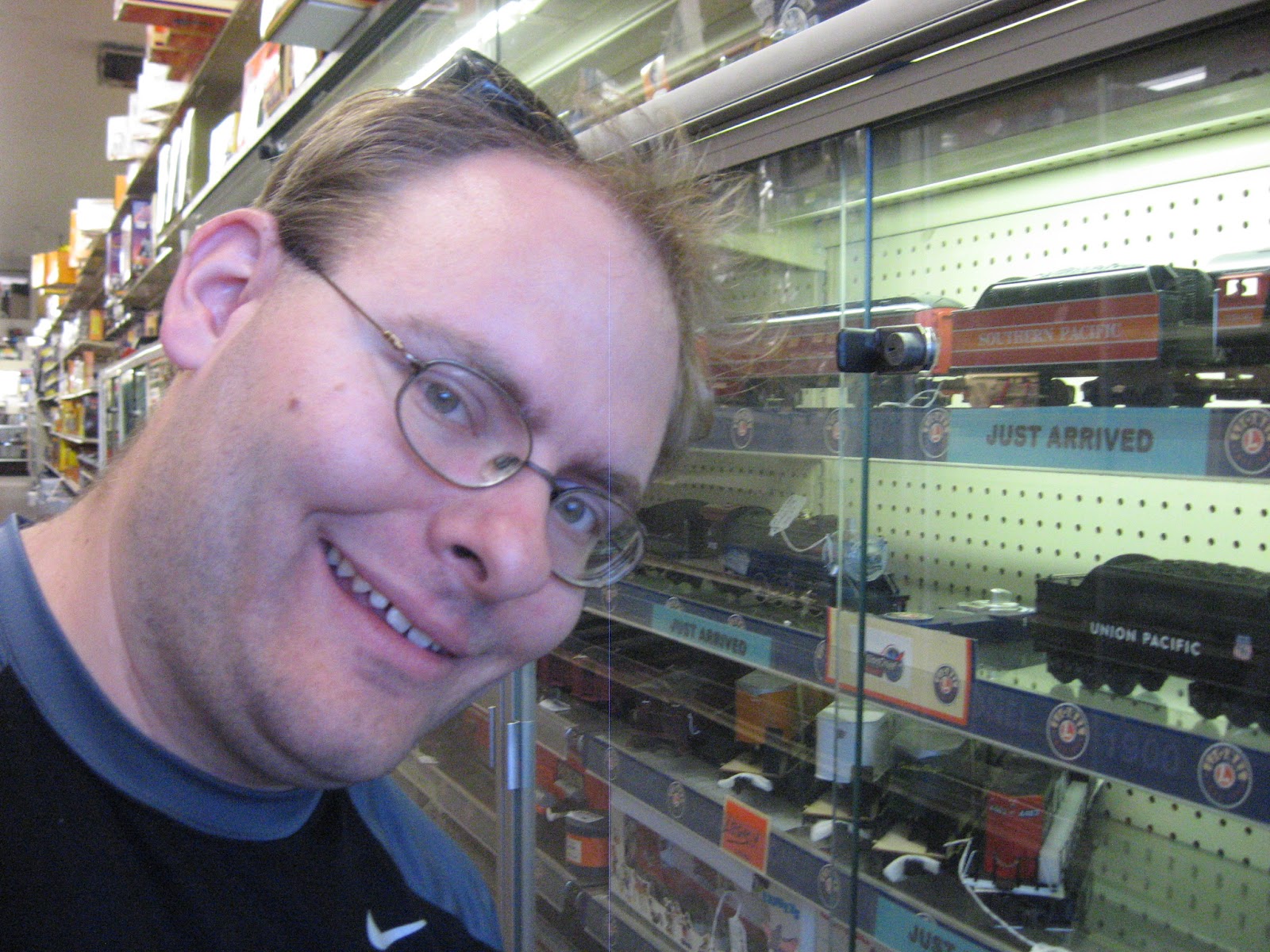
Here I am in one of the O Gauge aisles at Caboose Hobbies

The 6 new citizens I purchased for the train layout

Two RTD trains meet along the curve south of the Alameda Station

A few of about 100 UP locomotives parked in the yard

A string of 6 UP engines await clearance to enter the yard, with the Mile High Stadium and the Rocky Mountains in the background

Here's the nifty Training Train at the Auraria West Station

Boats taking a hike at the Oak Station in Lakewood

The DIY cross buck on the shed, with the Whistle sign in the foreground

The 20th Century Limited can now be viewed in our stairwell

Thursday, October 29, 2015

Roundhouse, CRM, and Cross Bucks

Welcome to the end of October, readers! As I advised earlier, I'll be providing some railroad-related details from our trip to Denver ~

After having lunch in Cheyenne we stopped by the historic Union Pacific Depot. Well, actually we went to the not-so-historic parking lot of the Depot. Amber checked on my surgery recovery progress, and I was able to stand and look at the Union Pacific roundhouse. There were no parked trains obstructing the view, so we were there at an opportune time. The roundhouse is only open to visitors once a year during Depot Days in May of each year. But, as a ferroequinologist, it was fun just to be on site. For those of you that don't know the significance of this, the UP roundhouse in Cheyenne is home to the railroad's operational historic locomotives. Here, the engines receive restoration, maintenance, and protection from the elements. The steam locomotives that reside here are Northern #844, Challenger #3985 and newcomer Big Boy #4014. There are also vintage diesel locomotives and passenger cars that get stored/serviced here. While crossing over the train yard bridge, I spotted an E or F unit still bearing the CNW livery. I hope to visit the inside of the roundhouse during Depot Days someday!

On a Tuesday afternoon, we visited the Colorado Railroad Museum in Golden. Staff were busy decorating the campus for the Polar Express events, which will take place over the next few months. Our reason for visiting, however, was the garden railroad display. We spent an hour with Alan Olson, the chairman of the Denver Garden Railroad Society, who graciously provided information, ideas, and answers about starting a garden railroad from scratch. We discussed track, plants, grades, buildings, rolling stock, electronics, weather, wildlife, track plans and more. We will continue to use Alan as a resource as we get closer to construction of the garden railroad in our backyard in Billings. Some useful ideas from Alan included: a kidney-bean shaped track plan with scenery obstructions to provide interest, battery-powered locomotives, the use of thyme as ground-cover, using drip-irrigation, running trains in the snow, tracks at waist height, and track structure that can support a human's weight. We stayed with Alan until the museum closed, and picked up a copy of Garden Railways Magazine on the way out.

Back in Billings, I was able to paint the lettering on my Do-It-Yourself cross bucks for display in the backyard!


Until next week, keep those rails shiny!

Myself and the Cheyenne roundhouse

View of Cheyenne's historic depot

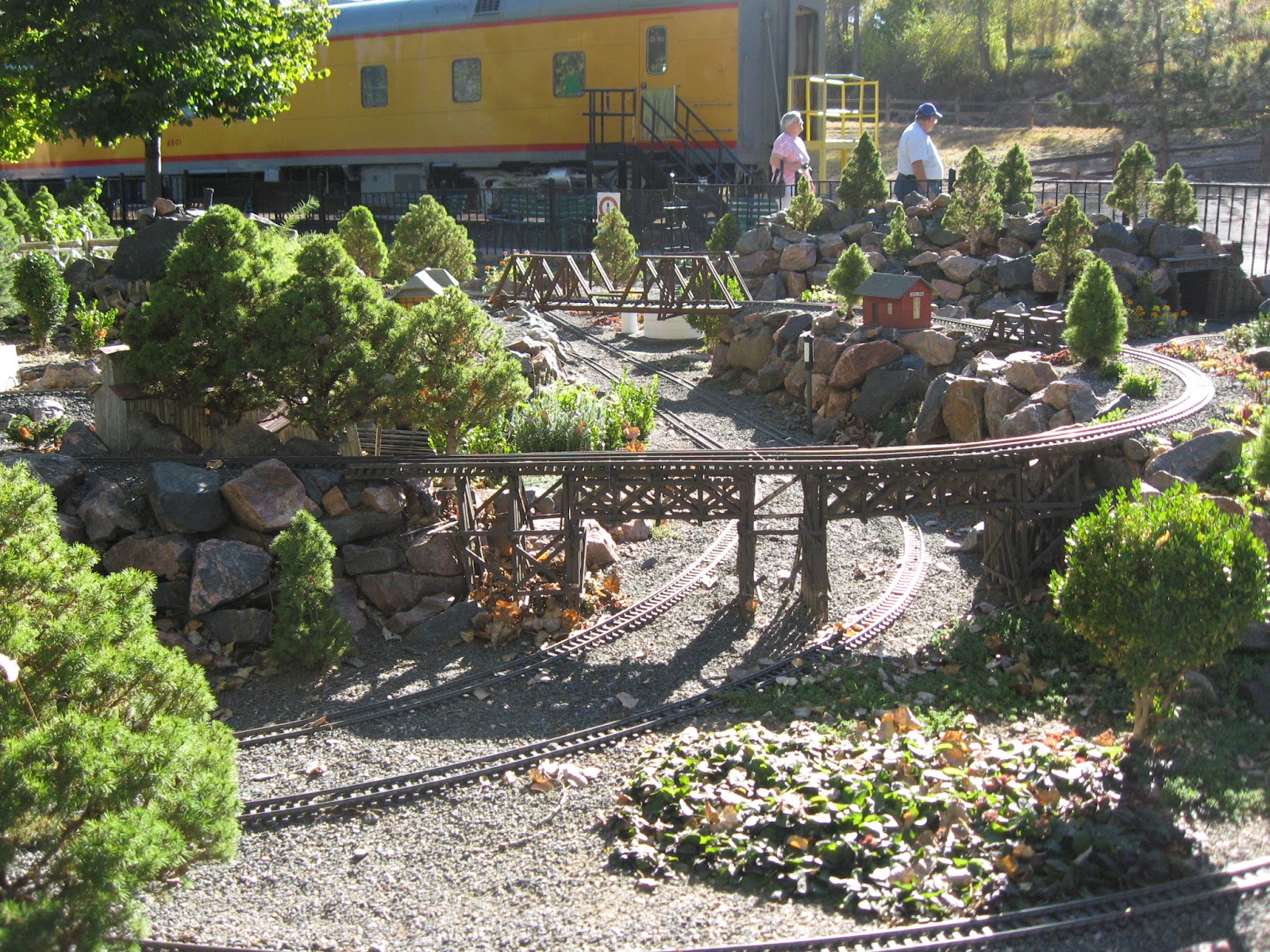
Bridges and water feature on the CRM garden railroad

Elevated section of the garden railroad

Photo showcasing track, structures, rocks, plants, and seating along the garden railroad

Multilevel features on the garden railroad

Alan draws some sample track plans while I look on

Time for Christmas! Usually visitors see the words "Colorado Railroad Museum - Delay Junction" on this building.

This dead tree is a great spot for giant Christmas ornaments at the museum

DIY cross bucks in process

Thursday, October 22, 2015

Rails in Excel

Hello Readers ~ sorry for missing a post last week, I was out on vacation!

My wife and I visited the Denver area for a week, and I have a lot of fun train adventures to share with you. Today I’ll provide an overview, and over the next few weeks I’ll get into some details. We visited the Union Pacific Depot and Roundhouse in Cheyenne on October 10th. On the 13th, we visited with Alan Olson at the Colorado Railroad Museum and discussed garden railroading. On the 14th, I took the Denver Light Rail train downtown to do some shopping at Caboose Hobbies. On October 15th, I camped out on a foothill near Golden to do some trainspotting, and also viewed the rail operations at the Coors Brewery. I also went to a store in Lakewood that specializes in consigned railroad and model railroad items. And, on October 17th, I spent several hours at the Colorado Model Railroad Museum in Greeley.

Since returning, I’ve done a bit of “digital organizing” – I have a spreadsheet that I use to keep track of train projects and plans, and it needed some work to make it more useful. The spreadsheet contains the following tabs of information:
·         Map1: Two maps of the proposed 32’x20’ O Scale layout. The first shows track and building locations, and is divided into 29 sections. Each section refers to a specific area of the layout for easy reference, like “Silver Falls-Downtown” or “Silver Falls-Yard”. The second shows color-coded tracks and streets, town/place names, and geographic features like lakes, rivers, and forests. It also shows where each major railroad on the layout is based. For example, the town of Cedar Valley is primarily served by the Great Northern, while the town of Red Stone is served by the Rock Island and Santa Fe, with occasional service from the Frisco and Katy. There is also a key showing 108 proposed buildings/structures. Both maps use close-to-scale measurements for track and structures. I plan to add a topographical map as well.
·         Silver Falls Upper: A map showing detail of downtown Silver Falls, which will be elevated. The 23 proposed buildings are shown with close-to-scale measurements. This detail information would not have shown up well on the larger maps on the previous tab.
·         Area Attrib: A list of any detail or idea to include in the layout of the future. There are 365 items so far, and this is a good spot to list ideas. Example 1: For the church in Silver Falls, look at American Model Builders kit #152-491, which is a 7x4x6” brick building and currently costs about $32. Paint it cream with brown trim. Example 2: Remember to install tell-tales in front of all bridges and tunnels throughout the layout.
·         Wish Locos&Sets: A list of locomotives and passenger sets I’d like to eventually own. Some of the items on the list haven’t been produced yet. For example, I’d like to buy the Santa Fe “Midnight Chief” F3 ABA diesel set from K-Line to go with my existing passenger set. The model number is K-25303, and currently sells for about $445 on eBay or Trainz. A goal date to purchase this set is in 2019. This sheet also contains a cross reference of scale sizes and how an actual inch compares to model feet in each scale.
·         Wish Rolling Stock: Similar to the previous tab, this is a list of freight cars or individual passenger cars I’d like to add to the fleet. It also includes a list of 185 applicable Atlas O Reefers for reference.
·         Engine House: This is a new tab I added this week to track repair work. It shows the current status, report date, begin date, fix date, item details, and problem description for each issue that occurs on the train set. Going forward, I will use this to track all the work that is performed. For example, on 10/21/2015, I reported that the Denver Rocket passenger set has very squeaky wheels, and is in need of something to quiet it down.
·         ILLINOIS: contains a list of items we brought back from Illinois this year. This is mostly for reference, and once the master inventory is complete, this tab can be removed.
·         Train Names: A list of every motive unit and its current status. It also shows when the unit was last run on the train set. A separate list on this tab shows every train by name or purpose and the last time it was run. I also use these lists to schedule the next roster line up, so I end up with a good rotation through the locomotives and trains. For example, the Great Northern 2-8-2 mike was last run in April, 2015 and is in operational status. Or, the Broadway Limited last ran in May, 2014, and was pulled by the Pennsy GG1.
·         Train Log: A list of train-related activities done each day. For example, on 5/18/2014, I successfully tested the lighting on the Granite Canyon Pullman car, but encountered other issues (see previous blog for details on that one!)
·         Inventory: This will contain the master inventory of all train-related items in my collection. It will show a Record Update Date, What the item is (a model train, an artifact, or an “other”), the Manufacturer, Type of Item, Sub Type of Item, Description, Scale, Roadname, Road Number, Item Number, Year Manufactured, Condition, if the Box is present, the Box Condition, personally assessed Value, and Notes.
·         Abbreviations: This is another tab I added this week. If someone who isn’t me uses this spreadsheet, this tab will provide a key to the various railroad (or other) abbreviations I use. For railroads, it also lists sample color schemes used. For example, “GN” refers to Great Northern, and the color schemes used on the layout (circa 1955) are orange/dark green/yellow. Or, “EB” refers to East Bound.
·         Summary: This sheet is here to remind me how each railroad is represented on each layout. It is a basic summary of the future O-Scale, O27-Scale, and G-Scale layouts. It includes equipment that hasn’t been purchased yet. For example, “ATSF is a through-line, with one F3 diesel set and a matching passenger set.”
·         Details: I use this sheet to list prototypical pairings of locomotives and passenger sets. It shows which town hosts each locomotive and train, and in some cases, lists the proposed date of purchase in the future.
·         Garden: This includes very early sketches of a garden railroad plan, with measurements provided based on track loop diameter.
·         Garden Details: This is similar to the Area Attrib sheet, but shows G-Scale details instead. For example, “include a cabin on a mountain”.

So, stay tuned for details on my railroad adventures in Denver over the next few weeks, and also regular updates on model train activities here in Billings. Until then, enjoy these pics, and keep those rails shiny ~


UP roundhouse in Cheyenne, home to Big Boy 4014

The DGRS railroad at CRM

Southbound RTD light rail train in Denver

The famous Caboose Hobbies

A UP freight works its way up the S curve

Lots of tracks throughout the Coors facility

A little peek of the phenomenal HO layout at CMRM

A big collection of Pullman towels at CMRM

Thursday, October 8, 2015

Livingston Model Trains

Hello there,

This week I didn't have the opportunity to do a lot of train-related activities. But, I did open up the Burlington E8 motive unit and moved the wire the was rubbing against the rotating motor component. I tested it for several minutes, and the rubbing sound appears to have gone away!

So, since I don't have much additional news on my own railroading endeavors, here is a quick write up and view of the Livingston Model Railroad Club in Livingston, MT.

We visited a train swap meet at the restored Livingston Northern Pacific depot in April, 2012. The depot itself is worth checking out if you're in town - it is a marvelous structure and the town has done a great job maintaining it. Next to the depot is the original NP baggage building, and the local model railroad club houses their layouts there. They have an expansive, winding HO layout, and a nice, long O layout too. The O gauge layout was made by a modeler who has since passed away, but in this location, hundreds of people have been able to see his handiwork. The operating layout is very well scenic'd, and hosts local-to-Montana trains, both modern and historic. The pics below are from our 2012 visit, and you can learn more about the Livingston Model Railroad Club here: http://www.livingstonmuseums.org/depot/Modelers.html.

Modern MRL power on the Livingston layout

Great scenery and details! Here, a little red "beep" brings a train across a bridge

Unit trains and great weathering on this busy little layout

I watch happily as a steamer drifts by

Thursday, October 1, 2015

Paper Railroadania

This week I was recovering from some surgery, so I had to do mostly tame activities. I was able to place a lot of my paper railroad memorabilia into protective sleeves for storage and eventual inclusion in binders.

Lots of railroad paperwork collected over the years

Thursday, September 24, 2015

Craft Project

I continued working on some hand-made railroad cross bucks this week. I had previously cut and painted them, and this week I sketched the lettering on them. Just a quick update this week ~

Lettering outlines on boxcar wood

Thursday, September 17, 2015

RR Crossing

This week I did some full-scale railroad work. A few months ago, I acquired a damaged railroad crossing sign that had been struck and abandoned. I gladly adopted it, and have given it a new home in our backyard. Much of the post was split apart from the impact, so I had to shorten it considerably, but with a deep hole and plenty of concrete, this sign should remain here for a long time! On the opposite side of the shed is the train whistle sign I installed last year.

In model train news, I haven't made substantial progress due to a very busy week at work, but I did test the CSS Interurbans in reverse, and they ran around Track 3 about 50 times without any issues. This is great news, and I can now proceed to modify the front truck so that the cowcatcher won't "catch" the third rail at junction spots.

I also performed more troubleshooting on the NP 0-6-0, but there is no progress to report yet. I did some shuffling of boxes in the train room as well, but that wasn't interesting enough to warrant a picture. So, enjoy views of our increasingly railroad-themed shed below, and until next time, keep those rails shiny!

The new railroad crossing sign in place

This whistle sign, found in Canada was placed here last summer