Showing posts with label Status View. Show all posts

Saturday, May 7, 2022

Good bye and Hello

Happy Train Day 2022 to all. It's been a long time, and there have been plenty of long trains that have passed in the meantime. I'll fill in some missing railroad-related adventures in future posts, but the most important events in the past 29 months involved a good bye and a hello.

Just before Labor Day 2020 I got a call from my Uncle Bill Monteleone, a great man and model railroader. He has always been a part of my enjoyment of this hobby and my interest in trains in general. We had a wonderful conversation, about family and trains. When we finally said “good bye”, I had no idea it would be our last good bye. He passed away about two weeks later. Maybe some future posts will relate some of our train tales; until then:

Here's a toast to Uncle William, may his name forever stand

And always be respected by folks throughout the land

For when his mortal race had run and the curtain around him fall

We carried him home to Glory on the Wabash Cannonball

And five months later I said a loving hello to my son Maverick (“Ricky”) Zephyr, who arrived in February 2021. He's exploring everything now, including trains, along with his older brothers Wesley Hudson and Cody Selkirk. So, much of my model railroading quests of late have occurred with Ricky in a baby carrier on my back (Lille Baby – a fantastic product for new moms and dads). Perhaps he is absorbing lots of railroad experience... in addition to locomotive oil, grease, and smoke fluid...

Anyway, in celebration of Train Day the boys and I watched some steam locomotive videos on YouTube, and later Ricky and I repaired a diesel locomotive, and now we have a fully functional roster again. I also did some initial research on replacement diesel truck side frames.


Young Railroaders


I've had a used Canadian Pacific GP9 in storage for some time, but hadn't had the opportunity to run it until now. After initial lubrication, it would run smoothly at first, but then behave strangely – slowing down and speeding up on its own, and eventually slowly coming to a full stop. And regardless of what speed it was running, the rear pickup roller would spark more than any Post War Lionel locomotive I've seen! This is a dual motor model 206, road number 8488 manufactured by Williams. I performed some basic troubleshooting steps before poking around with anything. I overturned the locomotive and placed it on some fabric, then connected leads from a transformer to the rear pickup roller and one wheel. This powered both motors without all the sparking that was present when the unit was on rails. For another test, I put masking tape over the rear pickup roller and applied power with it on the track. This resulted in no power at all to the locomotive, which told me something was amiss with the front pickup roller. I removed the shell, and thankfully this is one of those times when the problem was immediately apparent. An important-looking red wire near the front motor was attached to * nothing *. I could see where it was originally attached to a crimp-style connector, but the front truck had likely been swung too far to the engineer's side at some point, which broke the wire. So, I removed the old crimp-style connection, found a new one, and attached it to the important-looking red wire. After re-affixing everything I ran the shell-less locomotive on some test runs around Track 1 with great success. I reattached the shell, and was able to run the all-CP freight train continuously at a relatively slow speed. So, a bit of time and ingenuity netted me another fully functional Geep on Train Day – not bad!


Seems like that important-looking red wire should be connected to something...


A shell-less test run


Back on track

I have a different used diesel locomotive set that is in need of several replacement truck side frames. The set seems to run perfectly – it just needs a couple cosmetic parts to complete it. This is an MTH Premier FT set, and currently there are no parts for this listed on MTH's (new) parts website, and I have a feeling that even if they were listed, they would be out of stock. So, I've started looking at other potential ways to get decent looking truck side frames for this locomotive set. I have seen various Post War Lionel truck side frames for sale on eBay, and they are plentiful. Perhaps one of these parts would be close in style to the ones I need? I inspected one of my existing truck side frames, and compared it visually to the many Post War styles online. I found that replacement truck side frames for a Lionel 2343 may be built in such a way that one could be augmented for my purposes. I then referenced my big Post War Lionel Repair & Service book, to see what would be involved in removing a side frame from one of my PW locomotives for comparison. While there was lots of good information to be found, none of it was overly helpful for this particular quest. I believe a bit more online searching will give me the answers I need.

Truck Side Frame Research

Okay, lets get to my current fully ARMED and OPERATIONAL roster!

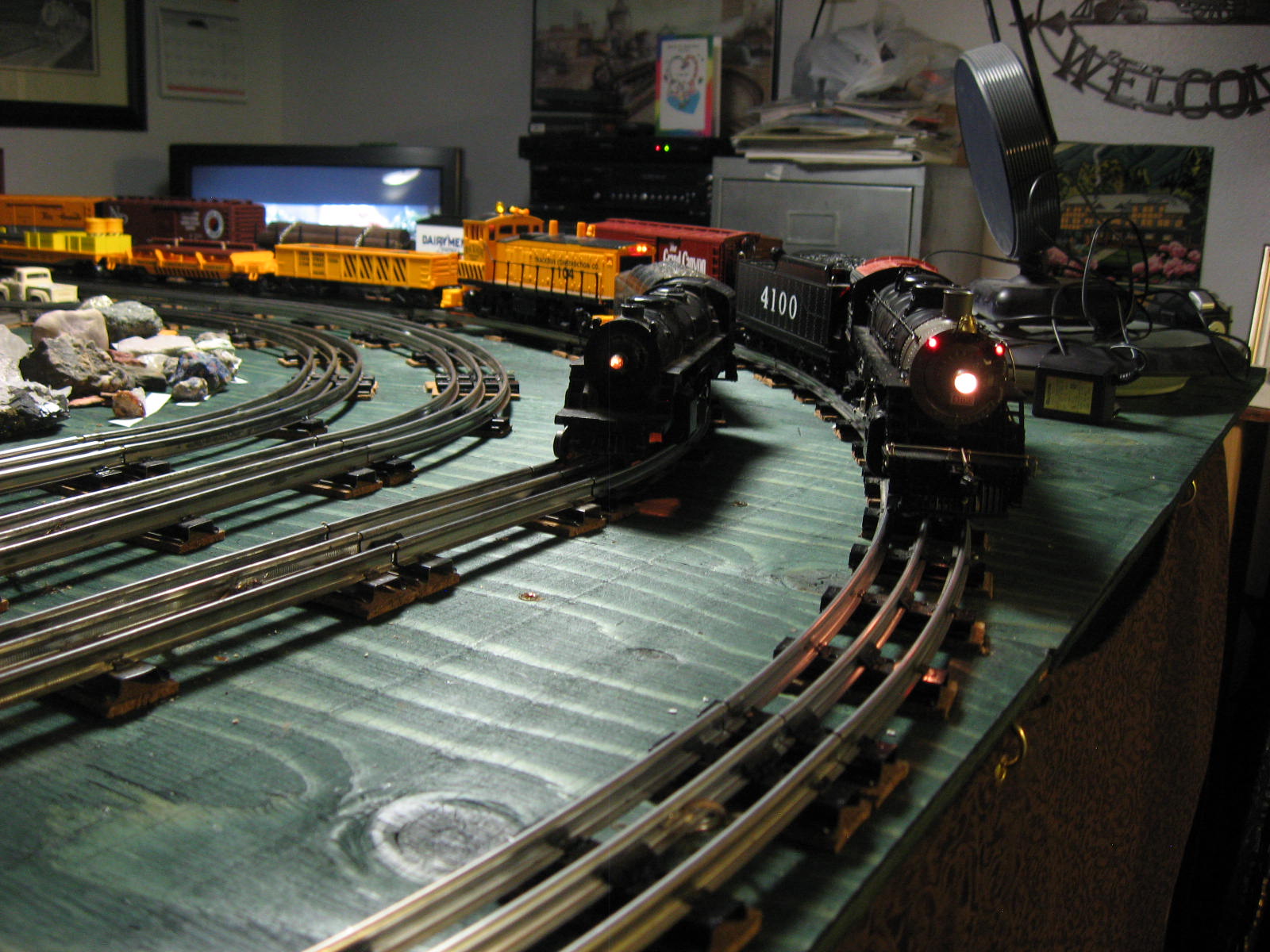
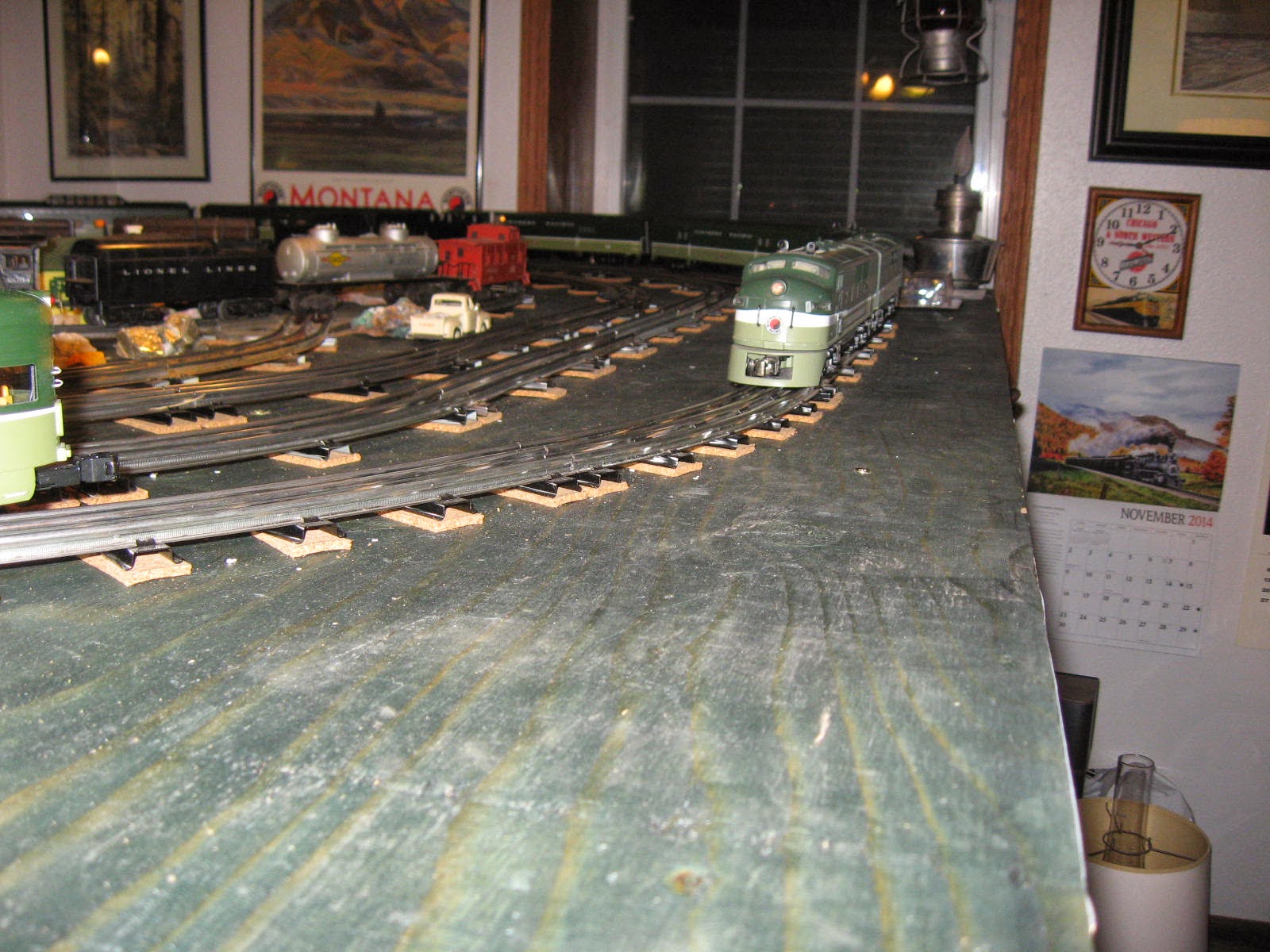
On Track 1 is an all-Canadian Pacific freight headed by the Williams GP9 mentioned earlier, sporting the handsome grey/maroon paint scheme. The freight cars are a Lionel single-dome black “water only” tank car, an MTH grey/maroon boxcar, and an MTH red bay window caboose. This is the first run for all four members of this train.

On Track 2 is an all-Chicago Northwestern freight train, headed by Lionel 4-6-0 “Ten-wheeler” #361. This loco had a guest appearance at church last year – I'll get to that in a future post. The rolling stock on this train features a K-Line yellow/green woodside reefer, an Atlas brown outside-braced boxcar, and MTH green hopper with coal load, an MTH boxcar in boxcar-red sporting the “Challengers” motto, and a sporty yellow/green bay window caboose. This is the first appearance for all of these cars except the reefer and the hopper.

On Track 3 is another Chicago Northwestern-helmed freight, but this time all the freight cars are reefers of various small-to-large companies. Oddly, but by popular request from my boys, it is also headed by a CNW rotary snow plow. This MTH yellow operating plow has seen plenty of action on this layout, but it is always a crowd pleaser and is genuinely fun to run. The locomotive is a Lionel 8056 Fairbanks Morse Train Master, which I've had since high school. Ever the trend setter, I posed with this locomotive in my senior pictures! Anyway, the motors in this loco can growl along with the best of any of its older Post War brethren, and it is strangely refreshing to send this one around the loop surrounded by more technologically advanced steam locomotive models on neighboring tracks. Following the Train Master is a colorful assortment of reefers: K-Line white/blue Rath's Blackhawk Ham, Atlas grey/brown Marty Cheese from Monroe Wisconsin (relatively close to where I grew up in Illinois), MTH yellow/brown Lakeshire Cheese from Plymouth Wisconsin, K-Line McLhaney Creamery from the breezy plains of Texas, Lionel green A&P milk car based in West Bend Wisconsin, K-Line red/yellow Black Hills Packing from Rapid City South Dakota, and the reliable MTH yellow/green CNW center cupola caboose. This is the first run for all of the reefers.

Track 4 is a shay-powered caboose train. You may find a real-life version of this train at the Illinois Railway Museum on steam days throughout the summer season. Powering this tourist train is Lionel Elk River 3-truck shay #12. Shays are fascinating and fun to watch and experience. This Lionel model does a pretty good job of capturing the motions and sound of real shays, and the resulting ultra-slow speed operation is strangely peaceful, despite the cacophony of motion required in the engine's gears to make it happen! The six cabeese in the train comprise some old favorites and some first-time runs. It starts with a K-Line orange woodsided Milwaukee Road rear cupola, followed by an MTH Tuscan N-8 Pennsylvania Railroad cabin car, then a K-Line red woodsided Illinois Central rear cupola, then an MTH blue/white Electro-Motive extended vision, followed by a K-Line silver Chicago Burlington & Quincy offset cupola, and finally an MTH red Great Northern extended vision.


Shays look fascinating 

Until next time, here's another toast to Uncle Bill, and keep your rails shiny


Thursday, November 1, 2018

On Schedule


Against the odds (and there has been plenty of odd in my life lately), I got the new roster running on time. My self-imposed schedule is to have a different roster set up by the last day of each even-numbered month, and last night I got everything rolling successfully.
So, what’s on display this time? Freight Trains
Track 1 is a salute to the Illinois Central, with all IC equipment: the black GP9 (Williams), a boxcar painted in the passenger train livery (MTH), a black hopper hauling southern IL coal (Williams), and a handsomely-detailed red, wood-sided caboose (K-Line). The locomotive is a very dependable, smooth runner, and the rolling stock handles the crossover track with ease.
Track 2 is all the logs, all the time! CNW 0-8-0 steam locomotive #65 (MTH) is pulling and pushing all of the log cars in the fleet. At the front are two CP log cars (Lionel) followed by the switcher loco. After that are two NP log cars (Lionel), followed by 3 skeleton cars carrying extra-large hunks of trees (Lionel). All of the logs at once, along with the mid-train steam engine, make this a neat train to watch. Only issue I’m having with this one is a noisy smoke generator on the loco.
Track 3 brings back the CB&Q GP7 (Lionel) and a unique freight consist. Behind the engine is a D&RGW reefer (MTH) in the striking orange/silver paint scheme. Then there’s the nifty ATSF autorack car (MTH) carrying four 1952 Cadallacs. Following this is an ATSF boxcar decorated in one of the best non-prototypical paint jobs around: the black/red of the “Midnight Chief”/”Black Bonnet” train, first advertised by Lionel in the Postwar era but actually engineered by K-Line in the modern era. Next up is a bright red Swift reefer (Lionel), with tasty meats inside. A yellow Pure Oil tank car (K-Line) comes next, and then the Yule Marble depressed center flat car (Lionel) with its load of a (real) chunk of marble. Topping everything off is a steel-sided, offset cupola CB&Q caboose (K-Line) with a red flashing light above the rear deck. This train had an issue to resolve: the rear coupler on the ATSF boxcar would open frequently, and without warning. Inspection did not reveal the cause – apparently this car’s particular type of magnetic uncoupling system is susceptible to false opening signals when running on Track 3. I tried good ole’ Scotch tape, and this failed spectacularly 3 times, so I got some metal wire and fastened the ATSF boxcar to the Swift reefer manually. So far, it is proving to be a sufficient (albeit annoying) solution. I haven’t noted any permanent damage caused by the uncoupling, and subsequent unplanned head-end to trailing-end meets, but I’ll note that the autorack car does NOT like sudden bumps or stops! Thankfully there are bumpers in place to prevent the Caddies from going too far! The other note for this train is the engine: the motor is loud and emits a high-pitched sound sometimes, even after lubricating it. Maybe this is intentional, to more closely mimic its Postwar ancestor, since this is a PWC loco…
Track 4 marks the return of GN 2-8-2 (Williams) after two years in storage. After the repairs made in 2016, it actually pulls rather well, although the loco’s operation can best be described as “goofy”. First off, for a premium brass scale steam locomotive, you’d think they could have found a smaller headlight bulb. The bulb and casing are uncharacteristically huge compared to the rest of the engine, making it seem like a well dressed, well proportioned, refined fellow with a giant honking nose! BUT, the headlight works flawlessly, and the loco looks great from most angles. The unit still suffers from sound problems, which I’ve mostly gotten used to. Neutral sounds are fine, but the moment it starts moving it sounds like it is already out of breath. Instead of “CHUFF - chuff – chuff – chuff, CHUFF - chuff – chuff – chuff” it emits “CHUFFCHUFFCHUFFCHUFF, CHUFFCHUFFCHUFFCHUFF”. Additionally, the whistle most commonly becomes stuck when activating, necessitating a return to neutral to silence it. Occasionally the whistle will function properly, but then again, sometimes it activates randomly, or more disturbingly, it activates when I blow the whistle for the switcher on Track 2! ANYway, despite this, the locomotive performs quite well, originally pulling the Bozeman Zephyr around the layout before I had the freight consist prepared. Following the Mikado, in place of the originally scheduled express mail car, is a black MRR tanker (K-Line), which I figure is carrying extra water for the steamer. Next are three hoppers: yellow/green covered CNW (Williams), black NP with coal load (MTH), and green CNW empty (MTH). These are followed by more CNW rolling stock: a green tank (MTH) and yellow/green stock car (MTH). Towards the rear of the train is an NP flat car with two truck trailers riding piggyback (Lionel). Between the flat and the caboose, I placed the aforementioned GN express mail car (Weaver). Initial tests with this car made me worry that its thin plastic frame, coupled with the peculiar way it sits on its trucks, would prove to be an unreliable candidate to transfer the majority of the locomotive’s drawbar force to the rest of the train. Normally, express mail cars show up at the very front of a train (or the very rear, to make them easier/faster to switch out). And normally, they show up on passenger trains. As I’m currently without a GN passenger consist, this mail car will have to take what it can get! It will look great heading a streamlined Empire Builder, but it will likely require some re-engineering to actually stand up to the physical stresses of such an assignment! At the end of the train is red GN caboose X54 (MTH), which looks very sharp. Actually, all 3 cabeese in this roster are very prime models. For the past few weeks, I had the CNW switcher pulling just the skeleton log cars and a yellow/green, steel, center-cupola caboose (MTH). This is another great caboose, but it isn’t on the official roster, so it’s off to storage for now… but is scheduled to return with a LOT of cabooses in February 2019!
Hope you enjoy the pics below. I’ve started posting videos of each roster, or other train-related goodness to my YouTube channel: https://www.youtube.com/channel/UC00Sk1pE7ZSZSRYyVRXS7Ig?view_as=subscriber


Thursday, May 10, 2018

Maintenance of May


After over a year I was able, a little at a time, to switch out the roster, with my 17mo toddler's help/"help". He is still enamored with all things trains.

Here are some notes on the Maintenance of Way (MOW) roster: This is the first time I've put together a MOW theme.

The Postwar MOW train on Track 1 is extremely reliable, except for occasional derailment of the last two cars at the 45-degree crossover. I haven't recognized anything specific that needs to change to prevent this situation. The UP locomotive continues to be one of the best runners in the fleet, at 68 years young. The searchlight car, with repairs made previously, functions correctly and dramatically (especially in the dark). The locomotive and cars were all manufactured by Lionel in the 1940’s – 1950’s. Union Pacific FA A unit #2023, Lionel Lines searchlight car #3620, New York Central gondola #6462, Leigh Valley hopper #6456, and Southern Pacific caboose #6357.

The SFTA MOW train, which had to be moved from Track 3 to Track 2 to accommodate the scale CNW crane's boom length (see below), is right at home on this O-31 track. Being an entry-level K-Line set, the NW2 locomotive has a couple challenges - 1) While scale in proportions, it's decks are oversized and will impact trains on Track 3 while traversing curves, and 2) it doesn't have a "slow" speed - it goes from still to fast with nothing in between, and it will go even faster still. I can work with this, but it does mean I shouldn't run trains on Track 3 while this one is running on Track 2, and I shouldn't run it if I'm trying to calm myself or anybody down! “SFTA” is an abbreviation for Silver Falls Transit Authority, which in this case is leasing equipment from the Trackside Construction Company. NW2 #104, unnumbered rail transport car, unnumbered I-beam transport car, gondola carrying railroad ties #5630, and unnumbered crane car/caboose.

The CNW MOW train looks very sharp, and is truly O scale in proportions. However, this means that the crane boom, which extends 7.5 inches beyond the car's deck, sticks out quite a ways on corners. With the large hooks and equipment that hang from the boom, this would cause considerable damage to any trains operating on the next track. Originally, this train was scheduled to run on Track 2, but it would have obliterated the SFTA train which was planned to run on Track 3, so I swapped the two trains. My choice of equipment for Track 4 also made this an easy decision. Anyway, the CNW train runs at a slower pace, and I've turned the locomotive around to run backwards, which is prototypical. The cab (and thus, the engineer) is closer to the crane operation, and that provides better line-of-sight to maintenance work. I've observed various MRL work trains operating in a similar fashion, with REAL GP7s and GP9s, albeit with trimmed front hoods :) Lionel CNW GP7 #1518, MTH CNW crane #6359, and matching MTH crane tender #X250948.

And the trusty handcar makes its long way around Track 4. This handcar was built by Industrial Rail and is unnumbered.

As part of the changing of rosters, I entered or completed inventory records for all participating equipment. At this point, 72% of the fleet has been inventoried. Enjoy National Train Day this Saturday, and keep those rails shiny!

Postwar MOW train

SFTA MOW train

Long CNW crane boom

CNW MOW train

Handcar


Thursday, November 19, 2015

Total Re-org and CMRM Part 1

Howdy readers – today’s long post details a lot of work done in the Train Room over the past few days, and Part 1 of my visit to the CMRM.

I devoted nearly 12 hours to the Train Room this week, and while most of the changes will be invisible to guests, it was an extremely fruitful week! I’ll start with the layout…

I set up the CTA 4-car “L” set on Track 3. From reading the manual, I decided to try out a fun feature that allows me to program the train to stop automatically at a set of stations that I decide. To program the train, I use the “whistle/horn” and “bell” buttons on the transformer. However, the Lionel ZW transformer I’ve been using to power the set since March 2014 is about 70 years old and doesn’t have these buttons. A ZW transformer has a whistle lever, but this doesn’t work that well for programming purposes. To get around this, Lionel manufactured separate buttons that can be wired between the transformer and the track to provide whistle/horn and bell functionality to any transformer. I had been using these separate buttons, but there are a few drawbacks. One, a ZW controls four trains, meaning I would need 8 buttons (4 trains x 2 buttons each) to get full sound capabilities on each track. Two, these buttons are about $20 each, and I have 3, so it would be kind of expensive to get an entire set for a ZW transformer. Three, I use some rather beefy 10 or 12 gauge wire to power the layout, but these buttons use tiny 18 gauge wire, so when the buttons are used, the power flow is decreased significantly. Four, since bringing the remainder of the collection back from Illinois, I now have my full complement of transformers available to me, some of which have built-in whistle/horn and bell functionality.

So, I decided to make a big change in the layout power supply configuration. I swapped out the 250W Lionel ZW transformer with two 270W MRC transformers. This improves things significantly, and solves the whole whistle/horn and bell button issue. It also means that 2 tracks get to share 270W instead of 4 tracks sharing 250W, so train performance will improve overall. The MRC transformers are controlled by wired remotes. These remotes provide some handy added functionality as well – they have a “brake” button that smoothly slows down the train, and a “stop” button to be used in case of a problem that immediately kills power to both tracks. While I prefer operating a ZW to a wired remote, I am so far pleased with the results.

Anyway, back to the “L” cars… After hooking up the MRC transformers, I began programming the CTA set to stop at specific spots on the track and announce specific stations in an order of my choosing. I followed the manual, and after several attempts I got the train programmed. Even with buttons for the horn and bell functions, it is difficult to get the timing just right. When the train is running, I can send it a command to enter “auto mode”, and it will run and stop indefinitely without any prompting from me. It’s a neat feature for an “L” train!

I set up The Canadian on Track 4, which consists of 3 F3 locomotives and 6 streamlined passenger cars. For more details on this train, please see my December 5, 2013 blog post. This is the first time I’ve run this set in Montana, and it looks really sharp. And now I can operate the horn and bell a lot more effectively with the MRC transformer.

I ran all four trains and found that the extra-long CNW Trainmaster will bump trains on Track 3 when it is rolling on Track 2. So, I’ll just run 3 trains at a time, which is fine and slightly less noisy. Also, I discovered that CP Coach 111 has a low magnet on one of its couplers that occasionally strikes a track joint on the west side of Track 4, which needs some fixing. Later in the week, I opened up CP Coach 111 to check for problems with the truck. While I didn’t see any problems, I was pleasantly surprised by the car’s construction. I’ve never had need to open one of MTH’s passenger cars, but they are well built, especially compared to earlier car designs from other manufacturers. I ran the car with the low magnet at the rear and didn’t have any problems after 10 loops.

In preparation for the Christmas season, I set up the O-scale nativity set that my wife gave me. It looks pretty good with some rocks in the background. It is a neat feature that helps us remember what Christmas is all about!

Also in “above layout” news, I’ve hung up two more artifacts: a PRR can and an MRL crossing post license. I’ve also had some correspondence with the MTH Service Dept regarding the NP 0-6-0 sound problem. I also gave the room a good dusting. Last night I vacuumed the floor and some surfaces.

Now for “under layout” news… I spent a lot of Saturday sorting and organizing all of the non-train tubs. Meaning, the scenery, figures, vehicles, track, transformers, accessories, buildings, electronics, non-O-gauge trains, and a plethora of other items were removed and then replaced into new homes for storage. I found a few things I had been missing, and threw out some un-needed boxes and miscellany. Another big project was the completion of my “every train needs a box” initiative, which started and ended on Saturday. I have four specially designed padded corrugated boxes made for storing/transporting O gauge trains. These boxes now contain all of my trains that don’t have their original box anymore, and each box has a category: Post War Engines, Post War Freight, Modern Engines, and Modern Rolling Stock. After sorting everything, I reorganized the under-table area and the locomotive closet. The under-table area is now in a “U”-shaped storage formation, with the tubs/boxes that I access most often in front and on top. The tubs at the bottom of the locomotive closet contain items that I most likely will not need to access until the layout of the future is being built.

To help keep track of which “train box” contains which train, I’ve added a Location column to my inventory spreadsheet, so I can quickly see where a train is located in the train room. For example, if the field shows “TB1”, then I know that it is located in “Train Box 1”.


And now, back to Colorado...

On the second Saturday of our trip, my wife attended a shopping event in Loveland, CO, and I headed to Greeley. The Colorado Model Railroad Museum is located there in a 15,000 sqft steel building. I had a delightful visit! The museum contains a very large HO layout, a Thomas-themed O gauge layout, a wooden trainset for little kids, a real caboose, a Lionel collection, a large collection of railroadania, and a gift shop. I was there for about 3 hours, but easily could have spent the entire day. There were folks of all ages there to visit, and there were over a dozen staff members or volunteers onsite as well. I took a lot of pictures and video, and got some good ideas for layout details, as well as building construction ideas. I also purchased a Lionel Yule Marble flat car to commemorate the trip, and serve as a birthday present to myself in a few months J

The full-size caboose is a restored Colorado & Southern (CB&Q) rear-cupola wooden model. It sits on rails and ties inside the building. The interior is open for inspection, and is fully outfitted with authentic, period details (including the linens on the bed).

The O gauge layout, although rather small, is very impressive. It is basically a maze of interconnected track loops, and is covered with modern and historic operating accessories. There are 6 trains on the track, which consist of a Thomas-style locomotive and a caboose. There are buttons all around the perimeter of the layout which activate the multitude of accessories, and control the whistle sounds on the locomotives as well. The most impressive part of the layout is the control system, which is housed in a large set of processors on the wall. The system insures that the trains do not run into each other using a rather complicated set of blocking. The trains also run very fast, so they look sort of like a swarm of bees zipping in every direction when in motion.

The Lionel collection consists of about 200 Post War pieces in a glass display case. They also have some Post War transformers, accessories, and advertising on display.

The railroadania collection is spread throughout the entire facility, and consists of nearly 1,000 artifacts ranging from full-size semaphores to vintage time schedules. If time allowed, I would have spent more time studying these items. Highlights include a collection of 40 Pullman seat cloths from various railroads, over 100 time schedules from various railroads in a custom-built wooden rack, which visitors can read, railroad signage and uniforms, one of the most complete railroad lantern collections I’ve ever seen, 100’s of railroad switch keys in a glass case, and a pair of seats from a MRR Olympian Hiawatha passenger car. Wow!

The gift shop had mostly touristy items. However, there were a few custom model railroad cars for sale (including the Yule Marble car I purchased), and several DVD’s produced in house about layout construction and scenery. These looked pretty interesting!


But, the unopposed star of the museum is the massive HO layout, which I will talk about next week in the Thanksgiving post! Until then, have a jolly time, and keep all of your rails shiny ~

The November-December Roster: MKT NW2 Grain Train, CNW Trainmaster Fast Reefer Freight, CTA 6200-series “L” cars, CP F3 ABA The Canadian

The Canadian

CNW reefer freight

The CTA 6200-series set

PRR can

Under-layout view

Train box for PW Freight cars

The model railroad nativity set

Lionel display at the CMRM

Passenger car towel display at the CMRM

Railroad time tables display at the CMRM

Part of the railroad lantern collection at the CMRM


O gauge layout at the CMRM, notice the control system on the wall

C&S caboose inside the CMRM

Thursday, November 12, 2015

MPC Diesels and Front Range Curves

Welcome back to rail-land ~
This was a fruitful week in the Train Room. I also did some more planning for future expansion. And, I’ve detailed some more of my train adventures from our trip to Denver last month.

In the Train Room, I used the voltmeter to measure the ohm resistance in the speaker on the NP 0-6-0. The measurement showed approximately 16 ohms, which is exactly what a healthy speaker should show. According to MTH’s ProtoSounds 2.0 troubleshooting guide, either the chip needs to be reprogrammed, or the board needs to be replaced! Bleh! I emailed the MTH Customer Service team to see if they could provide any other insight.

To begin prepping for the Christmas season, I’ve put away the current projects, and will take them out again next year. So, the NP 0-6-0 and Electroliner were reassembled and stored safely in their boxes, and the rest of the roster was stored as well (The Bozeman Zephyr, CSS Interurbans, the NP freight train, and the UP Postwar train). While storing the Postwar searchlight car, the light housing fell and cracked. Thankfully, this was already a replacement housing, and more replacements are readily available. I’ve added this to the Engine House spreadsheet. As I put these trains away, I also inventoried them in the spreadsheet.

On Sunday, I got out all of the trains for the Nov/Dec roster. I also did some general straightening of the room, and changed all of the calendars to November. On Monday, I set up Track 1 with the MKT NW2 leading 4 CNW ore (grain) cars and an MKT caboose. The MKT engine is the first diesel locomotive we had on our train set when I was a kid. My father bought it at the Brass Whistle train store in Rockford, IL. For many years, this was the "ol' reliable" engine for moving freight. I also moved the portable fireplace, and in its place stacked 3 tubs of trains. On Tuesday I did some rearranging under the train table, to place frequently accessed tubs on top of infrequently accessed ones. I also set up Track 2 with the CNW Trainmaster pulling 5 reefers (MRR, GN, CNW, Dairy Men’s, NP) and a CNW caboose. I also lubricated the MKT NW2 and CNW Trainmaster. Both of these diesels were manufactured by “Lionel” during the 1970-1986 “MPC” era. MPC (Model Products Corporation) was a subsidiary of General Mills, and owned the Lionel rights during this time. These engines are 35-40 years old, and after some lubricating, they are running very well! As I set up these trains, I also inventoried them in the spreadsheet.

I also had fun planning out some options for the train building of the future. After dealing with a lot of boxing and unboxing trains recently, I’d like to one day have all of the trains on display or running on the layout. This means that I have to plan for sufficient wall/shelving space in the new building, so I did some preliminary calculating and wall-layout planning.

So, back to my Denver train-doings… On the Thursday of our trip, after dropping my bride off at training for the day, I drove north of Golden on Highway 93, and turned left towards the mountains on Highway 72. After two miles, I turned into a residential area on Blue Mountain Drive. This road took me to the top of a foothill, and I had views facing east towards Denver. I parked along the side of the road, and walked over to the edge of the hill. I was able to tracks below me, which traveled through a variety of curves. I arrived just in time to photograph and film a BNSF EB mixed freight coming down the mountains and entering the curves. Like the BNSF trains that travel through Billings, this one had engines on the front end and a few more at the back. It took it about 10 minutes to navigate the wandering track path, and I was able to view it the whole time. A few moments after the BNSF cleared, a waiting UP WB mixed freight powered up and began climbing the hill. The UP was headed by 5 locomotives, and had 1 helper locomotive located in the middle of the train. I watched the train wrap around itself as it continued up the hill. While watching the trains, a local resident came by as she was walking her dogs. She didn’t seem too surprised to see a railfan here, and she provided some interesting information about the curve the trains were traveling through below. Along the eastern side of the curve, on the west side of the track, a string of hopper cars were buried in the ground and filled with dirt. Trees were planted behind them. The trees and buried cars create a type of snow/wind fence, as this curve is in the direct path of any inclement weather coming off the mountains. The buried cars are somewhat visible from Highway 72. After the UP train went out of sight, I drove down the mountain road and met the train at the crossing. It continued through another curve around Coal Creek Peak while I headed back east. After another hour or two of climbing and curving, the train would arrive at the Moffat Tunnel and traverse the Continental Divide.

Meanwhile, I went back to Golden and drove through the Coors Brewery/Manufacturing plant. I drove through the entire facility and saw many interesting rail operations and equipment used at the beer-producing plant. Coors has their own fleet of locomotives, and a lot of freight cars get shuffled about all day long. There are also semi-frequent BNSF trains making deliveries to the plant. After returning to Lakewood, I visited Jenny’s Junk Emporium, which is a consignment shop that specializes in railroad and model railroad items. They had a lot of railroad artifacts and media, and trains of all scales, including quite a few G-Scale items. The prices were rather restrictive, so I just enjoyed looking. So, this was another fun morning of train-related activities! Next week I’ll conclude with a review of my visit to the Colorado Model Railroad Museum.

My Train goals for the coming week are: setup/inventory/lubricate trains on Tracks 3 & 4, finish reorganizing the tubs under the table, repack the “Train Boxes”, and make sure ALL of the tubs are labeled.

Until then, enjoy some more photos, and keep those rails shiny ~

BNSF train headed down the hill through the S curve

UP train headed up the hill towards the curves

UP train approaching the buried hopper cars

The mid-train helper engine

The UP WB train continues past Coal Creek Peak

Coors locomotive C997 awaiting orders

Another Coors engine parked in a siding

An intricate layout of tracks supporting the Coors plant

Testing the NP 0-6-0 speaker with a voltmeter

The MKT NW2 and the CNW Trainmaster pull their consists around Tracks 1 and 2

The first diesel train I ever operated (back in the 1980's)

Thursday, September 10, 2015

Grinders, Catchers, Wires and Tethers

This week I spotted the LORAM rail grinding train in the Billings yard for a maintenance stop. This was the first time I could see the entire unit in one view, and it appears to be an 11-car set. This is train puts on an impressive display when running – a set of cars equipped with grinders smooth the rails, assisted by lubricants stored in the tank cars, and spotters on the caboose extinguish brush fires resulting from the grinding with large water cannons, all without requiring the train to stop. It generates a lot of noise and dust!

Also this week I ran a few of the trains that we brought back from IL in July. I opened up the Chicago South Shore powered interurban to check the sound system and reaffix some loose passengers. The unit runs well and has good sound, but the front cowcatcher contacts that track at a few points, so I’ll do some troubleshooting to help it run more smoothly.

I replaced the battery on the Chicago Burlington & Quincy powered E8, and had the AA set pull the Bozeman Zephyr around Track 4. While replacing the battery, I think I inadvertently moved an internal wire, which is now rubbing against one of the flywheel motors. So, I’ll need to open that one up again and re-set that wire.

I also ran the Northern Pacific 0-6-0 switcher with a set of box cars. The engine was troublesome. At first it would not cycle out of neutral; this was resolved by re-sitting the tether between the engine and tender. After running properly for a while, the sounds stopped altogether, and then it got stuck in neutral again.

Meanwhile, the postwar Union Pacific FAs and postwar freight cars running around Track 1 ran flawlessly the entire week. Not a problem whatsoever!


I’ll let you know how the troubleshooting turns out next week – til then, keep your rails shiny!

The 11-car LORAM rail grinding train

Passengers and conductor inside the CSS interurban

Interurbans on Track 3

A new battery allows you to hear sounds from the locomotive when track power is off

UP, NP, CSS, and CB&Q

Train lineup with lights off

Thursday, August 20, 2015

Catch Up

Howdy - this post will give some brief details about my railroading exploits over the past year, when this blog was on hiatus. And of course, there are spiffy pics at the bottom!

July 2014
-Took some photos of individual trains while changing out the roster.
-Trains on track included the CNW Doodlebugs, Lionel Lines Columbia-class 2-4-2 Postwar steamer "trying" to pull the Rock Island Denver Rocket, Rock Island Northern 4-8-4 with a reefer freight, and Illinois Central GP9 with a caboose train.
-Repair work on the CNS&M Electroliner. One motor was failing to run, putting a lot of pressure on the second motor. I deemed that either the motor was bad, or that I did not have the tools/skills to repair. I send the Electroliner to Illinois to await repair in Michigan.
-On a hot day I photographed track repair equipment at work near the Billings Depot.
-I won my first game of Ticket to Ride.
-Set up the new roster: Track 1 - CBQ GP7 and small freight, Track 2 - CNW F7 and freight, Track 3 - Trackside Construction set headed by MP-15, Track 4 - Frisco Mikado 2-8-2 and freight

August 2014
-Saw a wacky-looking ballast recycling machine near the Depot.
-Also at the Depot, a special MRL train pulling a mix of modern and heavyweight passenger cars was parked for a day.
-Repaired Postwar #2034 to working order

September 2014
-My bride gave me a beautiful piece of artwork - a hand painted historic map of the Montana Railroad
-A string of nine BNSF locomotives came through Billings
-My folks were in town and visited the train layout
-While traveling, saw two enormous new MRL EMD SD70ACe locomotives followed by two little SW switcher locomotives in an EB train

October 2014
-Set up a model logging train at work as part of a "north woods" Halloween theme

November 2014
-Set up the new roster: Track 1 - LL 2-4-2 and small freight, Track 2 NP 0-6-0 and logging train, Track 3 - CNW GP7 #1518 and reefer freight, Track 4 - complete Vista Dome North Coast Limited passenger train (chasing its own tail)
-Decided to sell the K-Line Milwaukee Road GP7, as it is not a scale locomotive

December 2014
-Set up Christmas tree on the layout, with train ornaments
-Set up permanent Christmas lights under the layout for storage illumination
-Hosted family on Christmas day in the train room
-Set up CNW 0-8-0 freight around Christmas tree in the library room
-Prepared train tickets for visitors to the train room, and stamped them upon admission

No activity for a few months

April 2015
-Set up the new roster: Track 1 - green Brill trolley, Track 2 - CNW 0-8-0 and ore car train, Track 3 - GN 2-8-2 and mixed freight, Track 4 - CNW F7's and bi-level passenger train with the UP American View.
-Took various photos of the roster

May 2015
-Got to see a Lionel Smithsonian-edition NYC 20th Century Limited set at an auction in Lewistown. Only 500 of these were produced.
-At the auction, bought: ZW transformer, mint BA&P freight tag, numerous railroad paperwork items (majority from 1893), several railroad maps, framed painting of an NYC steam train, a heavy box of railroad spikes, and a large 1961 Burlington wall map of its western US tracks

June 2015
-Set up the new roster: Track 1 - CNW Doodlebugs, Track 2 - IC GP9 and caboose train, Track 3 - RI GP9 and CNW GP7 #1518 with the CNW Minnesota and Black Hills Express heavyweight passenger train, Track 4 - CNW 4-6-2 with a hopper car train
-Put all of the trains away in preparation for the remainder of railroad items to arrive from IL
-At the end of June, we set out for Illinois, and the rest you know! Now we're caught up, and keeping those rails shiny ~

CNW Doodlebugs take a ride on Track 4

A fast reefer freight heads around Track 4, pulled by the RI Northern

Electroliner under repair

Removing old, and installing new ties on MRL tracks by the Depot

First time playing, first time winning - Ticket to Ride

CBQ GP7, CNW F7, Trackside MP15, and Frisco Mikado all pulling freights

Special MRL passenger train at the Depot

Wacky looking ballast machine in Billings

Postwar 2034 undergoing repairs

Example of O27 vs O steam locomotives in action

Hand painted map of the Montana Railroad

9 locos at once

2 big locos and 2 small ones

Halloween at work

NP 0-6-0 pulls a log train

The Vista Dome North Coast Limited chases its own tail, while the 2034 zips around Track 1

Christmas time in the Train Room

Under-table illumination

Special Christmas tickets for the Train Room

My nephew enjoys the CNW 0-8-0 circling a Christmas tree

A trolley, the CNW 0-8-0, the GN 2-8-2, and the CNW F7's are all featured in Spring 2015

The switcher and the road engine at night

The illuminated 21" CNW Bilevels

The trolley takes a night trip

Busy day on the layout

A steel caboose follows the ore train

One of 500 Lionel Smithsonian NYC 20th Century Limited sets

Hat is a wee bit small for me

CNW Pacific #2903 pulls a long row of hopper cars

RI and CNW geeps team up to pull a heavyweight passenger train

Doodlebugs and cabeese