Showing posts with label CNW. Show all posts

Wednesday, May 24, 2023

Boxes North and Boxes South

I recently set up a new roster and ran everything through shakedown trials. I was not able to place all of the rolling stock as planned, because of a surprise I encountered with some Atlas boxcars. Some of the Great Northern boxcars have trucks that will not navigate the tight O-31 radius curves of Track 1. These cars are by no means long, so length is not the issue - it is the trucks! Anyway, I shifted some things around and now each track has a more diverse representation of rolling stock from different regions (just like real trains).

Another small obstacle was a coupler that wouldn't lock shut, and a bit of wire took care of that.

The biggest shakedown snafu was a human error, and it was a bit costly. In my eagerness to run a BCR-equipped MTH PS1 locomotive, I failed to let the BCR charge for 60 seconds (as prescribed by the manufacturer). I used the Direction button on the MRC transformer remote, and that proved to be a no-no. The interior lights on the loco flashed brightly for a moment and then failed. Dang. The full damages are the cab lights, and both pairs of number board lights. At this time I don't know if there is a board failure or just the bulbs. Thankfully, all other lights and locomotive functionality are operational, and this has likely taught me a valuable lesson I won't forget.

Everything is 1:48 O-Scale this time around:

On Track 1 is a short Great Northern freight pulled by MTH GP9 #620, including an MTH outside-braced brown Chicago & Alton boxcar and an MTH wood sided brown Great Northern boxcar, and trailed by a K-Line Great Northern caboose with a handsome livery that matches the locomotive. This is the first run on the temporary layout for all of these. Speaking of "temporary", this layout has been in use for over nine years now! I'm still making steps towards the new layout's construction, but "temporary" may not be an appropriate term for this setup. Perhaps the "basement layout" or the "fifty six layout" (7' x 8').

The Great Northern Geep


Anyway, Track 2 is powered by the reliable Lionel Chicago & North Western 4-6-0 "ten-wheeler" steamer. Its 6-car consist includes an Atlas yellow Armour reefer with the "star" logo, a pair of MTH brown C&NW steel-sided boxcars, a pair of Atlas brown Great Northern boxcars (which can't navigate O-31 curves), and an MTH red C&NW CA-1 caboose. This is my first run of everything on this train except the locomotive.

Brown boxcars are also a theme this time


Track 3 is powered by another reliable Lionel steamer: the #4100 Frisco 2-8-2 mikado, which is celebrating 30 years of operation this year. The mike is pulling an eclectic bunch of freight with road names known for southern routes. Following the loco is an MTH brown Cotton Belt boxcar, a Weaver brown Illinois Central "Mainline of Mid-America" boxcar, two MTH blue/gray/yellow Missouri Pacific boxcars (the one with the gray roof comes from my Uncle's collection), a Weaver brown Frisco outside-braced boxcar with a pesky coupler, a Lionel silver Southern tank car from my Uncle's collection, an MTH orange Frisco hopper with coal load, and the Lionel brown Frisco wood sided caboose. This is the first run here for everything between the hog and the cabin.

Happy 30th to the reliable Frisco mikado!


Track 4 is the token passenger train of this roster, and I believe it steals the show. For the first time, my complete version of the Milwaukee Olympian Hiawatha is on track and rolling. This is the first time I've had any of these on the layout, and is the very first time some of the passenger cars have been out of their box. The entire train was manufactured by K-Line in 2000, and everything matches brilliantly. And yep, this has the full 21" passenger cars. All together this is one of the gems of my collection, and I'm excited to finally get it out and play with it! Motive power comes from an F3 ABA, which is followed by the train's express boxcar, and then a baggage car, parlor car "Maple Valley", dining car, coach car, and finally the extra-spiffy "Dell Rapids" skytop lounge car. Altogether a stunning streak of orange, maroon, and black.

Strength of the Olympian Hiawatha


The Dell Rapids Skytop Lounge


Until next time, keep your rails shiny 


Saturday, May 7, 2022

Good bye and Hello

Happy Train Day 2022 to all. It's been a long time, and there have been plenty of long trains that have passed in the meantime. I'll fill in some missing railroad-related adventures in future posts, but the most important events in the past 29 months involved a good bye and a hello.

Just before Labor Day 2020 I got a call from my Uncle Bill Monteleone, a great man and model railroader. He has always been a part of my enjoyment of this hobby and my interest in trains in general. We had a wonderful conversation, about family and trains. When we finally said “good bye”, I had no idea it would be our last good bye. He passed away about two weeks later. Maybe some future posts will relate some of our train tales; until then:

Here's a toast to Uncle William, may his name forever stand

And always be respected by folks throughout the land

For when his mortal race had run and the curtain around him fall

We carried him home to Glory on the Wabash Cannonball

And five months later I said a loving hello to my son Maverick (“Ricky”) Zephyr, who arrived in February 2021. He's exploring everything now, including trains, along with his older brothers Wesley Hudson and Cody Selkirk. So, much of my model railroading quests of late have occurred with Ricky in a baby carrier on my back (Lille Baby – a fantastic product for new moms and dads). Perhaps he is absorbing lots of railroad experience... in addition to locomotive oil, grease, and smoke fluid...

Anyway, in celebration of Train Day the boys and I watched some steam locomotive videos on YouTube, and later Ricky and I repaired a diesel locomotive, and now we have a fully functional roster again. I also did some initial research on replacement diesel truck side frames.


Young Railroaders


I've had a used Canadian Pacific GP9 in storage for some time, but hadn't had the opportunity to run it until now. After initial lubrication, it would run smoothly at first, but then behave strangely – slowing down and speeding up on its own, and eventually slowly coming to a full stop. And regardless of what speed it was running, the rear pickup roller would spark more than any Post War Lionel locomotive I've seen! This is a dual motor model 206, road number 8488 manufactured by Williams. I performed some basic troubleshooting steps before poking around with anything. I overturned the locomotive and placed it on some fabric, then connected leads from a transformer to the rear pickup roller and one wheel. This powered both motors without all the sparking that was present when the unit was on rails. For another test, I put masking tape over the rear pickup roller and applied power with it on the track. This resulted in no power at all to the locomotive, which told me something was amiss with the front pickup roller. I removed the shell, and thankfully this is one of those times when the problem was immediately apparent. An important-looking red wire near the front motor was attached to * nothing *. I could see where it was originally attached to a crimp-style connector, but the front truck had likely been swung too far to the engineer's side at some point, which broke the wire. So, I removed the old crimp-style connection, found a new one, and attached it to the important-looking red wire. After re-affixing everything I ran the shell-less locomotive on some test runs around Track 1 with great success. I reattached the shell, and was able to run the all-CP freight train continuously at a relatively slow speed. So, a bit of time and ingenuity netted me another fully functional Geep on Train Day – not bad!


Seems like that important-looking red wire should be connected to something...


A shell-less test run


Back on track

I have a different used diesel locomotive set that is in need of several replacement truck side frames. The set seems to run perfectly – it just needs a couple cosmetic parts to complete it. This is an MTH Premier FT set, and currently there are no parts for this listed on MTH's (new) parts website, and I have a feeling that even if they were listed, they would be out of stock. So, I've started looking at other potential ways to get decent looking truck side frames for this locomotive set. I have seen various Post War Lionel truck side frames for sale on eBay, and they are plentiful. Perhaps one of these parts would be close in style to the ones I need? I inspected one of my existing truck side frames, and compared it visually to the many Post War styles online. I found that replacement truck side frames for a Lionel 2343 may be built in such a way that one could be augmented for my purposes. I then referenced my big Post War Lionel Repair & Service book, to see what would be involved in removing a side frame from one of my PW locomotives for comparison. While there was lots of good information to be found, none of it was overly helpful for this particular quest. I believe a bit more online searching will give me the answers I need.

Truck Side Frame Research

Okay, lets get to my current fully ARMED and OPERATIONAL roster!

On Track 1 is an all-Canadian Pacific freight headed by the Williams GP9 mentioned earlier, sporting the handsome grey/maroon paint scheme. The freight cars are a Lionel single-dome black “water only” tank car, an MTH grey/maroon boxcar, and an MTH red bay window caboose. This is the first run for all four members of this train.

On Track 2 is an all-Chicago Northwestern freight train, headed by Lionel 4-6-0 “Ten-wheeler” #361. This loco had a guest appearance at church last year – I'll get to that in a future post. The rolling stock on this train features a K-Line yellow/green woodside reefer, an Atlas brown outside-braced boxcar, and MTH green hopper with coal load, an MTH boxcar in boxcar-red sporting the “Challengers” motto, and a sporty yellow/green bay window caboose. This is the first appearance for all of these cars except the reefer and the hopper.

On Track 3 is another Chicago Northwestern-helmed freight, but this time all the freight cars are reefers of various small-to-large companies. Oddly, but by popular request from my boys, it is also headed by a CNW rotary snow plow. This MTH yellow operating plow has seen plenty of action on this layout, but it is always a crowd pleaser and is genuinely fun to run. The locomotive is a Lionel 8056 Fairbanks Morse Train Master, which I've had since high school. Ever the trend setter, I posed with this locomotive in my senior pictures! Anyway, the motors in this loco can growl along with the best of any of its older Post War brethren, and it is strangely refreshing to send this one around the loop surrounded by more technologically advanced steam locomotive models on neighboring tracks. Following the Train Master is a colorful assortment of reefers: K-Line white/blue Rath's Blackhawk Ham, Atlas grey/brown Marty Cheese from Monroe Wisconsin (relatively close to where I grew up in Illinois), MTH yellow/brown Lakeshire Cheese from Plymouth Wisconsin, K-Line McLhaney Creamery from the breezy plains of Texas, Lionel green A&P milk car based in West Bend Wisconsin, K-Line red/yellow Black Hills Packing from Rapid City South Dakota, and the reliable MTH yellow/green CNW center cupola caboose. This is the first run for all of the reefers.

Track 4 is a shay-powered caboose train. You may find a real-life version of this train at the Illinois Railway Museum on steam days throughout the summer season. Powering this tourist train is Lionel Elk River 3-truck shay #12. Shays are fascinating and fun to watch and experience. This Lionel model does a pretty good job of capturing the motions and sound of real shays, and the resulting ultra-slow speed operation is strangely peaceful, despite the cacophony of motion required in the engine's gears to make it happen! The six cabeese in the train comprise some old favorites and some first-time runs. It starts with a K-Line orange woodsided Milwaukee Road rear cupola, followed by an MTH Tuscan N-8 Pennsylvania Railroad cabin car, then a K-Line red woodsided Illinois Central rear cupola, then an MTH blue/white Electro-Motive extended vision, followed by a K-Line silver Chicago Burlington & Quincy offset cupola, and finally an MTH red Great Northern extended vision.


Shays look fascinating 

Until next time, here's another toast to Uncle Bill, and keep your rails shiny


Thursday, May 9, 2019

Train Day 2019 Success

Thank you to all who supported us by attending the 2019 Train Day festivities at the Billings Depot! After about 50 combined hours of set up, we had 8 operational loops for our guests!


Here is a overhead plan of the layout:


The set up and operation crew consisted of my folks and my uncle, who traveled from Chicago, IL for the event. During the event, we were all dressed as the crew of the Northern Pacific’s Vista Dome North Coast Limited passenger train, circa mid-1950’s. We had a conductor, brakeman, stewardess, and engineer (me). The gents all kept time with antique railroad-era pocket watches.

We also developed a free EBook, available here: https://payhip.com/b/kiXu, and a new website: https://www.modelrrfun.com/ prior to the event. We orchestrated a giveaway contest, where winners would receive either a Thomas the Tank Engine DVD, or one of two O-scale delivery trucks. A few hundred people attended our layout presentation. It was a lot of hard work, and stressful at times, but overall very rewarding to share the fun of model railroading with the community!

A friend loaned us a few boxes of Lionel Fastrack, which proved very helpful on the layout surface we had available. We ended up with 3 Fastrack loops, 3 tubular O27 loops, a Gargraves O54 loop, and a tubular O-style O42 loop. We were provided with 14 identical plastic tables as the foundation for the layout. We arranged them into a 5x3 grid, with an opening in the middle for the control station. This resulted in a 24’x12.5’ surface. We covered each table with a disposable green tablecloth, and ran track power lines between the table edges. There was very little wire visible on the table top, but LOTS of it under the tables, which we managed with cable ties. Once we had the track loops powered and tested, we added buildings, structures, and a bit of scenery to the layout.

Track 1 used O36 Fastrack and proved to be pretty reliable. It was actually used to display a trainset we were selling for a friend (one of the attendees actually purchased it later.) It ran a Postwar Lionel #1467W freight set, consisting of black Erie Alco locomotives (from 1952-3) and O27 freight cars (Lionel Lines stock car, Leigh Valley hopper car, Sunoco tank car, and Lionel Lines SP-style caboose.) Our backup motive power was the yellow Union Pacific Alco locomotives from the same set in earlier years. The Erie locomotives ran well for several hours, and then we gave them a break and pulled in the UP locos for the remainder of the event. Track 1 was powered by a Lionel RW transformer via a single lock-on. The only issues we had with the loop was the Fastrack versus the unevenness of the plastic table tops (as was an issue with every loop for the most part.) The tables were “high” on the edges, and went down half an inch or more into the “bowl” of the middle part of the table top. This was enough of a height difference to cause trouble at the track joints. We occasionally had to tighten the Fastrack connections, and eventually moved the loop slightly so that it only covered two tables instead of three. In the middle of this loop was our farm structures, along with a laptop that looped a video of my previous layout back in Illinois, along with footage of the real North Coast Limited passenger trains.

Track 2 also used O36 Fastrack, and was the most reliable, and maintenance-free-est loop on the layout. It was a Postwar Lionel passenger train, consisting of three Lionel Lines silver passenger cars (Elizabeth, Clifton, and Summit). It started the day being pulled by my father’s silver Union Pacific Alcos, and at midday we changed motive power to my son’s #2046 Lionel Lines hudson steam locomotive. The loop was powered by a Lionel LW transformer, which was fun to use (the whistle button worked great with the hudson’s whistle!) This loop just had one power connection, which was plenty. In the middle of this loop were several neighborhood-ish buildings: houses and a fast food restaurant.

Track 3 was a roughly 8’x3’ O27 layout, that encircled the control station at the very center of the layout. It hosted rapid transit trains (a Bowser streetcar in the morning and an MTH single CTA L car in the afternoon.) This loop was powered by one of the dual-track MRC O27 transformers, and had two lock-ons. This track was prone to separate in various places throughout the day, but was very easy to maintain since I was standing inside the loop all day. One of the 10” straight sections was so dirty that I had to spend some time cleaning it with an Emory cloth, which proved successful. I had intended to run a 4-car L train in the afternoon, but the cars had trouble navigating the O27 curves when coupled together, so I just ran the powered unit. It was still fun, since it provides a fun whistle and station announcement sounds.

Track 4 was an O36 Fastrack dog-boned-shaped track on the north side of the layout. It was powered by Lionel diesel locomotives, and pulled a variety of modernly-produced freight rolling stock. This track did not have ANY problems whatsoever – we just developed some locomotive issues. The rolling stock on this line shifted throughout the day, based on which locomotive was pulling the train. It hosted a die-cast K-line Northern Pacific hopper, a K-line wood-sided IGA reefer, a Lionel Great Northern wood-sided box car, a Lionel Dairy Men’s League reefer, an MTH Northern Pacific steel reefer, a Lionel Copper Range ore car, a K-Line Texaco tank car, a Lionel Montana Rail Link double-door box car, and for cabeese, either a Lionel Montana Rail Link extended vision or a K-Line Chicago Burlington and Quincy offset cupola. We started the day with a Lionel Montana Rail Link SD9 and finished with a Lionel Postwar Celebration Series Chicago Burlington and Quincy GP7. The line was powered by one of the MRC O27 transformers, through a single lock-on. This was probably part of the problem. I had another lock-on prepped, but ran out of time to actually run the power line and connect it to the transformer. The effect was that after the train ran through the loop a dozen times or so, it would become sluggish at certain points, even though the power supply remained at a consistent level. On the other hand, I’ve observed this behavior with trains powered by the MRC O27’s, even when there are MANY lock-ons on a line. The main takeaway from the event was a problem with the MRL SD9. When I picked it up to trade it with the CBQ GP7, I discovered that the front powered truck was no longer attached to the frame! Over time the mounting screw had come undone. What was remarkable was that the locomotive continued running as expected, even though it was literally “sitting” on the truck! Track 4 encircled the “yard” which is where all the backup motive power and rolling stock was stored for easy access. There were also several yard structures nearby.

Ah, Track 5, my bane for much of the day… So, Track 5 and Track 6 (also a problem child) used O27 track, and were mirrors of each other: one on the north side and the other on the south side of the layout. Overall, they were horseshoe-shaped, and met each other at a few spots along the center line of the layout. On paper, this provided a neat effect, and a lot of track for the train to enjoy. The combination of O27 track, the non-flat surface of the table tops, and two S-curves resulted in troublesome operation. Track 5 was the logging train. I set aside my two MTH steam switcher locomotives, a Northern Pacific 0-6-0 and a Chicago Northwestern 0-8-0, with matching cabeese, to pull seven log cars. The cars were all Lionel-produced, with four hauling a set of three stacked-logs each, and the other three hauling one “chunk” of a gigantic tree each. These last three cars were very short overall, only 9” long each. Through many trials, we found that the four “traditional” log cars, at 11.5” each, were too long to handle the track situations mentioned above. Also, after about a dozen derailments, we took the Lionel Northern Pacific caboose out of the roster and placed the MTH Chicago Northwestern caboose there instead. The CNW steamer was unable to handle the O27 S curves at all, as it’s 4 drivers ended up being to long to traverse the S curve properly. So, the NP 0-6-0 got to run all day. It had dozens of derailments in that time, including a spectacular wreak that sent it off the track onto its side. At one point the tender was smoking due to electrical issues. Just a bad day overall for the #1163! In the afternoon, we added some cork padding underneath the curves on the west side of this loop, which appeared to fix the majority of issues. This train, with the final roster being the NP 0-6-0, the three skeleton log cars, and the CNW caboose, ran without any problems for the last 2 hours of the event. It just took a while to figure out the right formula. The line was powered by a Lionel Z transformer via 3 lock-ons. Inside of Track 5 was Track 4, several yard structures on the west side, and a forest and logging buildings on the east side. We created the forest with two pieces of Styrofoam, covered with disposable table cloth, and then poked trees through the cloth into the Styrofoam. The end result was very good!

And onto Track 6, the southern twin of Track 5. This loop started with moderate goals but we had to chip away at them throughout the day. This line was supposed to feature some of the larger Postwar Lionel freight cars, and be pulled by either the (modern) Lionel Chicago Northwestern 4-6-2 pacific steamer, or the Postwar Lionel #2037 2-6-4 adriatic steamer. The rolling stock would have consisted of four 6464-series box cars, a gondola, a flat car carrying trucks, a searchlight car, and a bay window caboose. After much consternation, the roster for the event ended up being the CNW loco, two Great Northern 6464 box cars, and the Lionel Lines bay window caboose. The S curves, track separations, and frequent derailments proved very annoying. At point, a derailment and electrical short went unnoticed for an unknown period of time, resulting in a section of track becoming ALMOST white-hot. The line was powered by a Lionel ZW transformer. Here’s the main problem I have with Postwar transformers, in this situation: if an electrical short occurs, these transformers just keep sending power to feed it. Yes, that is the nature of things, but the MRC O27 transformers actually stop sending power when an electrical problem occurs, saving equipment and preventing several dangers. This happened frequently prior to and during the event. Locomotive 2037 did not perform well, even after lubricating it, so the CNW pacific had to run the line for all 6 hours of the event. We added cork padding to this loop as well, but it was not as effective as the cork on track 5. By the end of the day, I wasn’t dealing with the curves any more – I just manually ran the train backwards and forwards along the 16-foot straight section near the front of our display. Inside of the Track 6 loop was Track 1 and Track 2, along with the “downtown” section of the layout, which included the large MTH station as the focal point.

Track 7 carried the heavyweight passenger steam train on O54 Gargraves track. Everything mentioned thus far was “inside” of the Track 7 loop. Morning power was supplied by a Lionel Frisco 2-8-2 mikado, and afternoon power was supplied by an MTH Chicago Northwestern 4-6-4 covered Hudson. This train, with its large steam locomotives, and its overall 60’ track-length, proved to be a crowd favorite. After various troubleshooting efforts, to ensure that this train wouldn’t impact the train on Track 8, it pulled all six of my Lionel 19” heavyweight Pullman cars and a K-Line Santa Fe heavyweight car at the end. Initially there was a Weaver Railway Express Agency headend car behind the locomotive, but it developed some coupler problems later in the day. All-in-all it was an impressive looking train with either locomotive. It was powered by one of the O27 MRC transformers, through five lock-ons. This track provided the biggest mystery of the day. During the testing phase, the locomotive would lose power within a length of track section, very close to a lock-on. We worked on it for a long time to ascertain what was going on. We replaced the offending piece of track with several smaller pieces, and that resolved the issue. The mystery continues: how do you lose power in the middle of a 3-foot piece of track, with wooden ties, and a lock-on on the adjoining track to the west and a couple tracks to the east? Despite our track alignment efforts, this train did bump into the VDNCL on Track 8 along the eastern side of the layout, so I began running them separately from each other.

Track 8 featured our flagship passenger train: the 11-car Northern Pacific Vista Dome North Coast Limited. The cars were produced by MTH, and were pulled in the morning by a Lionel Northern Pacific F3 ABA set, and in the afternoon by a K-Line Chicago Burlington and Quincy E8 AA set. With just a couple inches difference in the two motive power sets, the train was nearly 21 feet long. And due to the size of Track 8, the entire train could be on straight sections without any curves along the northern and southern edges of the layout. That alone was fantastic! I’ve run this train on my home layout on Track 4, and it chases its tail and is nearly all curves. It was so neat to see this train really stretch out! The track used brand-new O-gauge track from Menards with O42 curves (which is the minimum allowed radius for this set.) The track was prone to disconnecting at a few spots, so we wired them together. Track 8 encompassed Track 7, and thus the entire layout was ringed by Track 8. This train was admired by all our guests. An impressive feat discovered during testing: I ran the entire train with a single lock-on connected to a MRC O27 transformer! I added several more after the initial test, but wow that Lionel F3 has power! As mentioned earlier, this train did bump into the heavyweight train at a few spots, so I had to either make sure they only passed on straight sections, or alternated between the two trains. After attempting to drive 8 trains simultaneously for many hours, I found that alternating Track 7 and 8 was easier and much less stressful. Especially while continuing to deal with the antics of Track 5 and 6.

The train crew greeted visitors and encouraged them to sign up for our giveaway contest. They answered questions and explained the train layout and the real trains that the layout represented. The crew also had to help with any layout problems, as I couldn’t physically reach most issues without shutting the layout down, crawling under the table and addressing them myself. We opened a window, which allowed those outside to see the layout as well, and provided some refreshing spring air to the room.
It was a great event, and I believe it was a success. This was most likely the largest temporary O-gauge layout constructed in this state this century. The engineer would like to thank the following people for making this display and presentation possible:
Bill Monteleone, our Conductor
Merrill Poynter, our Brakeman
Joyce Poynter, our Stewardess
Julie Poynter, our Right-Of-Way Liaison
Charlie Pratt, provider of historic artifacts
Gary Aasheim, provider of track
Toni Calton, provider of historic artifacts
The Billings Depot staff: Marci, Caleb, Michelle and company

My beautiful bride and kids for helping me and putting up with me all the time, even more so this past week!

The Depot did another great job for their second annual Train Day event. The Rimrock modelers had wonderful HO and N scale layouts, in addition to a slew of railroad artifacts and railroad footage playing in their section. We had our O gauge layout and a section of Northern Pacific artifacts and information. The Depot hosted two different gift shops and several activities for kids - a miniature train ride, giant coloring pages, a carnival game, face painting, food, and the return of the "Race the Train" exhibit. It was a beautiful day, and we were so happy to welcome so many folks to the event!

Thursday, November 1, 2018

On Schedule


Against the odds (and there has been plenty of odd in my life lately), I got the new roster running on time. My self-imposed schedule is to have a different roster set up by the last day of each even-numbered month, and last night I got everything rolling successfully.
So, what’s on display this time? Freight Trains
Track 1 is a salute to the Illinois Central, with all IC equipment: the black GP9 (Williams), a boxcar painted in the passenger train livery (MTH), a black hopper hauling southern IL coal (Williams), and a handsomely-detailed red, wood-sided caboose (K-Line). The locomotive is a very dependable, smooth runner, and the rolling stock handles the crossover track with ease.
Track 2 is all the logs, all the time! CNW 0-8-0 steam locomotive #65 (MTH) is pulling and pushing all of the log cars in the fleet. At the front are two CP log cars (Lionel) followed by the switcher loco. After that are two NP log cars (Lionel), followed by 3 skeleton cars carrying extra-large hunks of trees (Lionel). All of the logs at once, along with the mid-train steam engine, make this a neat train to watch. Only issue I’m having with this one is a noisy smoke generator on the loco.
Track 3 brings back the CB&Q GP7 (Lionel) and a unique freight consist. Behind the engine is a D&RGW reefer (MTH) in the striking orange/silver paint scheme. Then there’s the nifty ATSF autorack car (MTH) carrying four 1952 Cadallacs. Following this is an ATSF boxcar decorated in one of the best non-prototypical paint jobs around: the black/red of the “Midnight Chief”/”Black Bonnet” train, first advertised by Lionel in the Postwar era but actually engineered by K-Line in the modern era. Next up is a bright red Swift reefer (Lionel), with tasty meats inside. A yellow Pure Oil tank car (K-Line) comes next, and then the Yule Marble depressed center flat car (Lionel) with its load of a (real) chunk of marble. Topping everything off is a steel-sided, offset cupola CB&Q caboose (K-Line) with a red flashing light above the rear deck. This train had an issue to resolve: the rear coupler on the ATSF boxcar would open frequently, and without warning. Inspection did not reveal the cause – apparently this car’s particular type of magnetic uncoupling system is susceptible to false opening signals when running on Track 3. I tried good ole’ Scotch tape, and this failed spectacularly 3 times, so I got some metal wire and fastened the ATSF boxcar to the Swift reefer manually. So far, it is proving to be a sufficient (albeit annoying) solution. I haven’t noted any permanent damage caused by the uncoupling, and subsequent unplanned head-end to trailing-end meets, but I’ll note that the autorack car does NOT like sudden bumps or stops! Thankfully there are bumpers in place to prevent the Caddies from going too far! The other note for this train is the engine: the motor is loud and emits a high-pitched sound sometimes, even after lubricating it. Maybe this is intentional, to more closely mimic its Postwar ancestor, since this is a PWC loco…
Track 4 marks the return of GN 2-8-2 (Williams) after two years in storage. After the repairs made in 2016, it actually pulls rather well, although the loco’s operation can best be described as “goofy”. First off, for a premium brass scale steam locomotive, you’d think they could have found a smaller headlight bulb. The bulb and casing are uncharacteristically huge compared to the rest of the engine, making it seem like a well dressed, well proportioned, refined fellow with a giant honking nose! BUT, the headlight works flawlessly, and the loco looks great from most angles. The unit still suffers from sound problems, which I’ve mostly gotten used to. Neutral sounds are fine, but the moment it starts moving it sounds like it is already out of breath. Instead of “CHUFF - chuff – chuff – chuff, CHUFF - chuff – chuff – chuff” it emits “CHUFFCHUFFCHUFFCHUFF, CHUFFCHUFFCHUFFCHUFF”. Additionally, the whistle most commonly becomes stuck when activating, necessitating a return to neutral to silence it. Occasionally the whistle will function properly, but then again, sometimes it activates randomly, or more disturbingly, it activates when I blow the whistle for the switcher on Track 2! ANYway, despite this, the locomotive performs quite well, originally pulling the Bozeman Zephyr around the layout before I had the freight consist prepared. Following the Mikado, in place of the originally scheduled express mail car, is a black MRR tanker (K-Line), which I figure is carrying extra water for the steamer. Next are three hoppers: yellow/green covered CNW (Williams), black NP with coal load (MTH), and green CNW empty (MTH). These are followed by more CNW rolling stock: a green tank (MTH) and yellow/green stock car (MTH). Towards the rear of the train is an NP flat car with two truck trailers riding piggyback (Lionel). Between the flat and the caboose, I placed the aforementioned GN express mail car (Weaver). Initial tests with this car made me worry that its thin plastic frame, coupled with the peculiar way it sits on its trucks, would prove to be an unreliable candidate to transfer the majority of the locomotive’s drawbar force to the rest of the train. Normally, express mail cars show up at the very front of a train (or the very rear, to make them easier/faster to switch out). And normally, they show up on passenger trains. As I’m currently without a GN passenger consist, this mail car will have to take what it can get! It will look great heading a streamlined Empire Builder, but it will likely require some re-engineering to actually stand up to the physical stresses of such an assignment! At the end of the train is red GN caboose X54 (MTH), which looks very sharp. Actually, all 3 cabeese in this roster are very prime models. For the past few weeks, I had the CNW switcher pulling just the skeleton log cars and a yellow/green, steel, center-cupola caboose (MTH). This is another great caboose, but it isn’t on the official roster, so it’s off to storage for now… but is scheduled to return with a LOT of cabooses in February 2019!
Hope you enjoy the pics below. I’ve started posting videos of each roster, or other train-related goodness to my YouTube channel: https://www.youtube.com/channel/UC00Sk1pE7ZSZSRYyVRXS7Ig?view_as=subscriber


Thursday, June 7, 2018

The Wreck of the Wreckers


Now, I can say that ole’ Mark ran a safe railroad, and he’d actually be the first to say it, modest as he is, but he would have been right until that first week of June. Sure, a derailment here and there when testing rolling stock, or when dealing with that pesky crossover at Granite Junction, but all-in-all his trains stayed on the track. But that all changed last Tuesday night.

We all knew it was a month for them maintenance trains. (I think ole’ Mark was showcasing them, for what reason, who could guess?). But all them cranes and searchlights and whatnot were taking precedence over our revenue makers, and I for one was tired of taking the siding so often. The week before, ole’ Mark was showing off that fancy CNW boom, but he noted that the cab would swivel a bit too eagerly, and told the hogger on that Geep to keep it slow on the curves. Well, telling Macky Fergurson not to go fast is like telling a fish not to swim.

So that brings us to Tuesday. Macky was taking the CNW MOW around the yard on Track 3, the construction crew train was stopped on Track 2 awaiting orders, and Sven and Rudy were incessantly piloting that handcar on Track 4. Ole’ Mark was in the tower, but busy working on some 100-year old documents. The stage was set.

Macky broke into the southeast curve and that boom shifted outward. First it knocked over the fuel tank at the substation, causing it to be dragged and then land right on Track 4. Then the back of the crane cab hit the rear of the construction train, ramming the caboose and plowing that tie car off the track. The impact forced the crane off the track and into a downward angle. Then along came those ninnies in their handcar, and managed to get stuck on the crane’s hook.

So we called in a wrecker crew to right the wreckers. The Geep and construction trains were righted and chuffed out to the engine house on their own power. Sadly, Sven and Rudy’s beloved handcar may have had its last pump. The 671, anxious for its own turn to shine on Track 4 next month, was called in to push the handcar back to the engine house, and that may have been Handcar #1’s last trip on the silver streets. But ole’ Mark isn’t one to give up easily – having a place for us to pilot these steamers, tin cans and dingers is proof of that.

Keep those rails shiny for good ole’ Sven and Rudy


The 6-6 disaster from the south

The two-crane wreck, seen from Granite Junction

The comparatively gigantic, 70-year old steam turbine preps to push the handcar (perhaps) on its last voyage

Addendum: The above-described wreck was NOT intentional, it was a real accident, and one that warranted its own posting, because the results were spectacular, and I could not have "engineered" such a set up myself. I never ever condone crashing model trains intentionally. (Or full-size trains, for that matter.) The two MOW trains survived unblemished, but the handcar has major electrical and/or mechanical problems to resolve.

Thursday, May 10, 2018

Maintenance of May


After over a year I was able, a little at a time, to switch out the roster, with my 17mo toddler's help/"help". He is still enamored with all things trains.

Here are some notes on the Maintenance of Way (MOW) roster: This is the first time I've put together a MOW theme.

The Postwar MOW train on Track 1 is extremely reliable, except for occasional derailment of the last two cars at the 45-degree crossover. I haven't recognized anything specific that needs to change to prevent this situation. The UP locomotive continues to be one of the best runners in the fleet, at 68 years young. The searchlight car, with repairs made previously, functions correctly and dramatically (especially in the dark). The locomotive and cars were all manufactured by Lionel in the 1940’s – 1950’s. Union Pacific FA A unit #2023, Lionel Lines searchlight car #3620, New York Central gondola #6462, Leigh Valley hopper #6456, and Southern Pacific caboose #6357.

The SFTA MOW train, which had to be moved from Track 3 to Track 2 to accommodate the scale CNW crane's boom length (see below), is right at home on this O-31 track. Being an entry-level K-Line set, the NW2 locomotive has a couple challenges - 1) While scale in proportions, it's decks are oversized and will impact trains on Track 3 while traversing curves, and 2) it doesn't have a "slow" speed - it goes from still to fast with nothing in between, and it will go even faster still. I can work with this, but it does mean I shouldn't run trains on Track 3 while this one is running on Track 2, and I shouldn't run it if I'm trying to calm myself or anybody down! “SFTA” is an abbreviation for Silver Falls Transit Authority, which in this case is leasing equipment from the Trackside Construction Company. NW2 #104, unnumbered rail transport car, unnumbered I-beam transport car, gondola carrying railroad ties #5630, and unnumbered crane car/caboose.

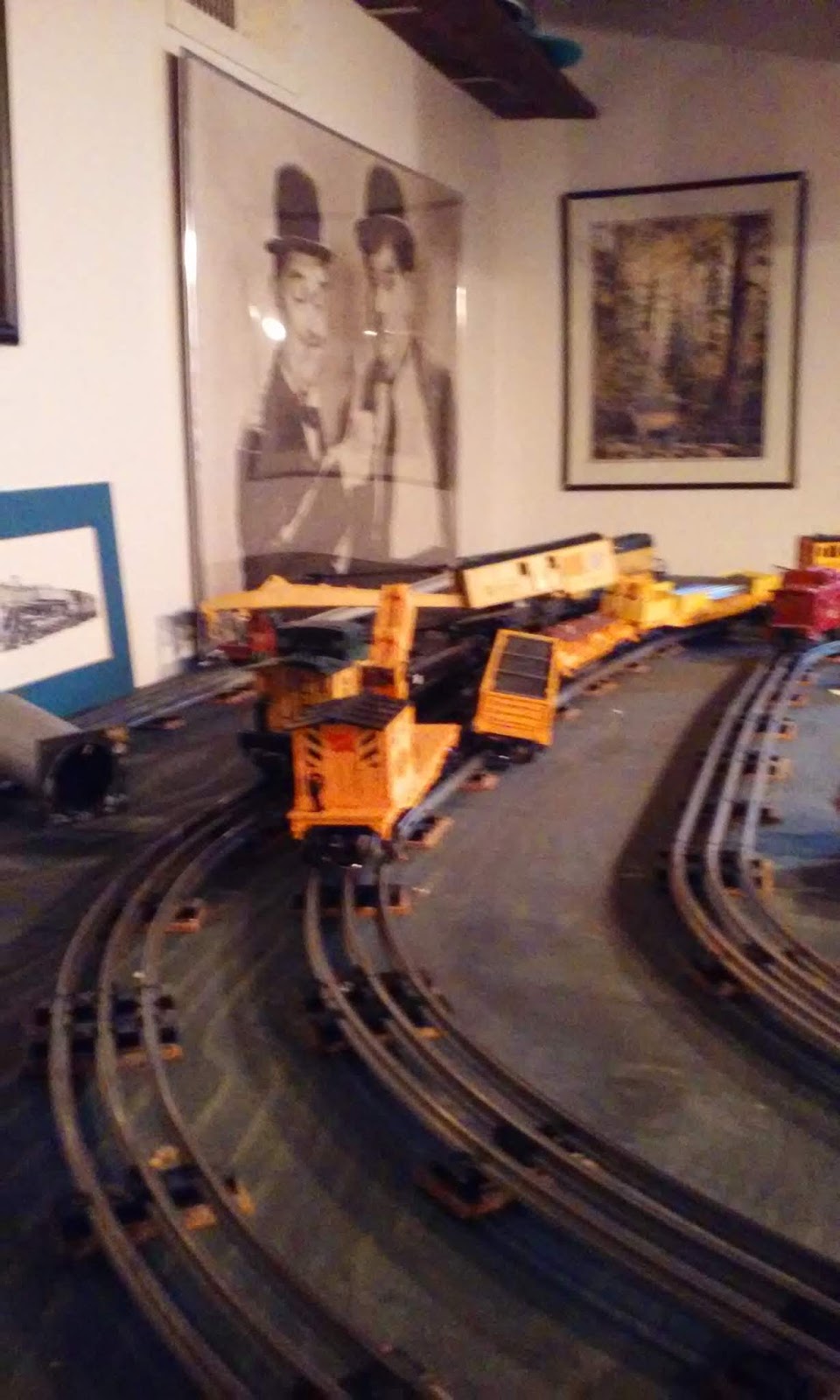
The CNW MOW train looks very sharp, and is truly O scale in proportions. However, this means that the crane boom, which extends 7.5 inches beyond the car's deck, sticks out quite a ways on corners. With the large hooks and equipment that hang from the boom, this would cause considerable damage to any trains operating on the next track. Originally, this train was scheduled to run on Track 2, but it would have obliterated the SFTA train which was planned to run on Track 3, so I swapped the two trains. My choice of equipment for Track 4 also made this an easy decision. Anyway, the CNW train runs at a slower pace, and I've turned the locomotive around to run backwards, which is prototypical. The cab (and thus, the engineer) is closer to the crane operation, and that provides better line-of-sight to maintenance work. I've observed various MRL work trains operating in a similar fashion, with REAL GP7s and GP9s, albeit with trimmed front hoods :) Lionel CNW GP7 #1518, MTH CNW crane #6359, and matching MTH crane tender #X250948.

And the trusty handcar makes its long way around Track 4. This handcar was built by Industrial Rail and is unnumbered.

As part of the changing of rosters, I entered or completed inventory records for all participating equipment. At this point, 72% of the fleet has been inventoried. Enjoy National Train Day this Saturday, and keep those rails shiny!

Postwar MOW train

SFTA MOW train

Long CNW crane boom

CNW MOW train

Handcar


Thursday, May 4, 2017

CNW Days

A merry welcome to May ~

In the past month, I've put away the Through-lines roster and set up the CNW roster. I also partially resolved an issue with locomotive sound problems on Track 4. A minor brake wheel repair was also performed on the CNW piggyback flatcar.

So, here's the new CNW roster!

On Track 1, we see the reliable CNW 0-8-0 switcher pulling a couple ATSF cars. The orders were to transport a boxcar full of dynamite to the Midnight Gold Mine at Juniper Peak. However, the engineer didn't want to make the trip with just his tender between him and a few tons of explosives, so he got permission to cut in the hopper car as a spacer! The locomotive was made by MTH and the rolling stock are K-Line productions. Occasionally, the tender coupler was opening when entering the 45 degree crossover track from the northeast, which sometimes resulted in a crash and derailment. This issue has been temporarily resolved with some electrical tape to keep the coupler closed, and no damage has been reported.

On Track 2, the CNW Doodlebugs are making another appearance. For the next month or so, the 'bugs will be running folks and supplies between Red Stone and Juniper Peak. The little unit train runs very smoothly, and I think the directional lighting is nifty.

On Track 3, the mighty and massive CNW Fairbanks Morse Train Master locomotive is hauling a mostly-coal train. Coal prices are up, and so is production at the Peacock Coal Mine deep in the Roosevelt Mountains. They needed a strong motive unit to pull this load through the foothills and into Silver Falls for distribution. From a prototypical viewpoint, the Train Master is the most powerful single-unit diesel locomotive in the current fleet, being slightly stronger than a single E8 unit. (As of this entry, I believe the prototypically strongest locomotive I have is the GG1.) With two motors, the actual model is pretty powerful too. Built in 1980 by Lionel, this loco has a nice growling sound when running, making a sound system unnecessary! This locomotive does have one prototypical flaw, in that the real CNW never operated a Train Master, but the paint scheme is sharp and it’s a fun loco to operate! Behind the engine are three hoppers filled with coal: an MTH GN, and MTH CNW, and a K-Line NP. After that is a Williams CNW covered hopper and another MTH CNW hopper, both empty for this trip. Then there's the 4-truck Yule Marble Co #6 flatcar, carrying a big chunk of marble to be used in a monument in Silver Falls. And, the train is completed by an MTH CNW woodside caboose. This might be the first time the caboose is being run separately from its original freight set. It's been slightly troublesome, in that its coupler kept opening on the northeast corner of the loop, but some electrical tape fixed that right up. No damage reported.

On Track 4, the Minneapolis and Black Hills Express (M&BHX) is being pulled by the CNW class E-4 Hudson. The M&BHX has been led by various locomotives in the past, but this is its first pairing with #4008. There are many happy vacationers on board, heading from the Twin Cities to visit Mount Rushmore, Custer, and the surrounding attractions. The steam engine was made by MTH and the 5 passenger cars (REA baggage, "Chicago" coach, "Minneapolis" coach, "Milwaukee" coach, and "Kansas City" observation) were made by Frank's Roundhouse.

As with the PRR GG1 in the Through-lines roster, the Hudson had sound system issues when running on Track 4. After more troubleshooting, I figured out that the problem was with the wired remote control assigned to the track coming from the MRC transformer. I swapped the remote with the Track 2 remote, and the sound issues went away. The Doodlebugs on Track 2 are not experiencing any sound issues, but their sound system is much less complicated compared to the Hudson.

Now on to the pics and video! Keep those rails shiny ~


CNW switcher #65 hauls some coal and dynamite on Track 1

The CNW Doodlebugs squeeze between the freight trains

The Train Master and the Kansas City

Colorful hoppers

The CNW covered Hudson waits while passengers board the M&BHX

The M&BHX

Thursday, March 2, 2017

Through-lines coming Through

Here's an update from the train room for March 2017. I'm very happy to report that my son, now 3 months old, really enjoys model trains. When he's upset, I run the trains for him, and he calms down every time. The combination of the train's motion and sounds have a lulling affect, and he's even fallen asleep a couple of times as the trains circle about in front of him.

Since my last post, I celebrated another birthday, and my parents and my parents-in-law all gifted me some nice railroad-related items. I received two nice posters of steam locomotive paintings, for the Northern Pacific and Great Northern railroads. I was also given several model railroad scenery supplies, including a bag of real coal. I also received an authentic chain for my railroad pocket watch. And, my wife gave me an evening with just the two of us, which meant a lot more to me than a thousand trains. Thank you to everybody for your generosity!

I've been running NP 0-6-0 for my son (well, for me too) and haven't had any problems until recently. I warmed it up one day, and there were no audible sounds from the speaker. This is the same issue I encountered last year, and took it to Caboose Hobbies in Denver to have it repaired. I've contacted The Caboose (new owner and location) to see if they have detailed records of what was specifically repaired last year, in hopes that I can duplicate it.

Over the past week, with help from my father and son, the train layout roster has been changed. We also performed a bit of inventory on the previous and new roster items. As of now, there are 97 items remaining to inventory. The theme of the roster is "through-lines", meaning that these trains are not run by local/regional railroads - they are "passing through". The locomotives in use are the only ones in the collection from their respective railroads. So, here's the new March-April 2017 roster for your review and entertainment:

On Track 1, the Blue Train makes its first-ever run this month. With the majority of its members hailing from the mostly-blue livery of Montana Rail Link, I developed this train simply because my bride likes the color. With last year's acquisition of the Union 76 tank car, this mixed freight now includes three scale-and-time-displaced cars with a locomotive and caboose. As more primarily-blue rolling stock is collected, they will be added to this special freight. This version of the Blue Train consists of the MRL SD9 (Lionel), a Needham Packing reefer (MTH), a Union 76 oil tank (K-Line), an MRL double-door boxcar (Lionel) and an MRL extended vision caboose (Lionel).

Track 2 hosts an all-dairy-related train. The Dairy Express is led by the MPC-era MKT NW2 (Lionel), a GN stock car (Petersen) a Borden milk tank car (Lionel), a Carnation reefer (K-Line), a Dairy Men reefer (Lionel) and an MKT extended vision caboose (Lionel). The NW2 is a single-motor unit and runs very well - it growls like a Postwar locomotive and was the first diesel model I had as a youngster.

On Track 3, reliable and mighty Mikado #4100 pulls mixed freight #408. A variety of goods and materials are in tow behind the Frisco 2-8-2 steam locomotive, built by Lionel in 1993. First, a CP log car (Lionel), followed by two recently acquired Lionel tankers with Philadelphia Quartz and Army liveries, a Midnight-Chief-inspired boxcar (#97191, K-Line), a Peacock reefer (K-Line), an Old Dutch reefer (K-Line), a GN hopper laden with coal (MTH), a CNW flatcar with semi trailer (called a "piggyback") (MTH), a late-80's MRR tank car (Lionel), an IC hopper (Williams) and a Frisco wood-sided caboose.

The ATSF boxcar has a brake-side coupler issue. It's opening at certain spots on the loop, but I haven't determined the cause yet. I thought the magnet was activating, but I've proved that isn't the issue. It only opens when it is coupled to another car, so weight and force, combined with certain sections of track are somehow causing it to malfunction. I'll keep troubleshooting, but for now I've placed the boxcar at the end of the train to prevent uncoupling problems.

Also, as I learned while holding my son, one should not shift the Frisco Mikado into forward from neutral at 25% power. I had gotten used to running the NP Switcher, which has a very gentle shift and can run smoothly at low speeds, but the 2-8-2 experienced extreme acceleration. The log car uncoupled from the tank car and both derailed. Of course, this happened at the inaccessible corner of the layout, so it took some ingenuity, while holding a baby, to pull the cars closer and re-rail them. No harm done, and everything is running again, but it was a small adventure to fix it.

And on Track 4, I've assembled the longest-yet version of the Northern Range heavyweight coach train. This time, its being pulled over Pennsylvania Railroad ROW, so the train is called the "Philly Phoenix" and is pulled by a big GG1 electric locomotive (Williams). The real-life prototype for this locomotive is nicknamed "Blackjack", and can be viewed at the Pennsylvania Railroad Museum. Behind my O-scale version of Blackjack is a troop car converted into an REA head-end car (Weaver), the Van Twiller combine (Lionel, first time on rails ever), the Willow River coach (Lionel), the Willow Valley coach (Lionel), the Willow Range coach (Lionel), the second Willow River coach (Lionel), the Highland Falls sleeper (Lionel), and the Granite Canyon coach (K-Line) takes up the rear.

The GG1 horn sputters frequently while pulling the Philly Phoenix. This can be prevented by holding down the Bell button on the controller. I think this is just a symptom of something fishy going on electronically with Track 4, as I’ve had problems with Whistle/Horn-Bell functionality in the past.

With my son around, the trains are all getting a lot more run time, which means more fun for everybody!

Have a blessed day, and keep those rails shiny!


Bday steam locomotive artwork

The Blue Train

Dairy Express

Frisco 2-8-2

"Chicaqo" piggyback

Santa Fe Blackbonnet paint scheme

Mike and Blackjack

Part of the Philly Phoenix