Showing posts with label Garden Railroad. Show all posts

Thursday, October 4, 2018

While I was out... and Cody too!

Hello again. The summer flew by, as always. So here’s a summary posting of the ferroequinological goodness I’ve been up to these past three months…
In June, we traveled to Illinois to visit family and trains. We visited the Illinois Railway Museum during their celebration of the Railroad Post Office (RPO). My son Wesley got to experience a real, running steam locomotive for the first time, as we were happy to see that SLSF decapod #1630 was operational that day. We also got to visit the J Neils Lumber Company shay #5 in steam shop, which was “close” to running as a refit continued (the shay should be fully operational for the 2019 season). Plus, we got to see dozens of other locomotives, rolling stock, and “railroad accessories” at the country’s largest train museum! Wesley also got his first ride on a streetcar (CTA “Red Rocket” #3142), and we got to enjoy the day with my Uncle Bill (another long-time ferroequinologist). When I was young, I was blessed to be able to go to IRM frequently, but it’s a bit harder when one lives 1200 miles away…
Speaking of Uncle Bill, we were able to stay with him and Aunt Dee in the Chicago area. And Wesley got the opportunity to see his great O Gauge layout. While visiting my wife’s relatives north of Chicago, we took a trip to the Chicago Botanical Gardens and viewed their substantial outdoor G Scale layout. I had never been there before and was delighted by the dozen trains they were running simultaneously through a landscape of American landmarks. We all had a great time experiencing the mesh of gardening and model railroading!
Back home, and after cleaning up the “wreck of the wreckers”, I switched the layout to an all-Lionel-Post-War-steam roster. The planned roster never actually ran, but here it is anyway:
Track 1: #2034 2-4-2 steam with LL searchlight, NYC gondola, LV hopper and a LL SP-style caboose
Track 2: #2037 2-6-4 steam with 6 6464-series boxcars and a LL bay window caboose
Track 3: #2035 2-6-4 steam with a set of silver O27 streamlined passenger cars
Track 4 #671 6-8-6 steam with remaining O27 Post-War freight cars and a work caboose
Right off the bat, there were a few setbacks. #2037, while a reliable runner, doesn’t have the strength to pull itself and 7 freight cars. Also, #2035 wouldn’t advance more than a couple wheel revolutions. It would reverse for a few inches, but after a bit of cleaning and troubleshooting I couldn’t get it running, so I took it out of service. Then, some tests of the turbine (#671) proved that it was in a rather cantankerous mood. First, the whistle mechanism got stuck in the “on” position. Then, it started giving me intermittent electrical problems, causing trains on other tracks to malfunction, due to their connection through the transformer. And finally, the thing looks and sounds like a fireworks display when operating, with its thunderous grinding sounds and constant under-chassis sparking. So 671 was put out of service too.
The eventual roster that actually went into service, keeping to the “spirit” of all-steam Post-War running, was:
Track 1: #2034 2-4-2 steam with LL searchlight, NYC gondola, LV hopper and a LL SP-style caboose
Track 2: #2037 2-6-4 steam with 3 6464-series boxcars and a LL bay window caboose
Track 3: modern Lionel Illinois Central 2-6-4 steam with a variety of O27 Post-War rolling stock and a work caboose
Track 4 Union Pacific #2023 FA diesel and the other 3 6464-series boxcars and a LL SP-style caboose
This roster ran well for a few months, and then I encountered more steam trouble. Both #2034 and the IC steamer went offline. Diesel 2023 moved to Track 1 and the MTH NP 0-6-0 steamer took over Track 4 (note that the NP still does not output any sounds).
Back in the real world, I got a picture of a freight train at sunset in Big Timber, MT, with the Crazy Mountains in the background.
And, since it’s been so long since the last update, I’ve changed the roster a second time! The current roster, through the end of October 2018, is “Passenger trains”:
Track 1: Trolley
Track 2: CSS Interurbans
Track 3: RI E7A and partial Rocky Mountain Rocket
Track 4 CBQ E8AA and the Bozeman Zephyr
This setup is far less problematic than the previous one. The major issue is that running 18” cars (and really long locomotives) on Track 3 is always a poor idea, as they end up bumping into trains on both Track 2 and Track 4. So, the short Rocky Mountain Rocket only got to run when Track 2 and Track 4 trains were parked in safe places.
Oh yes, we had another baby too. He decided to come a little early. At home. With just my wife and I in attendance. So guess who got to deliver Cody? The ferroequinologist, that’s who. Everybody is healthy and the 4 of us are adjusting to each other, and Cody enjoys watching the trains run J Special addition!
We've kept our tradition of giving our boys middle names that are also steam locomotive classes. Wesley Hudson, and now Cody Selkirk. Selkirk is a Canadian 2-10-4. Why Canadian? Well, my bride and I were married in Canada, and Cody happened to arrive on our anniversary! Plus, "Cody" means "helper", and thus his name can be translated "helper locomotive".

Take care and keep those rails shiny til next time!


Wesley and the 1630

Happy day at IRM

Wesley and Uncle Bill detrain the Red Rocket

Two Hudsons: CBQ 3007 and Wesley

Wesley and Shay #5, both asleep

Wesley and I marvel at Uncle Bill's train layout

At the botanical gardens, a Santa Fe loco meanders between Old Faithful and Old Faithful Inn

The botanical garden layout is impressive; I could easily spend a few hours there!

Back in MT, we have the Post-War consists


Big Timber sunset on Sept 7th, 2018

Night time passenger trains


Myself and my boy, Cody Selkirk

Wesley, Cody and I watching trains downstairs

Cody and his boxcar

So blessed to have these two unique cars in my collection


Thursday, October 29, 2015

Roundhouse, CRM, and Cross Bucks

Welcome to the end of October, readers! As I advised earlier, I'll be providing some railroad-related details from our trip to Denver ~

After having lunch in Cheyenne we stopped by the historic Union Pacific Depot. Well, actually we went to the not-so-historic parking lot of the Depot. Amber checked on my surgery recovery progress, and I was able to stand and look at the Union Pacific roundhouse. There were no parked trains obstructing the view, so we were there at an opportune time. The roundhouse is only open to visitors once a year during Depot Days in May of each year. But, as a ferroequinologist, it was fun just to be on site. For those of you that don't know the significance of this, the UP roundhouse in Cheyenne is home to the railroad's operational historic locomotives. Here, the engines receive restoration, maintenance, and protection from the elements. The steam locomotives that reside here are Northern #844, Challenger #3985 and newcomer Big Boy #4014. There are also vintage diesel locomotives and passenger cars that get stored/serviced here. While crossing over the train yard bridge, I spotted an E or F unit still bearing the CNW livery. I hope to visit the inside of the roundhouse during Depot Days someday!

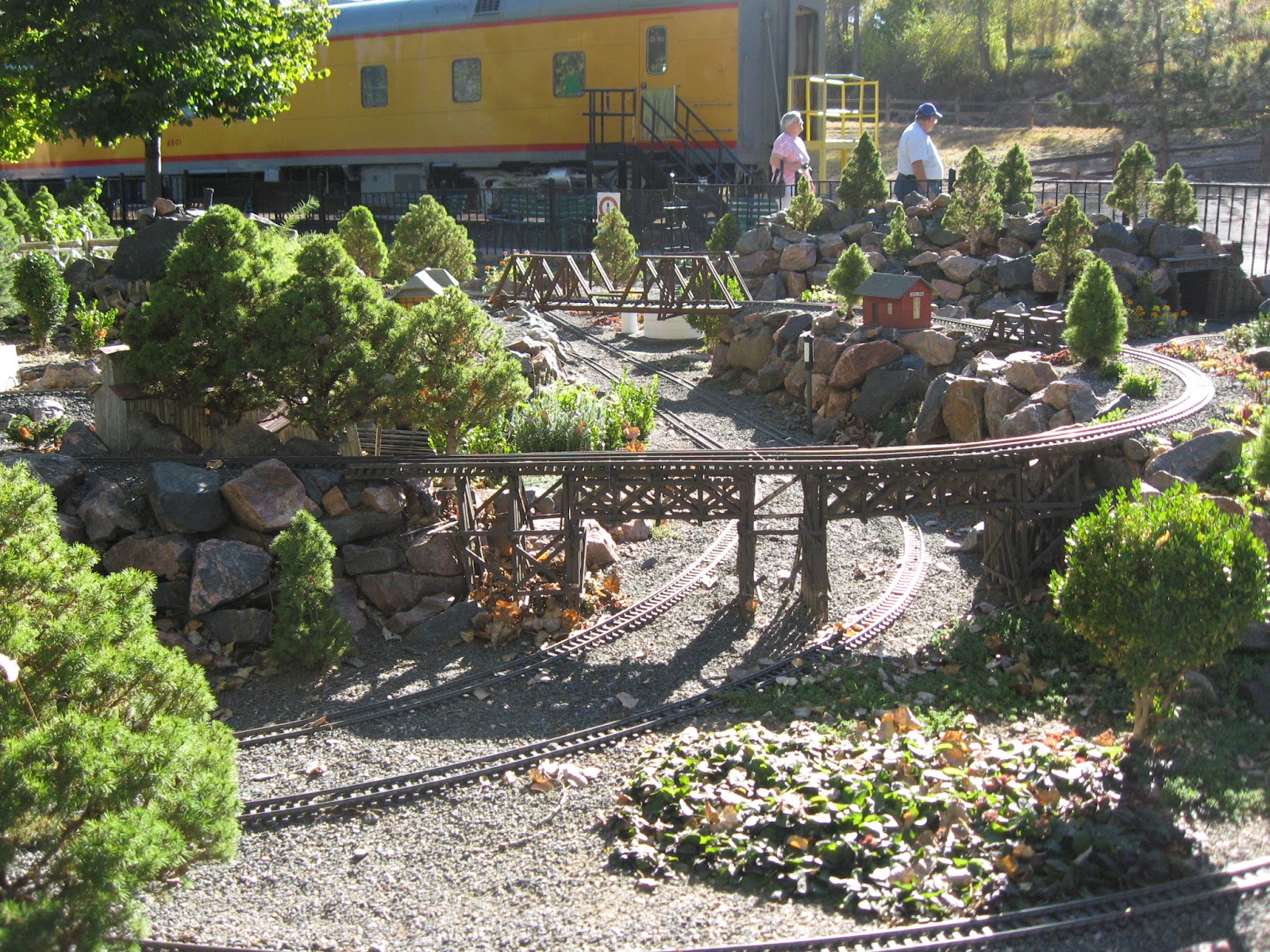
On a Tuesday afternoon, we visited the Colorado Railroad Museum in Golden. Staff were busy decorating the campus for the Polar Express events, which will take place over the next few months. Our reason for visiting, however, was the garden railroad display. We spent an hour with Alan Olson, the chairman of the Denver Garden Railroad Society, who graciously provided information, ideas, and answers about starting a garden railroad from scratch. We discussed track, plants, grades, buildings, rolling stock, electronics, weather, wildlife, track plans and more. We will continue to use Alan as a resource as we get closer to construction of the garden railroad in our backyard in Billings. Some useful ideas from Alan included: a kidney-bean shaped track plan with scenery obstructions to provide interest, battery-powered locomotives, the use of thyme as ground-cover, using drip-irrigation, running trains in the snow, tracks at waist height, and track structure that can support a human's weight. We stayed with Alan until the museum closed, and picked up a copy of Garden Railways Magazine on the way out.

Back in Billings, I was able to paint the lettering on my Do-It-Yourself cross bucks for display in the backyard!


Until next week, keep those rails shiny!

Myself and the Cheyenne roundhouse

View of Cheyenne's historic depot

Bridges and water feature on the CRM garden railroad

Elevated section of the garden railroad

Photo showcasing track, structures, rocks, plants, and seating along the garden railroad

Multilevel features on the garden railroad

Alan draws some sample track plans while I look on

Time for Christmas! Usually visitors see the words "Colorado Railroad Museum - Delay Junction" on this building.

This dead tree is a great spot for giant Christmas ornaments at the museum

DIY cross bucks in process

Thursday, October 22, 2015

Rails in Excel

Hello Readers ~ sorry for missing a post last week, I was out on vacation!

My wife and I visited the Denver area for a week, and I have a lot of fun train adventures to share with you. Today I’ll provide an overview, and over the next few weeks I’ll get into some details. We visited the Union Pacific Depot and Roundhouse in Cheyenne on October 10th. On the 13th, we visited with Alan Olson at the Colorado Railroad Museum and discussed garden railroading. On the 14th, I took the Denver Light Rail train downtown to do some shopping at Caboose Hobbies. On October 15th, I camped out on a foothill near Golden to do some trainspotting, and also viewed the rail operations at the Coors Brewery. I also went to a store in Lakewood that specializes in consigned railroad and model railroad items. And, on October 17th, I spent several hours at the Colorado Model Railroad Museum in Greeley.

Since returning, I’ve done a bit of “digital organizing” – I have a spreadsheet that I use to keep track of train projects and plans, and it needed some work to make it more useful. The spreadsheet contains the following tabs of information:
·         Map1: Two maps of the proposed 32’x20’ O Scale layout. The first shows track and building locations, and is divided into 29 sections. Each section refers to a specific area of the layout for easy reference, like “Silver Falls-Downtown” or “Silver Falls-Yard”. The second shows color-coded tracks and streets, town/place names, and geographic features like lakes, rivers, and forests. It also shows where each major railroad on the layout is based. For example, the town of Cedar Valley is primarily served by the Great Northern, while the town of Red Stone is served by the Rock Island and Santa Fe, with occasional service from the Frisco and Katy. There is also a key showing 108 proposed buildings/structures. Both maps use close-to-scale measurements for track and structures. I plan to add a topographical map as well.
·         Silver Falls Upper: A map showing detail of downtown Silver Falls, which will be elevated. The 23 proposed buildings are shown with close-to-scale measurements. This detail information would not have shown up well on the larger maps on the previous tab.
·         Area Attrib: A list of any detail or idea to include in the layout of the future. There are 365 items so far, and this is a good spot to list ideas. Example 1: For the church in Silver Falls, look at American Model Builders kit #152-491, which is a 7x4x6” brick building and currently costs about $32. Paint it cream with brown trim. Example 2: Remember to install tell-tales in front of all bridges and tunnels throughout the layout.
·         Wish Locos&Sets: A list of locomotives and passenger sets I’d like to eventually own. Some of the items on the list haven’t been produced yet. For example, I’d like to buy the Santa Fe “Midnight Chief” F3 ABA diesel set from K-Line to go with my existing passenger set. The model number is K-25303, and currently sells for about $445 on eBay or Trainz. A goal date to purchase this set is in 2019. This sheet also contains a cross reference of scale sizes and how an actual inch compares to model feet in each scale.
·         Wish Rolling Stock: Similar to the previous tab, this is a list of freight cars or individual passenger cars I’d like to add to the fleet. It also includes a list of 185 applicable Atlas O Reefers for reference.
·         Engine House: This is a new tab I added this week to track repair work. It shows the current status, report date, begin date, fix date, item details, and problem description for each issue that occurs on the train set. Going forward, I will use this to track all the work that is performed. For example, on 10/21/2015, I reported that the Denver Rocket passenger set has very squeaky wheels, and is in need of something to quiet it down.
·         ILLINOIS: contains a list of items we brought back from Illinois this year. This is mostly for reference, and once the master inventory is complete, this tab can be removed.
·         Train Names: A list of every motive unit and its current status. It also shows when the unit was last run on the train set. A separate list on this tab shows every train by name or purpose and the last time it was run. I also use these lists to schedule the next roster line up, so I end up with a good rotation through the locomotives and trains. For example, the Great Northern 2-8-2 mike was last run in April, 2015 and is in operational status. Or, the Broadway Limited last ran in May, 2014, and was pulled by the Pennsy GG1.
·         Train Log: A list of train-related activities done each day. For example, on 5/18/2014, I successfully tested the lighting on the Granite Canyon Pullman car, but encountered other issues (see previous blog for details on that one!)
·         Inventory: This will contain the master inventory of all train-related items in my collection. It will show a Record Update Date, What the item is (a model train, an artifact, or an “other”), the Manufacturer, Type of Item, Sub Type of Item, Description, Scale, Roadname, Road Number, Item Number, Year Manufactured, Condition, if the Box is present, the Box Condition, personally assessed Value, and Notes.
·         Abbreviations: This is another tab I added this week. If someone who isn’t me uses this spreadsheet, this tab will provide a key to the various railroad (or other) abbreviations I use. For railroads, it also lists sample color schemes used. For example, “GN” refers to Great Northern, and the color schemes used on the layout (circa 1955) are orange/dark green/yellow. Or, “EB” refers to East Bound.
·         Summary: This sheet is here to remind me how each railroad is represented on each layout. It is a basic summary of the future O-Scale, O27-Scale, and G-Scale layouts. It includes equipment that hasn’t been purchased yet. For example, “ATSF is a through-line, with one F3 diesel set and a matching passenger set.”
·         Details: I use this sheet to list prototypical pairings of locomotives and passenger sets. It shows which town hosts each locomotive and train, and in some cases, lists the proposed date of purchase in the future.
·         Garden: This includes very early sketches of a garden railroad plan, with measurements provided based on track loop diameter.
·         Garden Details: This is similar to the Area Attrib sheet, but shows G-Scale details instead. For example, “include a cabin on a mountain”.

So, stay tuned for details on my railroad adventures in Denver over the next few weeks, and also regular updates on model train activities here in Billings. Until then, enjoy these pics, and keep those rails shiny ~


UP roundhouse in Cheyenne, home to Big Boy 4014

The DGRS railroad at CRM

Southbound RTD light rail train in Denver

The famous Caboose Hobbies

A UP freight works its way up the S curve

Lots of tracks throughout the Coors facility

A little peek of the phenomenal HO layout at CMRM

A big collection of Pullman towels at CMRM

Thursday, September 3, 2015

First Spike: The Sasaparilla, Cedar Sap and Pacific Railroad

Hello, we made it to September ~

In late August, we did a bit of ferroequinological archaeology along the former Northern Pacific's Park Line, which ran from Livingston, MT to Gardiner, MT. Specifically, we explored the Point of Rocks area, which is now a boat launch site along the Yellowstone River. The Park Line roadbed was carved into the rocks along the River, and there we acquired a specimen (a rock) from the carved area. The NP ran passenger service over this line from 1883 to 1948.

In other news, I set up a publicity photo shoot to celebrate the beginning of the Sasaparilla, Cedar Sap and Pacific Garden Railroad in our backyard. In the photos below you'll see the entirety of the garden-scale railroad's current assets, along with railroad model Amber.

Have a great Labor Day, and keep those rails shiny ~

Here I am "standing in the gap" of the Point of Rocks along the Yellowstone River, where the NP tracks used to be

Here's the railroad rock we acquired to add to our landscaping projects

Railroad model Amber and the SCS&P

Colorado & Southern reefer car, track (provided by Uncle Bill), and water tower planter (provided by my folks)