Tuesday, December 18, 2018

For sale: Rolling Stock & Real Estate!

Howdy folks, I'm helping a friend sell some of his childhood model trains and building kits. This post is mostly to provide more info on these items, as we're selling them elsewhere, but if any of you are interested, please let me know :)

Here we have 15 Plasticville building kits from the mid-1950's. The original owner acquired them as a boy and has now decided to sell them. They have been meticulously cared for! No yellowing or damage. They all have their original boxes - some of the boxes haven't aged as well, but they look remarkable for 60+ year old cardboard! These buildings are roughly 1/4 scale (1 inch on the model = 4 feet on the real thing). They work great with O scale or S scale model trains, or on their own as stand-alone town display. If you've been looking for a unique gift for that hard-to-shop-for person, then here it is, in all its nifty, nostalgic brilliance!

I've personally examined each piece of each kit, and compared it with the data available at https://www.plasticvillefornewbies.com. The discounted price we're asking comes from an average of sold eBay auctions for the same kits (minus shipping of course).

There's also an unopened bag of Color-Rite "earth" to add some dirt-like realism to your town display! It is also from the mid-1950's.


15 vintage Plasticville kits and a bag of EARTH

103 box

103 kit

1302 box

1302 kit


1617 box

1617 kit

BN-1 box

BN-1 kit

CC-9 box

CC-9 kit

"Earth"

FB-1 box

FB-1 kit

GO-3 box

GO-3 kit

HP-9 box

HP-9 kit

HS-6 box

HS-6 kit

LC-2 box

LC-2 kit

MH-2 box

MH-2 kit

PO-1 box

PO-1 kit

RS-8 box

RS-8 kit

SG-3 box

SG-3 kit

SW-2 box

SW-2 kit


Here's a 1952/1953 Lionel Train set #1467w. It includes black/yellow Erie Alco PA AA diesels #2032 (powered and dummy), a black Lehigh Valley hopper car #6456 (with partial original box), a silver Sunoco tank car #6465 (with original box), a yellow Lionel Lines stock car #6656 (with partial original box), and a dark red Lionel Lines caboose #6357. It also includes the original #1033 90-watt transformer, 8 pieces of straight track, and 8 pieces of curved track. The powered locomotive has been tested, and it runs well. The e-unit shifts great, the light works, and the horn works too (when D-battery is installed). The rear coupler of the locomotive needs to be replaced. The required parts are #2023-26 and #622-57, available from JustTrains.com for a total of $7.40 + shipping. The dummy locomotive light works. The freight cars are all in "very good" condition. The caboose just needs a new light bulb (also available at JustTrains.com). The transformer needs a new black handle, but will still function without it in the meantime. That part is #RW-24, and sells for $2 to $7 online.


Lionel #1467 boxes & track (front)

Lionel #1467 boxes & track (rear)

Lionel #1467 locos and rolling stock (front) (transformer too)

Lionel #1467 locos and rolling stock (front)

Lionel #2032 powered unit, detail on coupler that needs replacing

Thursday, November 1, 2018

On Schedule


Against the odds (and there has been plenty of odd in my life lately), I got the new roster running on time. My self-imposed schedule is to have a different roster set up by the last day of each even-numbered month, and last night I got everything rolling successfully.
So, what’s on display this time? Freight Trains
Track 1 is a salute to the Illinois Central, with all IC equipment: the black GP9 (Williams), a boxcar painted in the passenger train livery (MTH), a black hopper hauling southern IL coal (Williams), and a handsomely-detailed red, wood-sided caboose (K-Line). The locomotive is a very dependable, smooth runner, and the rolling stock handles the crossover track with ease.
Track 2 is all the logs, all the time! CNW 0-8-0 steam locomotive #65 (MTH) is pulling and pushing all of the log cars in the fleet. At the front are two CP log cars (Lionel) followed by the switcher loco. After that are two NP log cars (Lionel), followed by 3 skeleton cars carrying extra-large hunks of trees (Lionel). All of the logs at once, along with the mid-train steam engine, make this a neat train to watch. Only issue I’m having with this one is a noisy smoke generator on the loco.
Track 3 brings back the CB&Q GP7 (Lionel) and a unique freight consist. Behind the engine is a D&RGW reefer (MTH) in the striking orange/silver paint scheme. Then there’s the nifty ATSF autorack car (MTH) carrying four 1952 Cadallacs. Following this is an ATSF boxcar decorated in one of the best non-prototypical paint jobs around: the black/red of the “Midnight Chief”/”Black Bonnet” train, first advertised by Lionel in the Postwar era but actually engineered by K-Line in the modern era. Next up is a bright red Swift reefer (Lionel), with tasty meats inside. A yellow Pure Oil tank car (K-Line) comes next, and then the Yule Marble depressed center flat car (Lionel) with its load of a (real) chunk of marble. Topping everything off is a steel-sided, offset cupola CB&Q caboose (K-Line) with a red flashing light above the rear deck. This train had an issue to resolve: the rear coupler on the ATSF boxcar would open frequently, and without warning. Inspection did not reveal the cause – apparently this car’s particular type of magnetic uncoupling system is susceptible to false opening signals when running on Track 3. I tried good ole’ Scotch tape, and this failed spectacularly 3 times, so I got some metal wire and fastened the ATSF boxcar to the Swift reefer manually. So far, it is proving to be a sufficient (albeit annoying) solution. I haven’t noted any permanent damage caused by the uncoupling, and subsequent unplanned head-end to trailing-end meets, but I’ll note that the autorack car does NOT like sudden bumps or stops! Thankfully there are bumpers in place to prevent the Caddies from going too far! The other note for this train is the engine: the motor is loud and emits a high-pitched sound sometimes, even after lubricating it. Maybe this is intentional, to more closely mimic its Postwar ancestor, since this is a PWC loco…
Track 4 marks the return of GN 2-8-2 (Williams) after two years in storage. After the repairs made in 2016, it actually pulls rather well, although the loco’s operation can best be described as “goofy”. First off, for a premium brass scale steam locomotive, you’d think they could have found a smaller headlight bulb. The bulb and casing are uncharacteristically huge compared to the rest of the engine, making it seem like a well dressed, well proportioned, refined fellow with a giant honking nose! BUT, the headlight works flawlessly, and the loco looks great from most angles. The unit still suffers from sound problems, which I’ve mostly gotten used to. Neutral sounds are fine, but the moment it starts moving it sounds like it is already out of breath. Instead of “CHUFF - chuff – chuff – chuff, CHUFF - chuff – chuff – chuff” it emits “CHUFFCHUFFCHUFFCHUFF, CHUFFCHUFFCHUFFCHUFF”. Additionally, the whistle most commonly becomes stuck when activating, necessitating a return to neutral to silence it. Occasionally the whistle will function properly, but then again, sometimes it activates randomly, or more disturbingly, it activates when I blow the whistle for the switcher on Track 2! ANYway, despite this, the locomotive performs quite well, originally pulling the Bozeman Zephyr around the layout before I had the freight consist prepared. Following the Mikado, in place of the originally scheduled express mail car, is a black MRR tanker (K-Line), which I figure is carrying extra water for the steamer. Next are three hoppers: yellow/green covered CNW (Williams), black NP with coal load (MTH), and green CNW empty (MTH). These are followed by more CNW rolling stock: a green tank (MTH) and yellow/green stock car (MTH). Towards the rear of the train is an NP flat car with two truck trailers riding piggyback (Lionel). Between the flat and the caboose, I placed the aforementioned GN express mail car (Weaver). Initial tests with this car made me worry that its thin plastic frame, coupled with the peculiar way it sits on its trucks, would prove to be an unreliable candidate to transfer the majority of the locomotive’s drawbar force to the rest of the train. Normally, express mail cars show up at the very front of a train (or the very rear, to make them easier/faster to switch out). And normally, they show up on passenger trains. As I’m currently without a GN passenger consist, this mail car will have to take what it can get! It will look great heading a streamlined Empire Builder, but it will likely require some re-engineering to actually stand up to the physical stresses of such an assignment! At the end of the train is red GN caboose X54 (MTH), which looks very sharp. Actually, all 3 cabeese in this roster are very prime models. For the past few weeks, I had the CNW switcher pulling just the skeleton log cars and a yellow/green, steel, center-cupola caboose (MTH). This is another great caboose, but it isn’t on the official roster, so it’s off to storage for now… but is scheduled to return with a LOT of cabooses in February 2019!
Hope you enjoy the pics below. I’ve started posting videos of each roster, or other train-related goodness to my YouTube channel: https://www.youtube.com/channel/UC00Sk1pE7ZSZSRYyVRXS7Ig?view_as=subscriber


Thursday, October 4, 2018

While I was out... and Cody too!

Hello again. The summer flew by, as always. So here’s a summary posting of the ferroequinological goodness I’ve been up to these past three months…
In June, we traveled to Illinois to visit family and trains. We visited the Illinois Railway Museum during their celebration of the Railroad Post Office (RPO). My son Wesley got to experience a real, running steam locomotive for the first time, as we were happy to see that SLSF decapod #1630 was operational that day. We also got to visit the J Neils Lumber Company shay #5 in steam shop, which was “close” to running as a refit continued (the shay should be fully operational for the 2019 season). Plus, we got to see dozens of other locomotives, rolling stock, and “railroad accessories” at the country’s largest train museum! Wesley also got his first ride on a streetcar (CTA “Red Rocket” #3142), and we got to enjoy the day with my Uncle Bill (another long-time ferroequinologist). When I was young, I was blessed to be able to go to IRM frequently, but it’s a bit harder when one lives 1200 miles away…
Speaking of Uncle Bill, we were able to stay with him and Aunt Dee in the Chicago area. And Wesley got the opportunity to see his great O Gauge layout. While visiting my wife’s relatives north of Chicago, we took a trip to the Chicago Botanical Gardens and viewed their substantial outdoor G Scale layout. I had never been there before and was delighted by the dozen trains they were running simultaneously through a landscape of American landmarks. We all had a great time experiencing the mesh of gardening and model railroading!
Back home, and after cleaning up the “wreck of the wreckers”, I switched the layout to an all-Lionel-Post-War-steam roster. The planned roster never actually ran, but here it is anyway:
Track 1: #2034 2-4-2 steam with LL searchlight, NYC gondola, LV hopper and a LL SP-style caboose
Track 2: #2037 2-6-4 steam with 6 6464-series boxcars and a LL bay window caboose
Track 3: #2035 2-6-4 steam with a set of silver O27 streamlined passenger cars
Track 4 #671 6-8-6 steam with remaining O27 Post-War freight cars and a work caboose
Right off the bat, there were a few setbacks. #2037, while a reliable runner, doesn’t have the strength to pull itself and 7 freight cars. Also, #2035 wouldn’t advance more than a couple wheel revolutions. It would reverse for a few inches, but after a bit of cleaning and troubleshooting I couldn’t get it running, so I took it out of service. Then, some tests of the turbine (#671) proved that it was in a rather cantankerous mood. First, the whistle mechanism got stuck in the “on” position. Then, it started giving me intermittent electrical problems, causing trains on other tracks to malfunction, due to their connection through the transformer. And finally, the thing looks and sounds like a fireworks display when operating, with its thunderous grinding sounds and constant under-chassis sparking. So 671 was put out of service too.
The eventual roster that actually went into service, keeping to the “spirit” of all-steam Post-War running, was:
Track 1: #2034 2-4-2 steam with LL searchlight, NYC gondola, LV hopper and a LL SP-style caboose
Track 2: #2037 2-6-4 steam with 3 6464-series boxcars and a LL bay window caboose
Track 3: modern Lionel Illinois Central 2-6-4 steam with a variety of O27 Post-War rolling stock and a work caboose
Track 4 Union Pacific #2023 FA diesel and the other 3 6464-series boxcars and a LL SP-style caboose
This roster ran well for a few months, and then I encountered more steam trouble. Both #2034 and the IC steamer went offline. Diesel 2023 moved to Track 1 and the MTH NP 0-6-0 steamer took over Track 4 (note that the NP still does not output any sounds).
Back in the real world, I got a picture of a freight train at sunset in Big Timber, MT, with the Crazy Mountains in the background.
And, since it’s been so long since the last update, I’ve changed the roster a second time! The current roster, through the end of October 2018, is “Passenger trains”:
Track 1: Trolley
Track 2: CSS Interurbans
Track 3: RI E7A and partial Rocky Mountain Rocket
Track 4 CBQ E8AA and the Bozeman Zephyr
This setup is far less problematic than the previous one. The major issue is that running 18” cars (and really long locomotives) on Track 3 is always a poor idea, as they end up bumping into trains on both Track 2 and Track 4. So, the short Rocky Mountain Rocket only got to run when Track 2 and Track 4 trains were parked in safe places.
Oh yes, we had another baby too. He decided to come a little early. At home. With just my wife and I in attendance. So guess who got to deliver Cody? The ferroequinologist, that’s who. Everybody is healthy and the 4 of us are adjusting to each other, and Cody enjoys watching the trains run J Special addition!
We've kept our tradition of giving our boys middle names that are also steam locomotive classes. Wesley Hudson, and now Cody Selkirk. Selkirk is a Canadian 2-10-4. Why Canadian? Well, my bride and I were married in Canada, and Cody happened to arrive on our anniversary! Plus, "Cody" means "helper", and thus his name can be translated "helper locomotive".

Take care and keep those rails shiny til next time!


Wesley and the 1630

Happy day at IRM

Wesley and Uncle Bill detrain the Red Rocket

Two Hudsons: CBQ 3007 and Wesley

Wesley and Shay #5, both asleep

Wesley and I marvel at Uncle Bill's train layout

At the botanical gardens, a Santa Fe loco meanders between Old Faithful and Old Faithful Inn

The botanical garden layout is impressive; I could easily spend a few hours there!

Back in MT, we have the Post-War consists


Big Timber sunset on Sept 7th, 2018

Night time passenger trains


Myself and my boy, Cody Selkirk

Wesley, Cody and I watching trains downstairs

Cody and his boxcar

So blessed to have these two unique cars in my collection


Thursday, June 7, 2018

The Wreck of the Wreckers


Now, I can say that ole’ Mark ran a safe railroad, and he’d actually be the first to say it, modest as he is, but he would have been right until that first week of June. Sure, a derailment here and there when testing rolling stock, or when dealing with that pesky crossover at Granite Junction, but all-in-all his trains stayed on the track. But that all changed last Tuesday night.

We all knew it was a month for them maintenance trains. (I think ole’ Mark was showcasing them, for what reason, who could guess?). But all them cranes and searchlights and whatnot were taking precedence over our revenue makers, and I for one was tired of taking the siding so often. The week before, ole’ Mark was showing off that fancy CNW boom, but he noted that the cab would swivel a bit too eagerly, and told the hogger on that Geep to keep it slow on the curves. Well, telling Macky Fergurson not to go fast is like telling a fish not to swim.

So that brings us to Tuesday. Macky was taking the CNW MOW around the yard on Track 3, the construction crew train was stopped on Track 2 awaiting orders, and Sven and Rudy were incessantly piloting that handcar on Track 4. Ole’ Mark was in the tower, but busy working on some 100-year old documents. The stage was set.

Macky broke into the southeast curve and that boom shifted outward. First it knocked over the fuel tank at the substation, causing it to be dragged and then land right on Track 4. Then the back of the crane cab hit the rear of the construction train, ramming the caboose and plowing that tie car off the track. The impact forced the crane off the track and into a downward angle. Then along came those ninnies in their handcar, and managed to get stuck on the crane’s hook.

So we called in a wrecker crew to right the wreckers. The Geep and construction trains were righted and chuffed out to the engine house on their own power. Sadly, Sven and Rudy’s beloved handcar may have had its last pump. The 671, anxious for its own turn to shine on Track 4 next month, was called in to push the handcar back to the engine house, and that may have been Handcar #1’s last trip on the silver streets. But ole’ Mark isn’t one to give up easily – having a place for us to pilot these steamers, tin cans and dingers is proof of that.

Keep those rails shiny for good ole’ Sven and Rudy


The 6-6 disaster from the south

The two-crane wreck, seen from Granite Junction

The comparatively gigantic, 70-year old steam turbine preps to push the handcar (perhaps) on its last voyage

Addendum: The above-described wreck was NOT intentional, it was a real accident, and one that warranted its own posting, because the results were spectacular, and I could not have "engineered" such a set up myself. I never ever condone crashing model trains intentionally. (Or full-size trains, for that matter.) The two MOW trains survived unblemished, but the handcar has major electrical and/or mechanical problems to resolve.

Thursday, May 10, 2018

Maintenance of May


After over a year I was able, a little at a time, to switch out the roster, with my 17mo toddler's help/"help". He is still enamored with all things trains.

Here are some notes on the Maintenance of Way (MOW) roster: This is the first time I've put together a MOW theme.

The Postwar MOW train on Track 1 is extremely reliable, except for occasional derailment of the last two cars at the 45-degree crossover. I haven't recognized anything specific that needs to change to prevent this situation. The UP locomotive continues to be one of the best runners in the fleet, at 68 years young. The searchlight car, with repairs made previously, functions correctly and dramatically (especially in the dark). The locomotive and cars were all manufactured by Lionel in the 1940’s – 1950’s. Union Pacific FA A unit #2023, Lionel Lines searchlight car #3620, New York Central gondola #6462, Leigh Valley hopper #6456, and Southern Pacific caboose #6357.

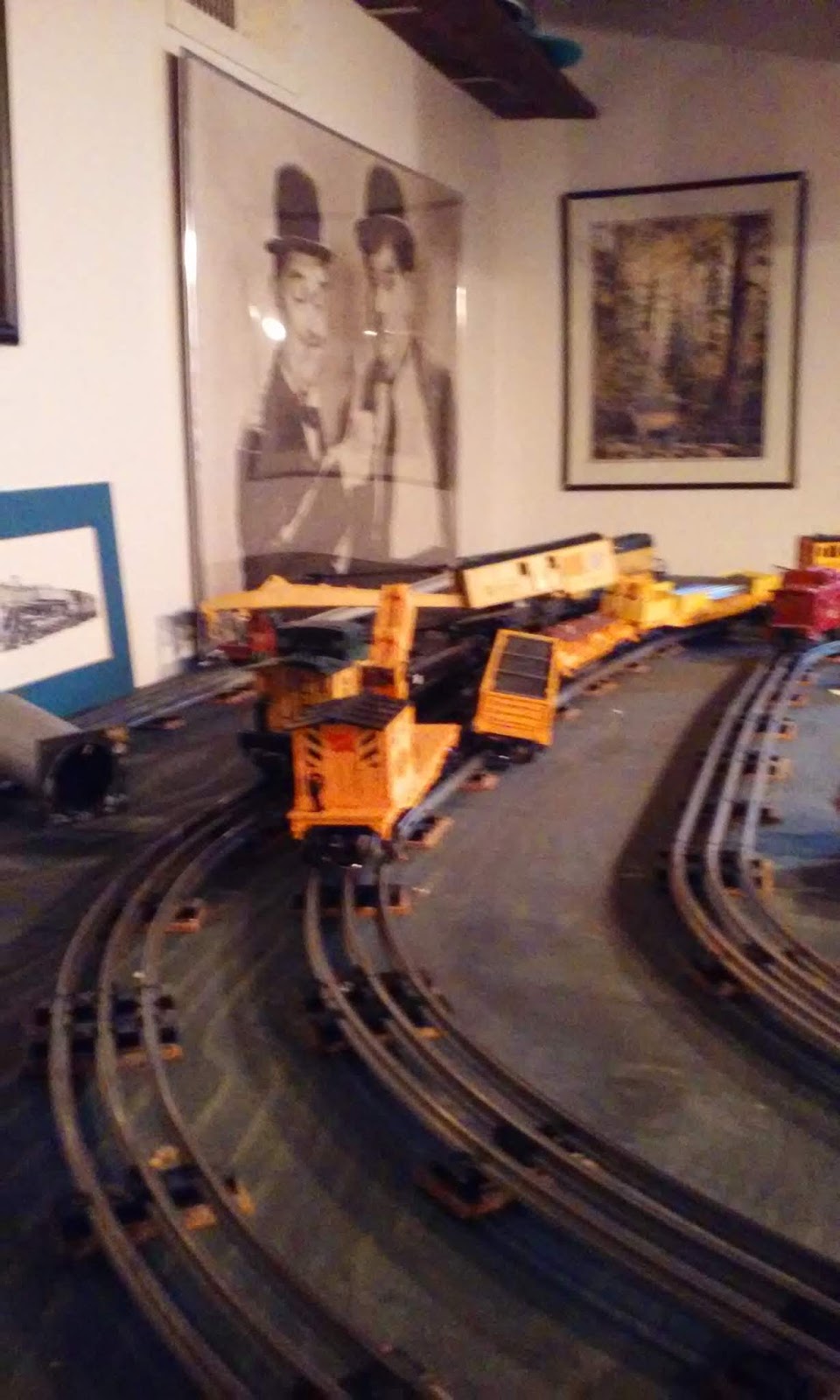
The SFTA MOW train, which had to be moved from Track 3 to Track 2 to accommodate the scale CNW crane's boom length (see below), is right at home on this O-31 track. Being an entry-level K-Line set, the NW2 locomotive has a couple challenges - 1) While scale in proportions, it's decks are oversized and will impact trains on Track 3 while traversing curves, and 2) it doesn't have a "slow" speed - it goes from still to fast with nothing in between, and it will go even faster still. I can work with this, but it does mean I shouldn't run trains on Track 3 while this one is running on Track 2, and I shouldn't run it if I'm trying to calm myself or anybody down! “SFTA” is an abbreviation for Silver Falls Transit Authority, which in this case is leasing equipment from the Trackside Construction Company. NW2 #104, unnumbered rail transport car, unnumbered I-beam transport car, gondola carrying railroad ties #5630, and unnumbered crane car/caboose.

The CNW MOW train looks very sharp, and is truly O scale in proportions. However, this means that the crane boom, which extends 7.5 inches beyond the car's deck, sticks out quite a ways on corners. With the large hooks and equipment that hang from the boom, this would cause considerable damage to any trains operating on the next track. Originally, this train was scheduled to run on Track 2, but it would have obliterated the SFTA train which was planned to run on Track 3, so I swapped the two trains. My choice of equipment for Track 4 also made this an easy decision. Anyway, the CNW train runs at a slower pace, and I've turned the locomotive around to run backwards, which is prototypical. The cab (and thus, the engineer) is closer to the crane operation, and that provides better line-of-sight to maintenance work. I've observed various MRL work trains operating in a similar fashion, with REAL GP7s and GP9s, albeit with trimmed front hoods :) Lionel CNW GP7 #1518, MTH CNW crane #6359, and matching MTH crane tender #X250948.

And the trusty handcar makes its long way around Track 4. This handcar was built by Industrial Rail and is unnumbered.

As part of the changing of rosters, I entered or completed inventory records for all participating equipment. At this point, 72% of the fleet has been inventoried. Enjoy National Train Day this Saturday, and keep those rails shiny!

Postwar MOW train

SFTA MOW train

Long CNW crane boom

CNW MOW train

Handcar