Hello Readers ~ sorry for missing a post last week, I was
out on vacation!
My wife and I visited the Denver area for a week, and I have
a lot of fun train adventures to share with you. Today I’ll provide an
overview, and over the next few weeks I’ll get into some details. We visited
the Union Pacific Depot and Roundhouse in Cheyenne on October 10th. On
the 13th, we visited with Alan Olson at the Colorado Railroad Museum
and discussed garden railroading. On the 14th, I took the Denver
Light Rail train downtown to do some shopping at Caboose Hobbies. On October 15th,
I camped out on a foothill near Golden to do some trainspotting, and also
viewed the rail operations at the Coors Brewery. I also went to a store in
Lakewood that specializes in consigned railroad and model railroad items. And,
on October 17th, I spent several hours at the Colorado Model
Railroad Museum in Greeley.
Since returning, I’ve done a bit of “digital organizing” – I
have a spreadsheet that I use to keep track of train projects and plans, and it
needed some work to make it more useful. The spreadsheet contains the following
tabs of information:
·
Map1: Two maps of the proposed 32’x20’ O Scale
layout. The first shows track and building locations, and is divided into 29
sections. Each section refers to a specific area of the layout for easy
reference, like “Silver Falls-Downtown” or “Silver Falls-Yard”. The second
shows color-coded tracks and streets, town/place names, and geographic features
like lakes, rivers, and forests. It also shows where each major railroad on the
layout is based. For example, the town of Cedar Valley is primarily served by
the Great Northern, while the town of Red Stone is served by the Rock Island
and Santa Fe, with occasional service from the Frisco and Katy. There is also a
key showing 108 proposed buildings/structures. Both maps use close-to-scale
measurements for track and structures. I plan to add a topographical map as
well.
·
Silver Falls Upper: A map showing detail of
downtown Silver Falls, which will be elevated. The 23 proposed buildings are
shown with close-to-scale measurements. This detail information would not have
shown up well on the larger maps on the previous tab.
·
Area Attrib: A list of any detail or idea to
include in the layout of the future. There are 365 items so far, and this is a
good spot to list ideas. Example 1: For the church in Silver Falls, look at
American Model Builders kit #152-491, which is a 7x4x6” brick building and
currently costs about $32. Paint it cream with brown trim. Example 2: Remember
to install tell-tales in front of all bridges and tunnels throughout the
layout.
·
Wish Locos&Sets: A list of locomotives and
passenger sets I’d like to eventually own. Some of the items on the list haven’t
been produced yet. For example, I’d like to buy the Santa Fe “Midnight Chief”
F3 ABA diesel set from K-Line to go with my existing passenger set. The model
number is K-25303, and currently sells for about $445 on eBay or Trainz. A goal
date to purchase this set is in 2019. This sheet also contains a cross reference
of scale sizes and how an actual inch compares to model feet in each scale.
·
Wish Rolling Stock: Similar to the previous tab,
this is a list of freight cars or individual passenger cars I’d like to add to
the fleet. It also includes a list of 185 applicable Atlas O Reefers for
reference.
·
Engine House: This is a new tab I added this
week to track repair work. It shows the current status, report date, begin
date, fix date, item details, and problem description for each issue that occurs
on the train set. Going forward, I will use this to track all the work that is
performed. For example, on 10/21/2015, I reported that the Denver Rocket
passenger set has very squeaky wheels, and is in need of something to quiet it
down.
·
ILLINOIS: contains a list of items we brought
back from Illinois this year. This is mostly for reference, and once the master
inventory is complete, this tab can be removed.
·
Train Names: A list of every motive unit and its
current status. It also shows when the unit was last run on the train set. A
separate list on this tab shows every train by name or purpose and the last
time it was run. I also use these lists to schedule the next roster line up, so
I end up with a good rotation through the locomotives and trains. For example,
the Great Northern 2-8-2 mike was last run in April, 2015 and is in operational
status. Or, the Broadway Limited last
ran in May, 2014, and was pulled by the Pennsy GG1.
·
Train Log: A list of train-related activities
done each day. For example, on 5/18/2014, I successfully tested the lighting on
the Granite Canyon Pullman car, but encountered other issues (see previous blog
for details on that one!)
·
Inventory: This will contain the master
inventory of all train-related items in my collection. It will show a Record
Update Date, What the item is (a model train, an artifact, or an “other”), the
Manufacturer, Type of Item, Sub Type of Item, Description, Scale, Roadname,
Road Number, Item Number, Year Manufactured, Condition, if the Box is present,
the Box Condition, personally assessed Value, and Notes.
·
Abbreviations: This is another tab I added this
week. If someone who isn’t me uses this spreadsheet, this tab will provide a
key to the various railroad (or other) abbreviations I use. For railroads, it
also lists sample color schemes used. For example, “GN” refers to Great
Northern, and the color schemes used on the layout (circa 1955) are orange/dark green/yellow.
Or, “EB” refers to East Bound.
·
Summary: This sheet is here to remind me how
each railroad is represented on each layout. It is a basic summary of the
future O-Scale, O27-Scale, and G-Scale layouts. It includes equipment that hasn’t
been purchased yet. For example, “ATSF is a through-line, with one F3 diesel
set and a matching passenger set.”
·
Details: I use this sheet to list prototypical
pairings of locomotives and passenger sets. It shows which town hosts each
locomotive and train, and in some cases, lists the proposed date of purchase in
the future.
·
Garden: This includes very early sketches of a
garden railroad plan, with measurements provided based on track loop diameter.
·
Garden Details: This is similar to the Area
Attrib sheet, but shows G-Scale details instead. For example, “include a cabin
on a mountain”.
So, stay tuned for details on my railroad adventures in
Denver over the next few weeks, and also regular updates on model train
activities here in Billings. Until then, enjoy these pics, and keep those rails
shiny ~
 |
| UP roundhouse in Cheyenne, home to Big Boy 4014 |
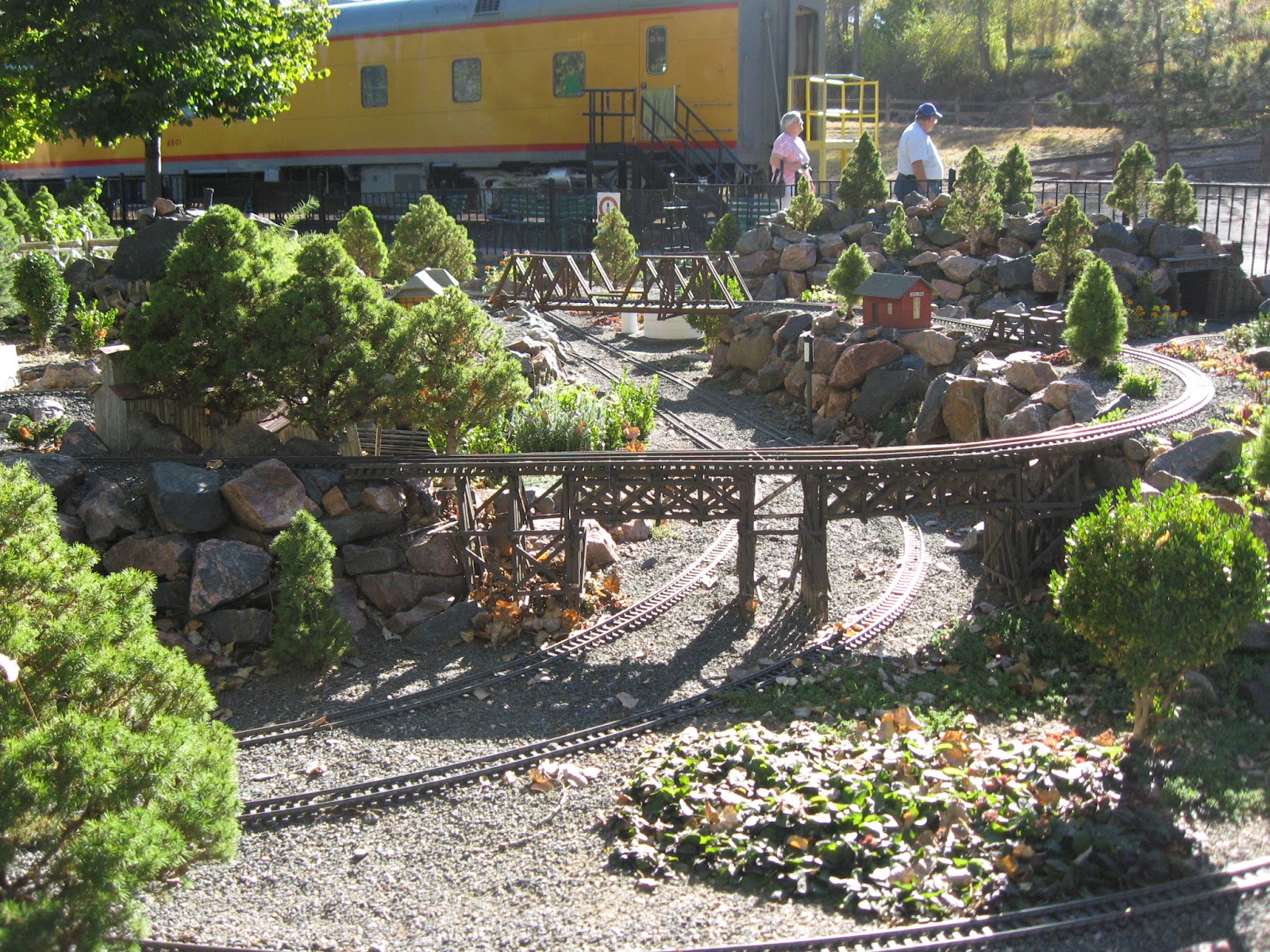 |
| The DGRS railroad at CRM |
 |
| Southbound RTD light rail train in Denver |
 |
| The famous Caboose Hobbies |
 |
| A UP freight works its way up the S curve |
 |
| Lots of tracks throughout the Coors facility |
 |
| A little peek of the phenomenal HO layout at CMRM |
 |
| A big collection of Pullman towels at CMRM |


