Thursday, December 12, 2013

Great Progress

On Saturday morning, I finished scraping the floor. This allowed the rest of the project to proceed quickly. I cleared everything out of the room, and using a shop vac borrowed from a friend at work, removed all of the scraping debris. Using a mixture of TSP and water, I treated the floor, and then dried it using a mop and the shop vac. Next I applied the concrete etching liquid to the borders of the room. This has special time limits and procedures to follow. It has to stay moist while it is "cooking" the floor, and must remain on the concrete for at least 30 minutes. Etching prepares the concrete for painting, so the paint will adhere properly. It must be completely removed from the floor before painting, so I rinsed it with the mop and sucked up the remaining liquid with the shop vac. Once it dried, I repeated the process on the remaining "middle" part of the floor. Then I had supper with Amber and her folks. I finished up Saturday night by painting the brown trim border around the bottom of the walls. I activated the moisture-detector test, which is just a piece of plastic duct-taped to the floor.
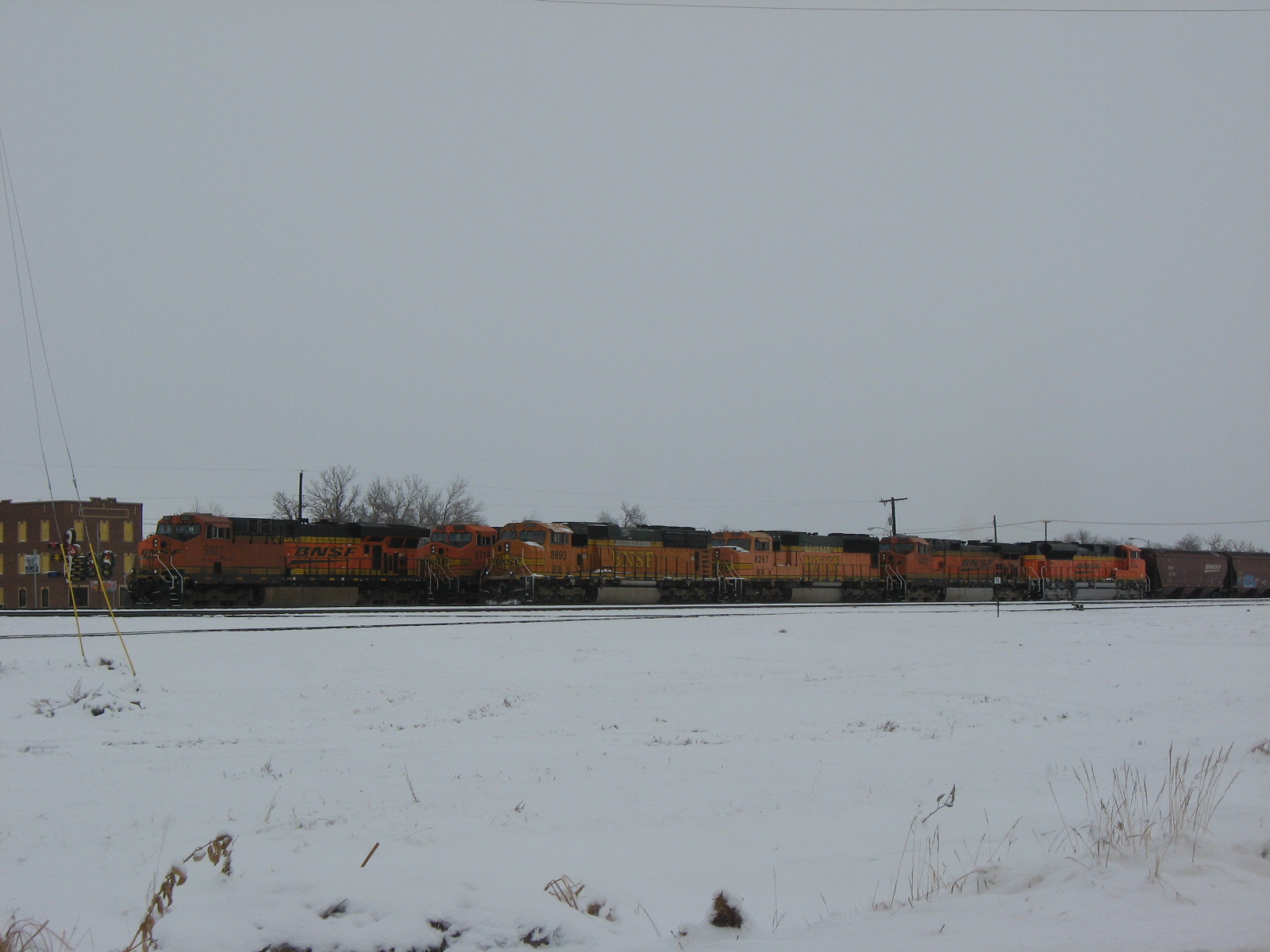
On Sunday morning, I checked the moisture-detector, and found it to be dry on the top and undersides. While in Laurel, MT, I took a picture of several BNSF locomotives waiting for orders to pull their trains WB (photo at top of this entry). After church, I checked for moisture once more to be sure, and then started the first coat of floor paint. I did some border work with the brush, and used the roller for the rest. After 4 hours, I applied the second coat, this time brushing the entire border, at Amber's suggestion. The results were very good!
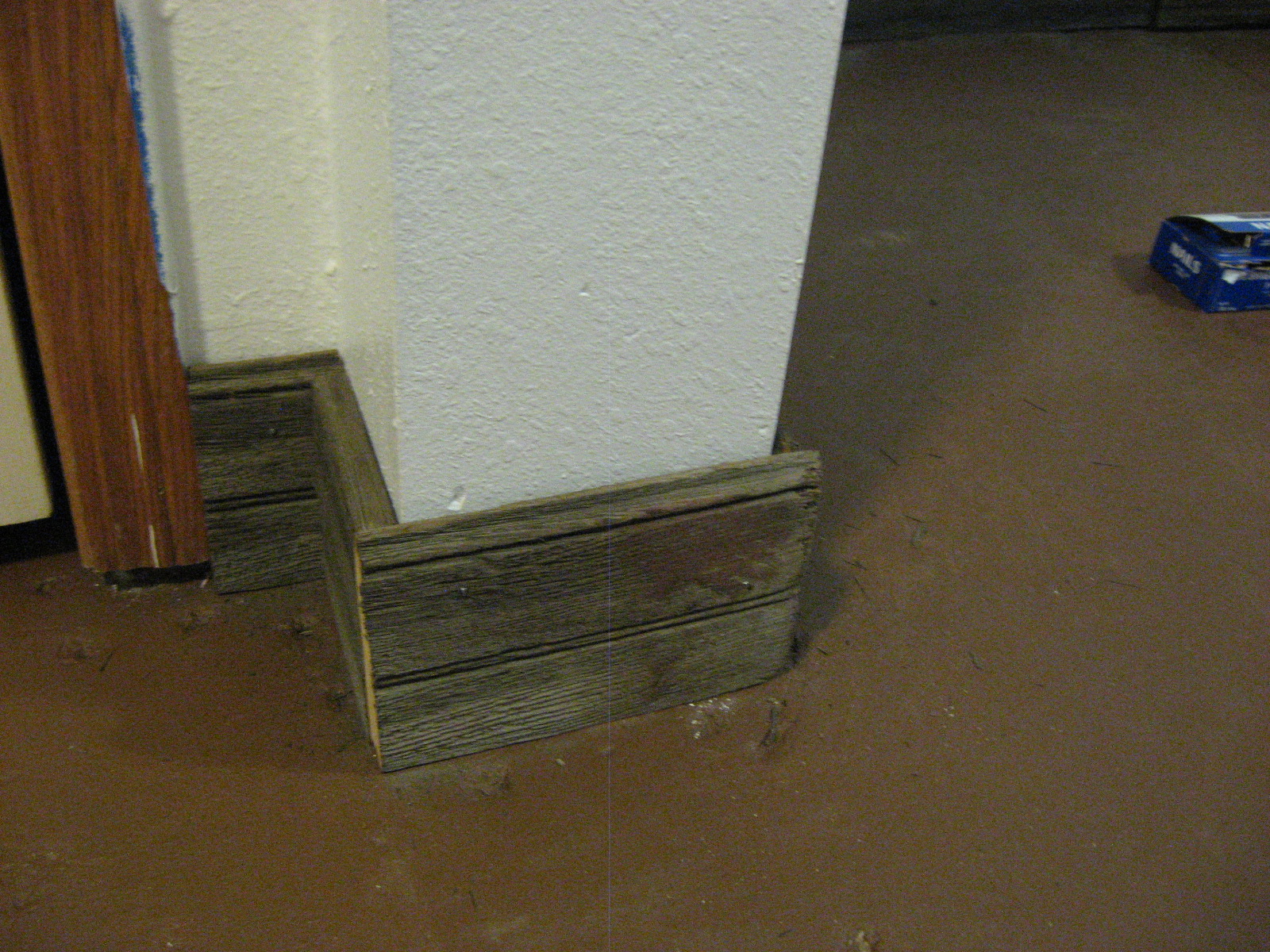
On Monday night, I brought in six planks of boxcar wood from our shed. A few years ago, our friend Jeff from church gave me one of his boxcar sheds. I took it apart (with help from my friends Darren, Kevin (Keg), Bill, and Andrew) one board at a time, and now most of it is sitting in our shed. It was originally Northern Pacific boxcar #31628, built in 1918. I cut the 6 planks into trim pieces for the Train Room, and nailed them to the wall. I placed pieces which still have some of the original boxcar paint on them in spots that are easy to view. Since this wood is nearly 100 years old, and spent most of its time outside, either as part of a tree, or part of a boxcar hauling grain throughout the country, or as part of an animal shed, some of it has rather large holes or cracks. This is why I painted the brown border around the bottom of the floor, so there wouldn't be white paint showing through these eccentricities.
On Tuesday, I cleaned and vacuumed the room again, and moved in the larger furniture pieces which sit along the eastern wall.
On Wednesday, I moved in the pictures that will be stored, and started sorting the papers we have accumulated since moving into the house in April. That project should be wrapped up tonight. I also started hanging up some railroad artwork and artifacts on the wall.

The floor has now been scraped, scrubbed, and etched. The brown border has been painted as well.

The finished floor!

Now the boxcar wood trim has been added. The upper right section of this board has some of the original red boxcar paint on it.

The room is now complete! Thank you to everyone who helped and tolerated this project (especially my bride) to this point. Looks like new walls and floor!

And this is what it looked like about 4 months ago...

Thursday, December 5, 2013

Tree Incentive


We've made it to December - that means I just have a few weeks to meet my Fall goal. Outside looks and feels quite Winter-y already, with 9" of snow and high temperatures below zero. I've been blessed with a new incentive to get the Train Room floor done though... and it is a Christmas tree. Right now, the items that are headed back to the Train Room are blocking the path to part of one of our Christmas trees. And, in my wedded bliss, I can strongly sense that my loving wife would strongly like to decorate a Christmas tree as soon as possible. So, scraping efforts have been doubled. 25% of the entryway/closet area has been scraped, and I've arranged to borrow another shop vac from a coworker, as the one I've been using is somewhat hindering the process at the moment. I believe this weekend will produce much progress.

The eighth in the series of future passenger train discussions is "The Canadian". This is a streamlined 7-car version of the real-life Canadian Pacific "Canadian" which entered service in 1955, and a form of it still operates today. The Canadian connected Vancouver, BC to Sandbury, ON, and then on to either Montreal, QC or Toronto, ON for a 71-hour trip. On our honeymoon, my wife and I were able to ride on The Skeena passenger train (a.k.a. "Jasper - Prince Rupert"), a small sight-seeing consist that runs on some of the same tracks as the current Canadian. We traveled from the bustling metropolis of Dunster, BC (I'm sure you've heard of it) to Jasper, AB. Dunster has a population of about 27, but they use the metric system, so I'm not sure how that converts. Anyway... it was a very fun and pretty 60-mile ride. We had practically an entire passenger car to ourselves. At the end of the train was the Waterton Park vista dome observation car (Canadian Pacific #15417). I was allowed to tour it briefly before the train left Jasper. Jasper was not on the original route of The Canadian; instead, it was served by Grand Trunk Pacific and Canadian National passenger trains. My Canadian is an O-scale MTH set, pulled by Williams F3 ABA locomotives. Lionel originally made a semi-scale version of this set in 1957; the locomotives from that original set are some of the most sought-after Lionel collectibles of the postwar era. Mine have little collector's value, but they make for a very sleek trainset, and will be pulling The Canadian around the train layout of the future for years to come. The observation car on my set is based on the Sibley Park (original Canadian Pacific #15413). The CP's color scheme of grey and maroon, with yellow accents, and their nifty beaver logo is rather ritzy, and graces the top of the blog today while running on the SPCR&GC RR. Keep your rails shiny ~

Section scraped in front of closet door

25% of this section done

The Canadian in the Canadian Rockies

Newlyweds and the Waterton Park in Jasper, AB

Thursday, November 28, 2013

Trainsgiving

The main part of the Train Room floor is complete! What remains is a 3x11 foot section, which contains two closets. The consistency of that section of the floor is rather odd. The surface ranges from yellowish to greyish to blackish. Scraping it is a challenge, because it is quite difficult to tell when you have reached the bottom layer of material. The main part of the room, while difficult, was very easy to tell when the raw floor was reached through scraping. I will attack this new section the same as the other, but it provides different challenges.

Today is Thanksgiving, and we are hosting the Gamsbys and Seemans. We have decorated for the event, which includes many autumny harvesty things, and a train!


This part of the floor is done!


This part of the floor is weird and in progress


Thanksgiving kitchen decor


Friday, November 22, 2013

Bring a Model Train to Work Day 2013

Hello all - a bonus post due to today being a special holiday ~
Bring a Model Train to Work Day occurs on an undetermined Friday in November every year! Here you can see my Lionel Frisco Mikado (a 2-8-2 steam locomotive) sharing my workspace for the day. Many coworkers stopped by to take a look.
Have a nice weekend, and keep your rails shiny ~

Locomotives Unlimited

Thursday, November 21, 2013

Scraping Fest

I have a much better progress report this week - the main part of the room is now 80% scraped. Once I figured out a good rhythm I was able to progress through several rows of scruffy tile glue. The vacuum does suck up the debris, but since it isn't working properly, it is adding a layer of finer dust to the entire room every time I run it. Thus, I'll have the added step of wiping off all of the surfaces and items in the room when the scraping is complete. But, I feel it will be done soon :)

The seventh entry in this series of future passenger trains is the "Night Fire". This is a heavyweight train populated by Pullman-made passenger cars. The reason I wanted to create this train is because Pullman cars can prototypically be pulled by just about any locomotive. I see Pullman cars as kind of "generic" in that they aren't necessary visibly tied to a particular railroad. This can allow for some neat motive power match-ups. I originally purchased four of Lionel's O-Scale heavyweight cars from a dealer at the monthly train show in Wheaton, IL (at the DuPage County Fairgrounds). As of this blog, the train show continues to occur, and is called the Great Midwest Train Show. Anyway... I think these four cars were designed for Lionel's Commodore Vanderbilt locomotive from the 1990's. Although the locomotive was New York Central, the cars do not show NYC markings. Later on, I added a front-end freight car, which matches the Pullman-green color-scheme nicely.  Later still, I added the K-Line made Santa Fe "Granite Canyon" to the consist. It is painted in Pullman-brown, but it fits in well with the style of the train, and is probably prototypical anyway - I've seen many historical photographs of trains where every passenger car wasn't the same style, color, or road-name! On the train layout of the future, this train set would be pulled by big steam - a CB&Q Hudson, the C&NW E-4, a C&NW H-1 or MR 4-8-4, the GN Mikado, an NP A-4, the RI Northern or the Frisco Mikado. The "Night Fire" will take passengers to all points on the layout, hailing from Liberty Station. Run some heavyweights down the track and keep those rails shiny ~

Here's the Train Room as of last night. Just 45 squares of glue remain in the main area.


The Inglehome is a Pullman lounge car that now safely resides at the Illinois Railway Museum.


Thursday, November 14, 2013

Just Two

Hello there - this week's work included disassembling and cleaning the shop vac, but it is still not running properly. I also had time to scrape two squares of the floor, but that's not a lot of progress!

The sixth in this series of future passenger train talks is the "Minnesota and Black Hills Express". This is a fictional five-car Chicago & North Western heavyweight passenger car train that heads northwest from Chicago to La Crosse, Wisconsin, and then traces the present route of Interstate 90 to Rapid City in the Black Hills of South Dakota. This route is special because it is the way we take when we visit Illinois. Highlights include the cheese stores of south-central Wisconsin, the Wisconsin Dells area, "Alice" of La Crosse, the Jolly Green Giant of Albert Lea, Goo's RV of Sioux Falls, the Corn Palace of Mitchell, the Bad Lands of south-western South Dakota, Wall Drug of Wall, and the limitless attractions and scenic views of the Black Hills themselves. The five-car heavyweight set was made by Custom Trains/Frank's Roundhouse, which was the first set of this type I purchased. "Heavyweight" refers to a type of passenger car manufactured with riveted steel. These cars started showing up in the 1910's and were generally more luxurious than their wooden predecessors, and offered a smoother ride because they were heavier. They are sometimes called "Pullmans", "Heavyweights", or just "passenger cars". My Minnesota and Black Hills Express would look well behind the same locomotives I've suggested for the "Fence Lake 400": O-Scale F7 diesel's, a 4-6-0, 4-6-2, or a big 4-8-4 steamer. Thanks for reading, and keep your rails shiny ~

A June 2008 sunset on Stockade Lake in Custer, SD (in the Black Hills). I waited amongst the mosquitoes for a while to get this shot...


A real C&NW heavyweight observation car

One of the cars on the Minnesota and Black Hills Express

Thursday, November 7, 2013

Edgar Harrison

This posting is named in honor of my nephew Edgar Harrison Seeman who was born this past Tuesday evening. He and mother are doing well, and I believe the three Seemans will head home from the hospital in the next day or so. We were with the new grandparents in the waiting room when Edgar arrived. It was an amazing and wonderful event, and Amber and I will do our best to provide love, support, and trains to our nephew.

This week I progressed to the 40% mark on floor scraping. The main part of the room was originally 15 tiles square, so that means I've completed the equivalent of 90 tiles. I tested the entry part of the room, and whatever is pasted to the concrete there is of a different consistency. It may require a different type of scraping technique, but it will probably demand the same amount of elbow grease. Special thanks to Bill Gamsby, who lent me his shop vac for this project. Before I continue my next swath of scraping, it sounds like the vacuum will need a little maintenance, so I'll try to get that done tonight.

The fifth in the series of future passenger train talks is the "Fence Lake 400". The Chicago & North Western railroad provided a passenger train which ran from Chicago to Saint Paul, a distance of 400 miles, which was designed to arrive in 400 minutes. Thus, the train was named the "400". The name proved popular, and several other C&NW trains were given the "400" suffix, even though they traveled farther and took longer than 400 minutes. One of these trains was the "Peninsula 400", which traveled from Chicago to Ishpeming in the Upper Peninsula of Michigan. For many summers while I was growing up, my father, sister and I would go on a weekend fishing trip with some church members to Fence Lake in Michigan. Fence Lake is about 30 miles west of Ishpeming. I have many fond memories of fishing, camping, exploring, and rope-swinging in and around the lake, and will be recreating portions of the terrain on the train layout of the future. There will even be a small resort town called Fence Lake. My "Fence Lake 400" will take passengers from Silver Falls through the farmlands to the north-woods destination of Fence Lake , where they can enjoy a relaxing time in and by the water. The train consists of four custom-painted streamlined aluminum passenger cars made by Williams. These represent 60', rather than 72' passenger cars, so they appear relatively short next to other O-Scale models. But that's ok! For motive power, there are a few choices. I have an F7 ABA C&NW set of diesel locomotives from Williams, with the shiny paint scheme that matches this passenger train nicely. There are also 3 O-Scale steam locomotives (none of which have been purchased yet) which would look spiffy with this set: a C&NW 4-6-0 Ten-Wheeler, the "Yellow Jacket": a covered/shrouded 4-6-2 C&NW Pacific locomotive, or the gigantic C&NW 4-8-4 class H-1 Northern locomotive. Thanks for reading, and remember to keep your rails shiny ~

Fence Lake in Michigan's Upper Peninsula. Eagle Island is on the left.

The real-life C&NW Business Train looks very similar to my model Fence Lake 400 consist. This photo was taken by James House in Elmhurst, IL in 1989.

And here's the C&NW Business Train along the eastern shore of Devil's Lake, south of Baraboo, WI. My family and I camped here numerous times, and I may attempt to re-create this scene on the train layout of the future.